
Infection Control in Clinical Settings: Infection is one of the biggest threats to a patient in hospital, and the nurse is the person who is closest to the patient for the longest time. If we understand how germs reach a person, how the chain of infection works and where we can break it, we can protect our patients, ourselves and our families. In this chapter you will learn what infection is, its stages, the chain of infection, the body’s defences, hospital-acquired infections, asepsis, hand hygiene, personal protective equipment, biomedical waste management and isolation precautions.
Learning objectives: define infection; describe the chain of infection; explain types and stages of infection; list factors increasing the risk of infection; define healthcare-associated infections; and explain biomedical waste management.
1. Definition of Infection
Infection is the entry of germs into the body of an individual, followed by their multiplication, leading to a specific or non-specific reaction by the body, with or without clinical symptoms and/or disease.
2. Nature of Infection
- Germs (microbes) are everywhere and are an important part of daily life. They are found in large numbers in water, soil and air, and on and in the human body. Most are harmless, but some become the cause of disease.
- Infection is the invasion of the tissues of a host organism by disease-causing organisms.
- Infections are caused by microorganisms such as viruses, prions, bacteria and viroids, and by larger organisms like parasites and fungi.
- Colonization is the presence and growth of microorganisms within the host without tissue damage.
- Disease or infection results only if the pathogen grows or multiplies and alters normal tissue function.
Student’s note: Colonization is not the same as infection. A person can carry Staphylococcus on the skin or nose (colonization) and stay healthy. It becomes an infection only when the germ damages tissues, for example when it enters a surgical wound.
3. Stages of Infection

| Stage | What happens |
|---|---|
| 1. Encounter | The person meets the microbe by direct contact, exchange of body fluids, contamination (objects, food, water) or through air and vectors. |
| 2. Colonization | When the microorganism enters the human body, it starts multiplying there. For growth it needs favourable conditions like temperature, pH and nutrition. |
| 3. Penetration | Invasion of anatomical barriers: to penetrate human tissues, the microorganism must cross the surface barrier (skin or mucosa). |
| 4. Spread | An invading microorganism may spread by one or more routes: direct extension, or through surrounding cells, to cause damage. It can cause sublethal damage or alter cellular function. |
| 5. Damage | Microorganisms damage the host by bulk effects, toxins released by bacteria, altered function of the host, and the response of the host to infection. |
| 6. Resolution | The host response usually begins with an inflammatory action, followed by a humoral or cell-mediated immune response. This may cause damage due to swelling, increased fragility of tissues, pus formation, scarring or necrosis, and then the infection settles. |
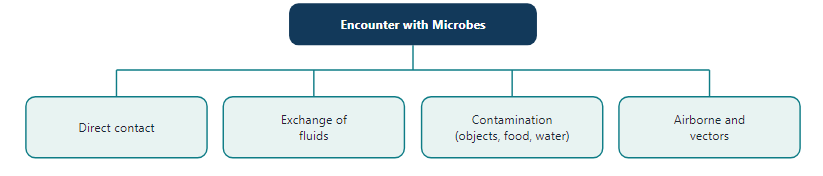
Periods of an infectious disease
| Period | Meaning |
|---|---|
| Incubation period | Time between entry of the germ and the first symptom. |
| Prodromal period | Mild non-specific symptoms (tiredness, malaise); the person is already infectious. |
| Illness period | Specific signs and symptoms are at their peak. |
| Decline period | Symptoms and the number of germs fall. |
| Convalescence | Recovery to normal health. |
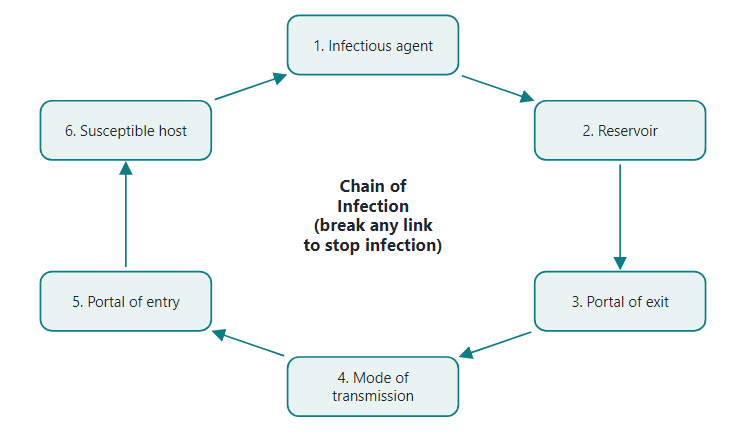
4. Chain of Infection
An infection happens only when all six links of a chain are connected. If any one link is broken, the infection cannot spread. This is why infection control focuses on breaking the chain.
| Link | Meaning | Examples | How to break it |
|---|---|---|---|
| 1. Infectious agent | The microorganism that causes disease. | Bacteria, viruses, fungi, parasites, prions | Cleaning, disinfection, sterilization, antibiotics |
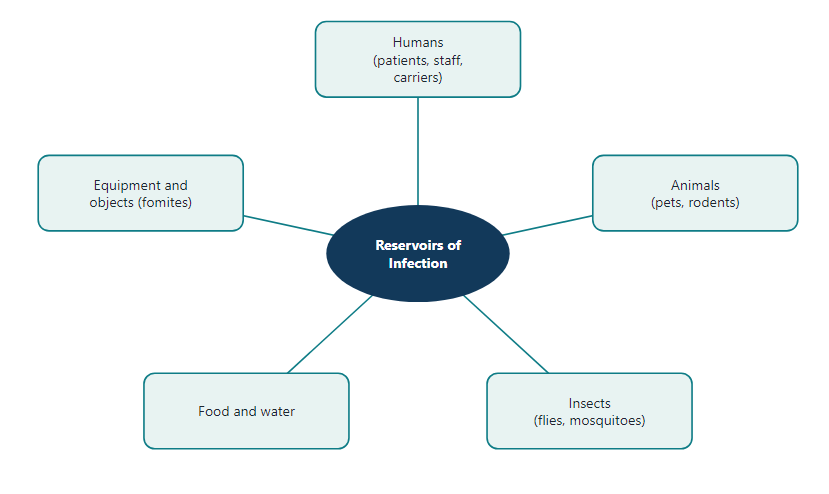
| 2. Reservoir | Where the germ lives and multiplies. | Humans (patients, staff, carriers), animals, insects, food and water, equipment and objects | Clean environment, treat infected persons, control pests |
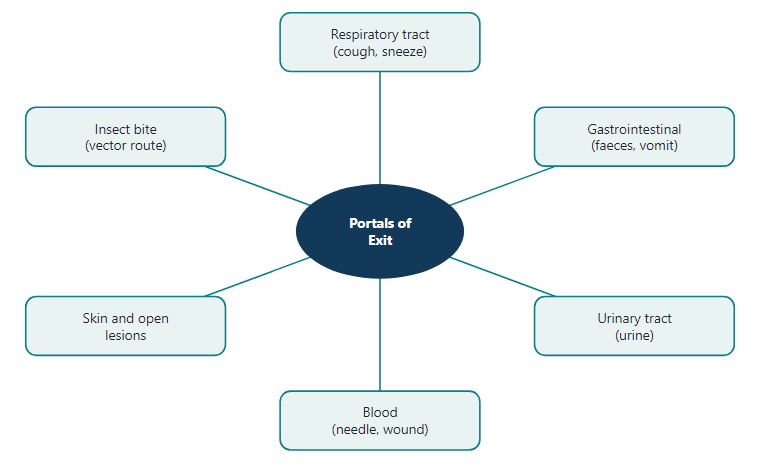
| 3. Portal of exit | The way the germ leaves the reservoir. | Coughing, sneezing, faeces, urine, blood, skin lesions, insect bite | Cover mouth and nose, safe disposal of waste, dressing of wounds |
| 4. Mode of transmission | How the germ travels to a new host. | Contact, droplet, airborne, vehicle, vector | Hand hygiene, isolation, PPE, safe handling of equipment |
| 5. Portal of entry | The way the germ enters a new host. | Breaks in skin, mucous membrane, respiratory tract, GI tract, urinary tract, injection or catheter sites | Aseptic technique, skin care, remove unnecessary devices |
| 6. Susceptible host | A person who can get the infection. | Newborn, elderly, malnourished, diabetic, immunocompromised | Vaccination, good nutrition, early treatment, protective isolation |
Modes of transmission
| Mode | Meaning and example |
|---|---|
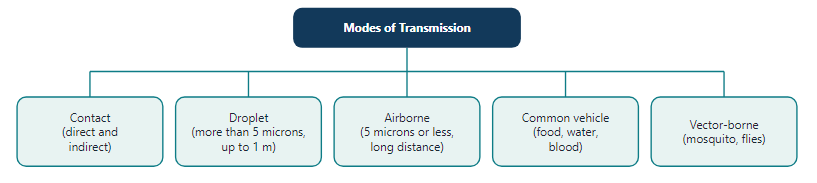
| Direct contact | Person to person (touching, exchange of body fluids): scabies, HIV, hepatitis B. |
| Indirect contact | Through contaminated objects (fomites), hands or equipment: MRSA, C. difficile. |
| Droplet | Large droplets (more than 5 microns) from cough or sneeze travel up to about 1 metre: influenza, meningitis. |
| Airborne | Tiny particles (5 microns or less) remain in air and travel far: tuberculosis, measles, chickenpox. |
| Common vehicle | Contaminated food, water, blood or drugs: cholera, typhoid. |
| Vector-borne | Through insects: malaria, dengue. |
Types of infection
| Type | Meaning |
|---|---|
| Local / Systemic | Limited to one area (boil) / spread through blood to the whole body (septicaemia). |
| Acute / Chronic | Short and sudden / long lasting. |
| Primary / Secondary | The first infection / a new infection that follows a weakening primary one. |
| Exogenous / Endogenous | From outside the body / from the person’s own flora. |
| Latent | Germ is present but inactive; can reactivate later (herpes, TB). |
| Community-acquired / Hospital-acquired | Present at admission or acquired outside / acquired in a health care setting. |
Factors increasing the risk of infection
- Host factors: extremes of age, poor nutrition, diabetes, cancer, HIV, long-term steroids, poor hygiene, smoking.
- Procedures and devices: urinary catheters, IV lines, ventilators, surgery, wounds.
- Hospital factors: overcrowding, poor hand hygiene, inadequate cleaning or sterilization, long stay.
- Agent factors: high number of germs, high virulence, drug resistance.
5. Body Defences against Infection
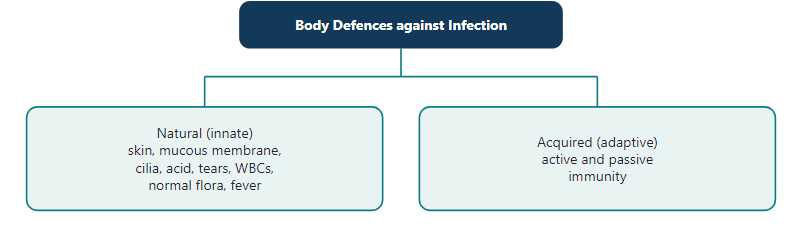
| Natural (innate) defences | Acquired (adaptive) immunity |
|---|---|
| Intact skin and mucous membranes; cilia in the respiratory tract; stomach acid; tears, saliva, mucus (lysozyme); normal flora; urine flow; fever and inflammation; phagocytic white cells. | Active: body makes its own antibodies (after infection, natural; after vaccination, artificial). Passive: ready-made antibodies given (from mother through placenta and breast milk, natural; immunoglobulin or antiserum, artificial). |
6. Healthcare-Associated Infection (HAI)
Healthcare-associated infection (HAI), also called nosocomial or hospital-acquired infection, is an infection that a patient gets while receiving treatment in a health care facility, which was not present or incubating at the time of admission (usually appearing 48 hours or more after admission).
Common HAIs: catheter-associated urinary tract infection (CAUTI), central line-associated bloodstream infection (CLABSI), surgical site infection (SSI), ventilator-associated pneumonia (VAP).
Prevention bundle: hand hygiene; aseptic technique; use catheters and lines only when needed and remove early; sterilization and disinfection; safe injection practices; correct PPE; biomedical waste segregation; environmental cleaning; staff vaccination and education; surveillance.
7. Asepsis
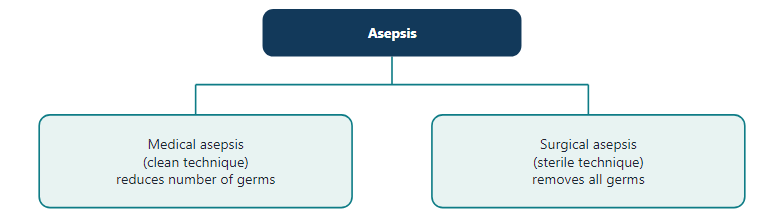
| Medical asepsis (clean technique) | Surgical asepsis (sterile technique) |
|---|---|
| Procedures that reduce the number of microorganisms and prevent their spread. Examples: handwashing, wearing gloves, cleaning, disinfection, isolation, using separate equipment. | Procedures that keep an area free of all microorganisms. Examples: sterile gloves, sterile dressing, catheter insertion, surgery, sterile field. |
Terms: Cleaning removes visible dirt. Disinfection kills most germs on objects. Antisepsis reduces germs on living tissue (skin). Sterilization destroys all germs including spores. Surgical scrub is a longer antiseptic hand wash (about 2 to 5 minutes) before surgery.
8. Hand Hygiene
Hand hygiene is the single most important measure to prevent infection.
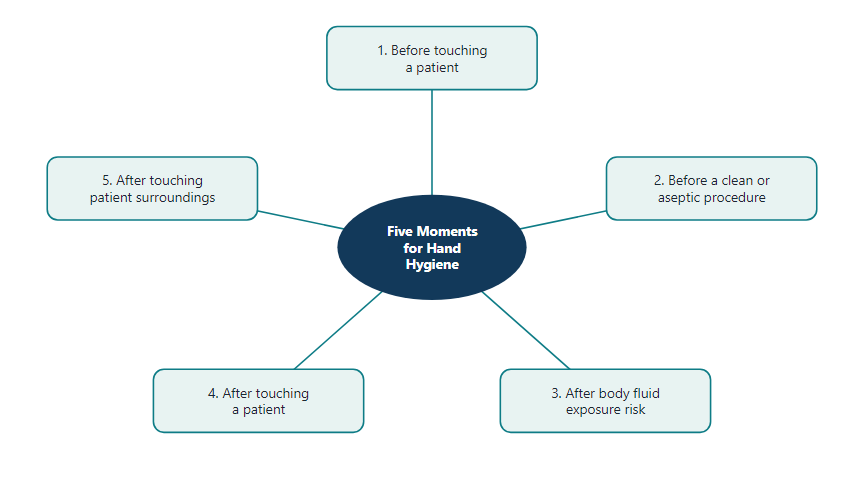
| Method | When to use | Duration |
|---|---|---|
| Handwashing with soap and water | When hands are visibly dirty or soiled with blood or body fluids; after toilet use; before eating | 40 to 60 seconds |
| Alcohol-based hand rub | When hands are not visibly soiled | 20 to 30 seconds |
| Surgical hand scrub | Before surgery or sterile procedures | As per policy (about 2 to 5 minutes) |
Six steps of handwashing or rub (WHO): palm to palm; right palm over left back and vice versa; palms together with fingers interlaced; backs of fingers against opposing palms; rotational rubbing of thumbs; rotational rubbing of fingertips in palm. Keep nails short, remove rings and watches, and dry with a single-use towel.
9. Personal Protective Equipment (PPE)
| PPE | Use |
|---|---|
| Gloves | Contact with blood, body fluids, mucous membranes, non-intact skin. |
| Gown or apron | Protects clothing and skin from splashes. |
| Surgical mask | Protects the wearer from droplets and splashes; protects the patient. |
| N95 respirator | Airborne infections such as TB and measles (fit-tested). |
| Goggles or face shield | Splashes to the eyes, nose and mouth. |
| Cap and shoe cover | Operation theatre, isolation rooms. |

Take off in this order: gloves, goggles, gown, mask, then hand hygiene
Rules: perform hand hygiene before putting on and after taking off PPE; never touch the outside of used PPE with bare hands; do not reuse single-use items; discard in the correct coloured container.
10. Biomedical Waste (BMW) Management
Importance: hospital waste can spread infection to patients, staff, waste handlers and the community, and can pollute the environment. About 10 to 25 percent of hospital waste is hazardous. Under the Bio-Medical Waste Management Rules, 2016 (India), every health facility must segregate, store, transport and dispose of waste properly.
Hazards: needle stick injuries and spread of HIV, hepatitis B and C; infections from contaminated waste; toxic effects of chemical and cytotoxic waste; environmental pollution; and misuse (recycling of syringes).
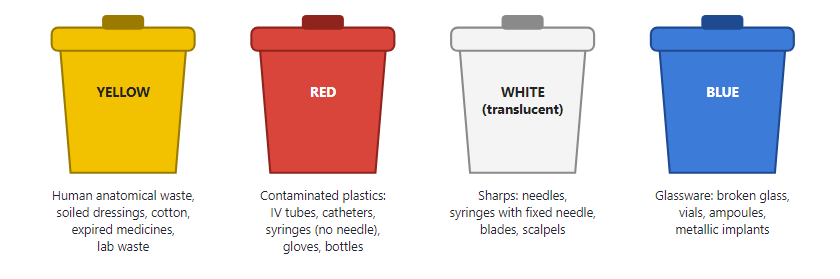
| Colour | Waste | Treatment |
|---|---|---|
| Yellow | Human anatomical waste, animal waste, soiled waste (dressings, cotton, bedding), expired and discarded medicines, chemical waste, microbiology waste | Incineration or deep burial (plasma pyrolysis); soiled waste may be autoclaved or microwaved then shredded |
| Red | Contaminated recyclable plastic: tubing, bottles, IV sets, catheters, urine bags, syringes without needles, gloves | Autoclave or microwave, shred, then recycling by authorized recyclers |
| White (translucent) | Waste sharps: needles, syringes with fixed needles, scalpels, blades; puncture-proof, leak-proof, tamper-proof container | Autoclave or dry heat sterilization, shredding or encapsulation |
| Blue | Glassware: broken or discarded glass, vials, ampoules; metallic body implants (cardboard box with blue marking) | Disinfection or autoclaving, then recycling |
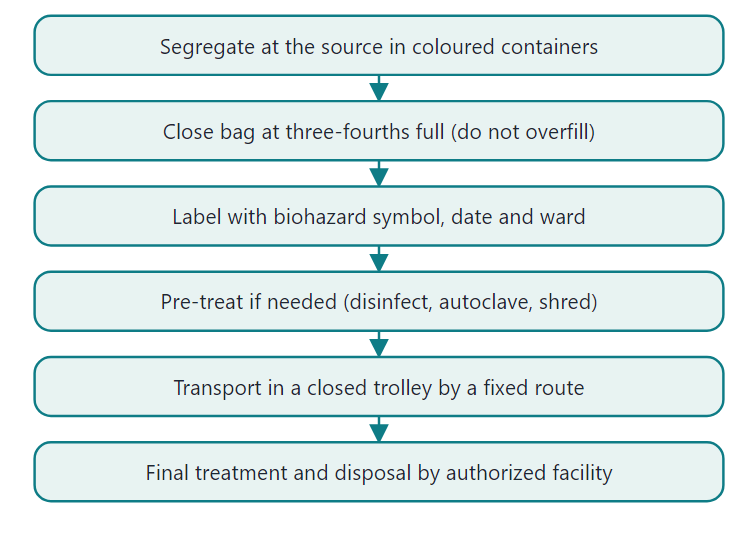
Safety points: never recap used needles; never mix general waste with biomedical waste; wear gloves and use the correct bag; report any needle stick injury at once and follow post-exposure prophylaxis; hepatitis B vaccination for all health workers.
Decontamination: infectious waste can be disinfected with 1 percent sodium hypochlorite before disposal where required by policy.
11. Isolation and Transmission-Based Precautions
Standard precautions are used for all patients at all times: hand hygiene, gloves, mask, eye protection and gown as needed, safe injection practices, safe waste disposal, cleaning of equipment and respiratory etiquette.
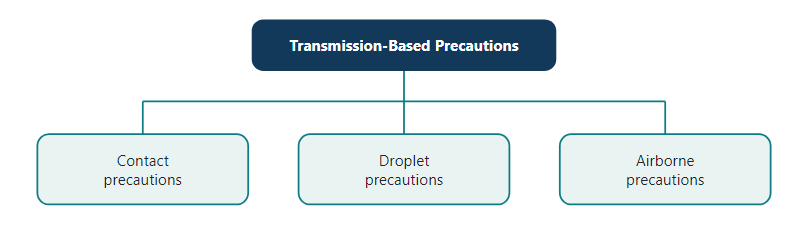
| Precaution | For | Measures |
|---|---|---|
| Contact | MRSA, C. difficile, scabies, wound infections, diarrhoea | Single room, gloves and gown, dedicated equipment (stethoscope, BP cuff), thorough cleaning |
| Droplet | Influenza, pertussis, meningococcal infection, mumps | Single room, surgical mask within 1 metre, patient wears a mask when moved |
| Airborne | TB, measles, chickenpox, COVID-19 (aerosol procedures) | Negative pressure room, door closed, N95 respirator, limited movement |
| Source (infectious) isolation | Protective (reverse) isolation |
|---|---|
| Protects others from the infected patient (barrier nursing). | Protects the susceptible patient (burns, neutropenia, transplant) from infection from others and the environment. |
Chapter Focus Points
- Infection is the entry and multiplication of germs in the host. Colonization is not disease.
- Six stages: encounter, colonization, penetration, spread, damage, resolution.
- Chain of infection: agent, reservoir, portal of exit, mode of transmission, portal of entry, susceptible host. Break any link to stop infection.
- HAI prevention depends on hand hygiene, asepsis, PPE, BMW segregation and isolation.
Infection Control in Clinical Settings MCQs
Q1. Infection is best defined as:
- Entry of germs into the body followed by multiplication, leading to a reaction with or without symptoms
- Only fever
- Only pus formation
- Presence of any food in the gut
Answer: A. As per the chapter.
Q2. The first stage of infection is:
- Colonization
- Encounter
- Penetration
- Damage
Answer: B. Encounter, colonization, penetration, spread, damage, resolution.
Q3. Multiplication of microbes at a site without tissue damage is:
- Colonization
- Invasion
- Resolution
- Contamination
Answer: A. Disease occurs only if the pathogen multiplies and alters tissue function.
Q4. For growth, microorganisms need favourable:
- Temperature, pH and nutrition
- Light only
- Salt only
- Silence
Answer: A. Colonization stage.
Q5. Invasion of anatomical barriers occurs in the stage of:
- Penetration
- Encounter
- Resolution
- Colonization
Answer: A. Microbes cross the surface barrier.
Q6. Damage to the host may be caused by:
- Bulk effects, toxins, altered function and host response
- Only toxins
- Only bulk
- Only drugs
Answer: A. Four mechanisms.
Q7. Host response to infection usually begins with:
- Inflammation
- Fever only
- Antibiotics
- Surgery
Answer: A. Then humoral or cell-mediated immunity.
Q8. Which is NOT a microorganism causing infection?
- Virus
- Bacteria
- Prion
- Vitamin
Answer: D. Also viroids, parasites and fungi.
Q9. Number of links in the chain of infection:
- 4
- 5
- 6
- 8
Answer: C. Agent, reservoir, portal of exit, mode of transmission, portal of entry, host.
Q10. The link that is the place where microbes live and multiply is the:
- Reservoir
- Portal of entry
- Host
- Vector
Answer: A. Examples: humans, animals, insects, food, equipment.
Q11. Coughing and sneezing are examples of:
- Portal of exit
- Portal of entry
- Reservoir
- Vector
Answer: A. Respiratory portal of exit.
Q12. A mosquito spreading disease is a:
- Vector
- Fomite
- Carrier
- Reservoir only
Answer: A. Vector-borne transmission.
Q13. Hand hygiene breaks which link?
- Mode of transmission (contact)
- Agent only
- Host only
- Portal of exit only
Answer: A. Along with cleaning and disinfection.
Q14. Hospital-acquired infection is also called:
- Nosocomial infection
- Endogenous infection
- Latent infection
- Zoonosis
Answer: A. Healthcare-associated infection (HAI).
Q15. An infection acquired in hospital usually appears after:
- 48 hours of admission
- 1 hour
- 10 minutes
- 6 months
Answer: A. Generally 48 hours or more after admission.
Q16. Skin and mucous membrane are part of:
- Natural defences
- Acquired immunity
- Active immunity
- Passive immunity
Answer: A. First line of defence.
Q17. Immunity from vaccination is:
- Active acquired
- Passive acquired
- Natural innate
- Maternal
Answer: A. Passive means ready-made antibodies.
Q18. Reducing the number of germs and preventing their spread is:
- Medical asepsis
- Surgical asepsis
- Sterilization
- Isolation
Answer: A. Clean technique.
Q19. Complete removal of all microorganisms including spores is:
- Sterilization
- Disinfection
- Antisepsis
- Cleaning
Answer: A. Surgical asepsis is the sterile technique.
Q20. Chemical used on living tissue to destroy germs is an:
- Antiseptic
- Disinfectant
- Detergent
- Sterilant
Answer: A. Disinfectants are used on objects.
Q21. Duration of handwashing with soap and water is about:
- 40 to 60 seconds
- 5 seconds
- 10 minutes
- 2 hours
Answer: A. Hand rub takes 20 to 30 seconds.
Q22. Alcohol hand rub is used when hands are:
- Not visibly soiled
- Visibly soiled with blood
- Always, in place of washing
- Never
Answer: A. Wash with soap and water if visibly dirty.
Q23. How many moments for hand hygiene (WHO)?
- 3
- 4
- 5
- 7
Answer: C. Before patient, before aseptic task, after body fluids, after patient, after surroundings.
Q24. The first step in donning PPE is:
- Hand hygiene
- Gloves
- Goggles
- Mask
Answer: A. Then gown, mask, goggles, gloves.
Q25. In doffing PPE, the first item removed is:
- Gloves
- Mask
- Gown
- Cap
Answer: A. Because they are the most contaminated.
Q26. Yellow bin is used for:
- Anatomical and soiled waste
- Sharps
- Glass
- Plastic tubing
Answer: A. Also expired medicines.
Q27. Needles and blades go into the:
- White translucent puncture-proof container
- Red bag
- Black bag
- Yellow bag
Answer: A. Sharps container.
Q28. Broken glass and vials go into the:
- Blue container
- Red bag
- Yellow bag
- General bin
Answer: A. Cardboard box with blue marking.
Q29. Contaminated IV tubes and catheters go into the:
- Red bag
- Blue box
- White box
- Green bag
Answer: A. Recyclable contaminated plastics.
Q30. Standard precautions apply to:
- All patients
- Only infected patients
- Only children
- Only ICU patients
Answer: A. Basis of all infection control.
Q31. TB and measles require which precautions?
- Airborne
- Contact only
- None
- Protective only
Answer: A. Negative pressure room and N95 respirator.
Q32. Influenza and meningococcal infections need:
- Droplet precautions
- Airborne only
- No precautions
- Contact only
Answer: A. Surgical mask within 1 metre.
Q33. MRSA and wound infections need:
- Contact precautions
- Airborne precautions
- None
- Droplet only
Answer: A. Gloves and gown.
Q34. Protective (reverse) isolation is used to protect:
- The susceptible patient from infection
- The nurse only
- The visitors only
- The environment only
Answer: A. For example burns or neutropenia.
Q35. Source isolation protects:
- Others from the infected patient
- The infected patient only
- Nobody
- Equipment only
Answer: A. Barrier nursing.
Q36. The best way to prevent needle stick injury is:
- Never recap used needles; discard in sharps container
- Recap with both hands
- Bend the needle
- Throw in open bin
Answer: A. Standard practice.
Q37. Which is a risk factor for infection in the host?
- Poor nutrition and low immunity
- Good hygiene
- Vaccination
- Normal immunity
Answer: A. Also age, chronic illness, invasive devices.
Important Questions as per INC Syllabus Pattern
Long answer questions (10 to 15 marks)
- Define infection. Explain the stages of infection and the chain of infection with a diagram.
- Describe the modes of transmission and the measures to break the chain of infection.
- Define healthcare-associated infection. Explain its prevention.
- Explain biomedical waste management, including colour coding and disposal.
- Explain medical and surgical asepsis and hand hygiene.
- Describe isolation and transmission-based precautions.
Short answer questions (5 marks)
- Stages of infection
- Reservoirs of infection
- Portals of exit and entry
- Factors increasing the risk of infection
- Natural defences of the body
- Nosocomial infection
- Five moments of hand hygiene
- Donning and doffing PPE
- Hazards of hospital waste
- Medical vs surgical asepsis
Very short answer questions (2 marks)
- Define infection.
- Define colonization.
- Name the six links of the chain of infection.
- What is HAI?
- What is a vector?
- Name the four BMW colour categories.
- Define antisepsis.
- What is protective isolation?
- Also read:
- CHAPTER 1: Introduction to Health and Illness, Nursing Foundation Unit 1 Notes PDF
- CHAPTER 2: Health Care Delivery System, Nursing Foundation Unit 2 BSc Nursing Notes
- Chapter 3: Nursing as a Profession and History of Nursing in India: BSc Nursing 1st Semester Notes (Nursing Foundation)
- CHAPTER 4: Hospital Admission and Discharge: Complete BSc Nursing Notes | 1st Semester Notes (Nursing Foundation)
- CHAPTER 5: Communication and Nurse Patient Relationship: Complete Notes | BSc Nursing 1st Semester Notes (Nursing Foundation)
- Chapter 6: Patient Education in Nursing: Notes for BSc Nursing 1st Semester, Nursing Foundation Notes with MCQs & Important Questions
- Chapter 7: The Nursing Process: Complete Notes for BSc Nursing, 1st Semester, Nursing Foundation
- Chapter 8: Documentation and Reporting: Notes with MCQs and Important Questions for BSc Nursing 1st Year, Nursing Foundation Notes
- Vital Signs: Assessment & Regulation Complete Notes for Nursing With MCQ and Important Questions
- Machinery, Equipment and Linen in Hospital: Types, Care, Cleaning, Indent and Inventory