
Nursing as a Profession and History: Welcome to Nursing Mitr. In this chapter we answer three questions: What is nursing? Why is it called a profession? How did it grow in the world and in India? We also study the bodies that govern nurses (TNAI, INC, SNRC), the values and ethics a nurse follows, and the laws that protect both nurse and patient. Read the chapter slowly once, then use the MCQs and INC-pattern questions at the end for revision.
After this chapter you will be able to: discuss aspects of professional nursing practice; describe the scope and career opportunities for nurses; explain and illustrate the historical perspectives of nursing; and apply the values, ethical principles and legal knowledge needed for safe practice.
Nursing: Definition and Concept
Nursing is both an art and a science. The science is the knowledge we learn from anatomy, physiology, psychology and nursing research. The art is how we apply it: with sympathy, mindfulness and respect for each patient’s dignity and personhood. A professional nurse delivers health care “artfully”, which means she treats the person, not just the disease.
Virginia Henderson: “The unique function of the nurse is to assist the individual, sick or well, in the performance of those activities contributing to health or its recovery (or to peaceful death) that he would perform unaided if he had the necessary strength, will or knowledge.”
In simple words: the nurse does for the patient what the patient would do for himself if he were able, and she also helps him become independent again. Notice the three things a patient may lack: strength, will, knowledge. Nursing care is designed to supply whichever one is missing.
The International Council of Nurses (ICN) adds that nursing includes autonomous and collaborative care of individuals of all ages, families, groups and communities, sick or well, in all settings, and covers health promotion, prevention of illness, and care of the ill, disabled and dying.
Aspects of Nursing
A person is not only a body. Illness disturbs every dimension of life, so the nurse looks after four aspects. This is called holistic care.
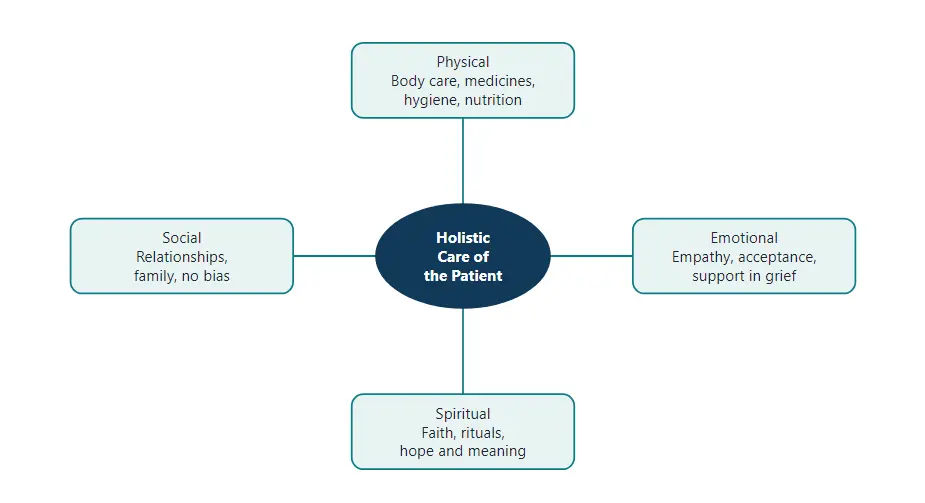
| Aspect | What the nurse does |
|---|---|
| Physical | The most important and most visible part. Patients focus on bodily sickness, and it disturbs the other dimensions. The nurse gives medicines, personal hygiene, nutrition, sleep and comfort. |
| Emotional | Accepts the patient as an individual and is empathetic during sickness, loss, grief or pain. The nurse needs emotional stability and emotional intelligence. |
| Social | Helps the patient maintain healthy relationships. The nurse must be free from personal prejudice and bias so that she can understand the patient’s mindset and help in conflict resolution. |
| Spiritual | Illness challenges a person’s belief system. The nurse encourages faith, helps the patient perform routines and rituals, and supports coping with illness, loss, grief or pain. |
Concepts (Principles) of Nursing Care
| Concept | Meaning |
|---|---|
| Fair and just | Care is impartial regardless of physical or psychological condition, age, gender, race, belief or social status. |
| Respect | Fundamental human rights are respected while giving care. |
| Therapeutic | Build a helping relationship with patient, family and society. |
| Collaboration | Work independently and also with the multidisciplinary team, while growing professionally. |
| Judicious | Timely and thoughtful implementation of health policies. |
| Evidence-based practice | Take part in research and use research findings in care. |
| Patient autonomy | Respect the patient’s right to accept or refuse treatment. |
| Informed practice | Give patient and family correct information on health status, investigations, procedures, diagnosis, treatment and prognosis. |
Fundamental Nursing Concepts and the Nursing Metaparadigm
Modern nursing is built on fundamental concepts such as health, illness, stress and health promotion. Nurses work with physicians and other staff in hospitals and community settings, with the aim of protecting and promoting the physical and mental health of patients and the community.
A metaparadigm is the broadest framework of a discipline. Every nursing theory (Nightingale, Orem, Roy and others) talks about the same four concepts.

- Person: the recipient of nursing care. This may be an individual, patient, group, family or community.
- Nursing: the attributes, characteristics and actions of the nurse providing care on behalf of, or together with, the patient.
- Health: the degree of wellness or well-being that the patient experiences.
- Environment: the internal and external surroundings that affect the patient.
Exam tip: Memory trick P-N-H-E (Person, Nursing, Health, Environment). If asked “metaparadigm”, draw this figure and write one line per concept.
Philosophy of Nursing
Philosophy states what we believe to be true about the nature of nursing and gives a base for nursing activities. Nursing is considered a “profession of charity”. It covers the following aspects:
- Spiritual: gives the nurse her motive. It develops meaning, purpose and hope in the patient’s present life, by listening to his story and helping him connect with God through prayer or meditation.
- Moral: understanding moral principles leads a nurse to study ethics and apply right conduct in daily situations.
- Intellectual: the nurse must be intellectually sound, with memory, communication skills, reasoning and wise judgement.
- Emotional: she must be a mature, self-dependent personality who relates well to others.
- Physical: she should have the knowledge and skills to guide others in physical activities and in keeping well.
- Social: nursing is linked to the culture of society. The nurse is a social being with privileges and obligations.
Other elements of the philosophy
| Element | Meaning |
|---|---|
| Genuineness | Being sincere and honest in the therapeutic relationship. |
| Respect | Unconditional positive regard. The nurse’s behaviour does not depend on how the patient behaves. |
| Concreteness | Giving messages in clear, specific language the patient understands. |
| Immediacy | Being sensitive to the patient’s feelings and dealing with them in the “here and now”. |
| Advocacy | Protecting the fundamental rights of the patient. |
Objectives of Nursing
- Apply the principles of philosophy in nursing interventions.
- Use scientific knowledge from nursing, natural sciences and general education for decision making.
- Use the nursing process to identify health potential and needs of individuals, groups, families and communities.
- Give comprehensive care without discrimination on race, sex, religion or culture.
- Use community resources to achieve the goals of nursing.
- Use research knowledge as evidence in practice.
- Take individual responsibility for decisions and actions.
- Use information and communication technology in patient care and own learning.
- Apply scientific investigation to test nursing interventions.
- Take actions for personal and professional growth to cope with change.
- Evaluate nursing care against accepted standards.
- Set goals for professional development, self-care and lifelong learning.
Characteristics of Nursing Practice
| Characteristic | Explanation |
|---|---|
| Respects diversity | Care is individualized for the unique needs of patient, family, group or community. |
| Coordination | The nurse coordinates with the health care team to achieve quality care. |
| Systematic and scientific approach | Uses the nursing process (assess, diagnose, plan, implement, evaluate) with critical thinking at each step. |
| Healing environment | A strong link between professional work and surroundings to get optimal outcomes. |
| Continuum of care | Specialized care in hospital or community for patients with health problems. |
| Therapeutic communication | Interaction that advances physical and emotional well-being. It is the backbone of nursing. |
| Physical and biological interventions | Medication, surgery care, hygiene, nutrition, sleep. |
| Psychosocial interventions | Cognitive behavioural therapy, family therapy, milieu therapy, psychodynamic approaches. |
| Spiritual interventions | Listening to the patient’s story and helping him connect through prayer or meditation. |
| Therapeutic relationship | Interpersonal relationship between nurse and patient, with strong presence and desire to support. |
| Empathetic nursing | Understanding the patient’s perspective. It reinforces his sense of importance. |
| Supportive care | Small acts such as sitting with the patient or reading the newspaper together. Therapeutic touch comforts and consoles. |
| Legal and ethical parameters | Practice stays within law and professional ethics. |
Scope of Nursing Practice
Scope of practice is the range of roles, functions, responsibilities and activities that registered nurses are educated and authorized to perform. It covers the full range of human experiences and responses to health and illness.
Nursing practice is accomplished through: advocating for quality health systems and healthy public policy; using scientific nursing knowledge with critical thinking; using nursing theories, models and the nursing process; following legal parameters; a holistic approach (biological, psychological, social, spiritual); active participation of the patient as a partner; and collaboration with the health team and community.
Expanded roles of nurses
Home care nursing, institutional nursing, school health nursing, geriatric nursing, industrial nursing, nurse educator, nurse epidemiologist, rehabilitation nurse, military nursing, disaster nursing, nurse researcher and nurse entrepreneur.
Extended roles of nurses
Certified registered nurse anesthetist, nurse practitioner, psychiatric NP, adult NP, pediatric NP, nurse-midwife practitioner, oncology NP, nurse informatics specialist and registered nurse lawyer.
How to remember:Expanded roles are new settings and areas where a nurse works. Extended roles need advanced education and take over duties once done only by other professionals.
Factors affecting the scope of nursing practice
| Factor | Example |
|---|---|
| Professional qualification | An independent practitioner or clinical specialist needs a doctorate in nursing. |
| Professional experience | An independent counsellor nurse needs experience as well as qualification. |
| Legal and ethical parameters | In the USA nurse practitioners can prescribe medicine; Indian law does not permit it. |
| Code of ethics and conduct | Every nurse must work within her profession’s code. |
| Accountability and autonomy | Functions depend on the autonomy given. |
| Issues and challenges | Infrastructure, comorbid illness, cost, resources, manpower, awareness, stigma. |
| Practice trends | Deinstitutionalization, continuity of care, IT, evidence-based practice, pandemics like COVID-19. |
| Practice standards and quality of care | Define the competence a nurse must show. |
| Personal characteristics | Interest, altruism, competence, emotional well-being, values. |
Career opportunities
Nurses can work as clinical nurses in hospitals and clinics, community health nurses, school and industrial nurses, nurse educators, administrators and managers, researchers, nurse practitioners, nurse entrepreneurs, military and disaster-relief nurses, and can also find opportunities in other countries after registration and verification.
Functions of a Nurse
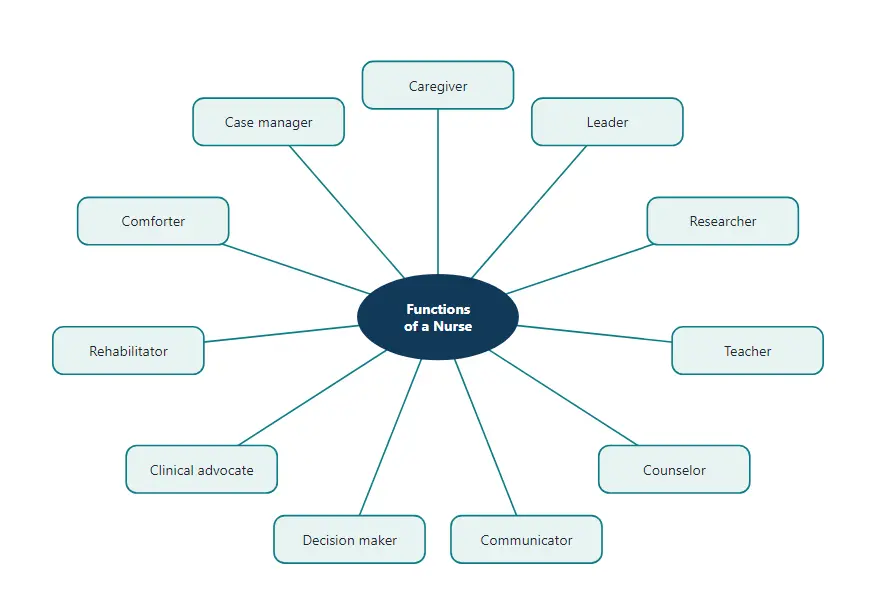
The caregiver gives direct care. The leader guides the team. The researcher uses and generates evidence. The teacher gives health education. The counselor helps patients solve emotional problems. The communicator links patient, family and team. The decision maker uses critical thinking. The clinical advocate protects patient rights. The rehabilitator helps return to maximum function. The comforter relieves pain and distress. The case manager coordinates the whole plan of care.
Role of nurse in various settings
| Setting | Specific functions |
|---|---|
| Hospital (OPD and IPD) | Maintain safety; risk assessment; physical and biological interventions such as medicines; counselling; case management in the team; discharge planning and referral; history taking and assessment. |
| Child ward | Monitor developmental level, give supportive interventions, provide a safe environment, teach social and adaptive skills. |
| Home setting | Medication, health education, self-care skills; check compliance to treatment; referral to NGOs; act as a liaison between patient and health system. |
| Community health centre | Liaison between community and health system; surveys on morbidity and risk population; home visits; awareness camps; training other care givers. |
| Hospice care | Medical and nursing care for chronic or terminally ill patients; support for the grieving. |
| Emergency | Suicide prevention and crisis intervention; direct care for vulnerable people; disaster management services. |
Qualities of a Nurse
A good nurse shows empathy, emotional stability, communication skills, flexibility, physical endurance, problem solving skills, quick response, respect and patience, sense of responsibility, honesty and loyalty, discipline, cooperation, observation power, confidence, knowledge and economy in using resources. Remember that skills can be taught, but attitude has to be built by the nurse herself.
Categories of Nursing Personnel in India
| Category | Remarks |
|---|---|
| ANM (Auxiliary Nurse Midwife) | Grassroots level health worker; program decided by INC in 1950. |
| GNM (General Nursing and Midwifery) | 3-year diploma; hospital and community nursing. |
| BSc Nursing and Post Basic BSc Nursing | Degree level; Post Basic BSc started in 1960s. |
| MSc Nursing, MPhil, PhD | Postgraduate and research level, for teaching, administration and research. |
| Nurse Practitioner | Advanced practice program (critical care and primary health care) started by INC. |
Profession: Definition and Characteristics
Profession: an occupation based on academic study and training that provides skilled services with an ethical component, for a definite fee or salary. It requires mastery of a complex set of knowledge and specific skills through formal education and practical experience.
Characteristics of a profession: (1) well-defined body of knowledge; (2) strong service orientation; (3) standardized formal education; (4) practice based on professional standards and a code of ethics; (5) autonomy in decision making and practice; (6) practice in a specialized setting.
Nursing as a Profession
As society’s needs changed, the goals of nursing also changed, and nursing slowly became a modern profession. It is caring, adaptive, individualized, holistic and family- and community-centred, and it deals with health promotion, maintenance and restoration. It fulfils the following criteria:
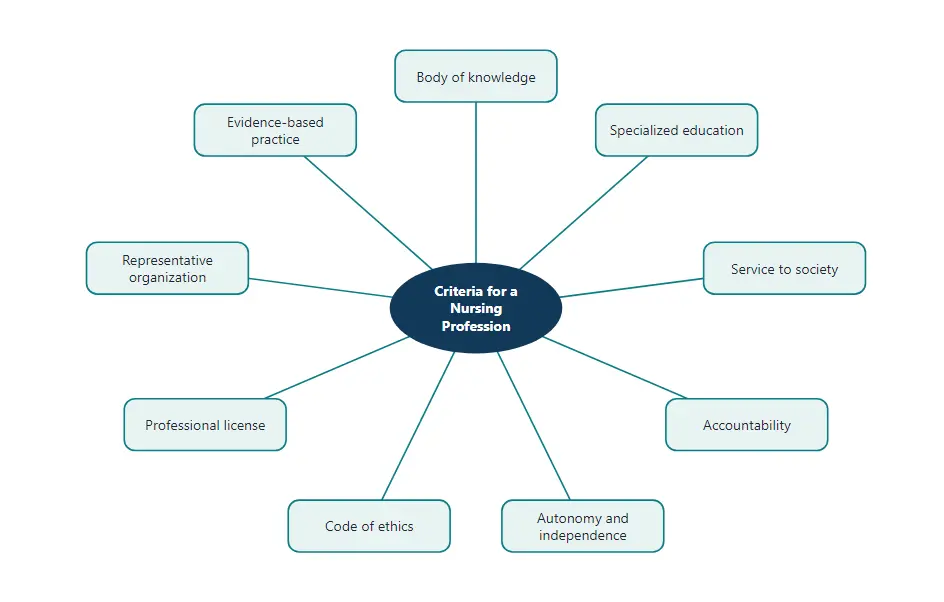
| Criterion | Explanation |
|---|---|
| Body of knowledge | Knowledge derived from experience and research is orderly and exact. Nurses keep expanding it to improve techniques and skills. |
| Specialized education | Schools and colleges give specialized education and training. |
| Service to society | Nursing means to care. It is an altruistic profession in which the nurse puts the patient’s well-being above her own. |
| Accountability | Answerable to oneself and others for one’s actions: judgements, actions, competence and quality of care. |
| Autonomy and independence | Nursing has its own approach, the nursing process, based on logical, critical and creative thinking. It is both independent and interdependent. |
| Code of ethics | Ethics are morals about right and wrong in human behaviour. The code gives standards and a framework for care. |
| Professional license | A legal permission showing that the person has passed the licensure examination and is qualified to practice. |
| Representative organization | Professional associations such as TNAI and SNRC maintain standards and promote education, research and welfare. |
| Evidence-based practice | Interventions based on data from proven research. |
High tip, the 3 H’s: Nursing needs the Head (cognitive knowledge), the Hand (psychomotor skills) and the Heart (affective attitude).
History of Nursing in the World
Early period
In ancient times, care of the sick was a family or religious duty. In ancient India the Charaka Samhita and Sushruta Samhita list the “attendant” (nurse) as one of the four pillars of treatment, along with physician, medicine and patient, and describe qualities of the attendant such as cleanliness, skill and devotion. In Buddhist India, King Ashoka built hospitals. In the early Christian era Phoebe is regarded as the first visiting nurse, and Fabiola established the first hospital in Rome. Religious orders and deaconesses nursed the sick through the Middle Ages.
Foundations of modern nursing
- 1836: Pastor Theodor Fliedner started a training school for deaconesses at Kaiserswerth, Germany. Florence Nightingale studied here.
- 1863: Henri Dunant founded the Red Cross.
- 1881: Clara Barton founded the American Red Cross.
Florence Nightingale: the founder of modern nursing
| Point | Detail |
|---|---|
| Born | 12 May 1820, Florence, Italy |
| Known as | “The Lady with the Lamp”, because she walked the wards at night with a lamp |
| Crimean War (1854) | Took a group of nurses to Scutari, Turkey. Improved sanitation, ventilation, diet and hygiene; death rate among soldiers fell sharply. |
| 1859 | Published Notes on Nursing |
| 1860 | Opened the Nightingale Training School at St. Thomas’ Hospital, London |
| 1907 | First woman to receive the Order of Merit |
| Died | 13 August 1910 |
| Remembered | International Nurses Day on 12 May. The Nightingale Pledge (1893, by Lystra Gretter) is the nurses’ oath. |
Exam tip: In a 10-mark answer on her contribution, write: nursing education, hospital reform, nursing practice (sanitation), nursing research and statistics, and the use of the nursing environment concept.
History of Nursing in India
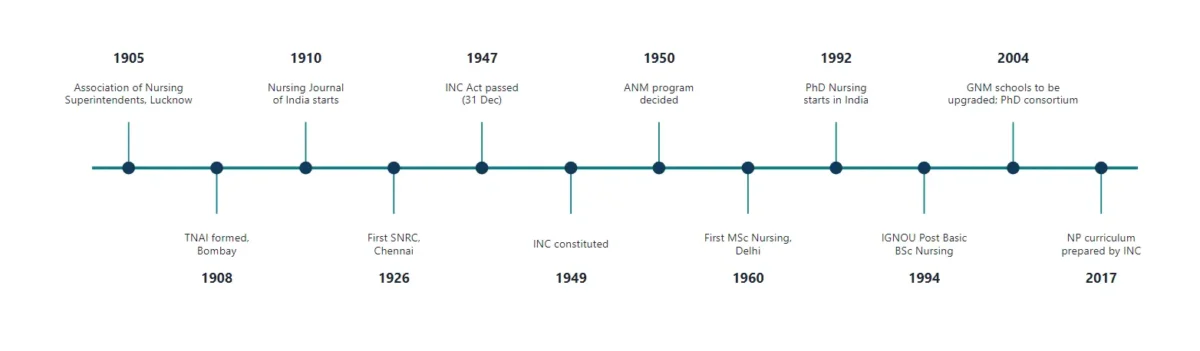
Indian nursing grew through social events and changing health needs. After the arrival of British rule, nursing for army and civilians was organized, hospital schools began, and institutions such as Lady Reading Health School (Delhi) trained health visitors. The professional organizations and degree programs developed mainly in the 20th century. Study the timeline and table below carefully, because years are a favourite for MCQs. Timeline of nursing in India1905Association of NursingSuperintendents, Lucknow1908TNAI formed,Bombay1910Nursing Journalof India starts1926First SNRC,Chennai1947INC Act passed(31 Dec)1949INC constituted1950ANM programdecided1960First MSc Nursing,Delhi1992PhD Nursingstarts in India1994IGNOU Post BasicBSc Nursing2004GNM schools to beupgraded; PhD consortium2017NP curriculumprepared by INCFig. 5: Timeline of major landmarks in Indian nursing (scroll sideways on a phone).
| Year | Landmark |
|---|---|
| 1947 | INC Act passed on 31 December on the recommendation of the board committee. INC constituted in 1949. |
| 1949 | First INC meeting on uniform standards of education. |
| 1950 | INC decides to establish the ANM program. |
| 1952 | Residential field teaching centre for Community Health Nursing at Najafgarh, under College of Nursing, Delhi, with Primary Health Centre. |
| 1953 | Post-certificate course in Community Health Nursing at All India Institute of Hygiene and Public Health, Calcutta. INC approved a guide for teachers and examiners. |
| 1959 | Postgraduate degree program at Rajkumari Amrit Kaur College of Nursing, New Delhi under Delhi University. |
| 1960 | First 2-year MSc Nursing at College of Nursing, Delhi. Post-certificate course in Community Health Nursing at Lady Reading Health School. |
| 1962 | 263 ANM schools in India. Trivandrum started first 2-year Post Certificate BSc Nursing. INC project with WHO to revise general nursing and midwifery syllabus. |
| 1964 | Post Basic BSc Nursing started as a university program in Chandigarh. Nurses League of Christian Medical Association of India renamed. |
| 1965 | WHO guide for Schools of Nursing in India published. |
| 1966 | TNAI research section started under Ms Margaret Craig. |
| 1977 | ANM curriculum revised for the multipurpose health worker scheme. |
| 1979 | Satellite Conference of Neuro-nurses of India (Neurological Society of India). |
| 1982 | Workshop to review syllabus of general nursing and midwifery. |
| 1986 | Nursing Research Society of India established (Dr Inderjit Walia founder president). MPhil nursing started at Rajkumari Amrit Kaur College. |
| 1989 | First newsletter of Nursing Research Society of India. |
| 1992 | PhD in Nursing started in India. |
| 1993 | Academy for Nursing Studies, Hyderabad (Indian Journal of Nursing and Midwifery is its official publication). |
| 1994 | IGNOU launched 3-year Post Basic BSc Nursing at all-India level. |
| 2004 | INC decided GNM schools attached to medical colleges and hospitals should upgrade to Colleges of Nursing. National Consortium for PhD in Nursing with Rajiv Gandhi University of Health Sciences; NIMHANS Bangalore is the nodal centre. |
| 2006 and 2008 | BSc and Post Basic BSc syllabus revised (2006); MSc Nursing syllabus revised (2008). |
| 2012-13 and 2015-16 | ANM syllabus revised; GNM syllabus revised. |
| 2016 | INC became part of the International Council of Nurses; online register of nurses started. |
| 2017 | INC prepared curriculum for Nurse Practitioner programs in critical care (from 2017) and primary health care (from 2018). |
Trained Nurses Association of India (TNAI)
- Started in 1905 at Lucknow as the “Association of Nursing Superintendents”. At its 1908 annual conference in Bombay it became the Trained Nurses Association of India.
- First President: Miss Allen Martin. First Secretary: Miss Burn.
- Official publication: Nursing Journal of India (founded 1910, published monthly).
- Helped in establishing INC (Act of 1947).
- Became a member of the Commonwealth Nurses Federation in 1947.
- About 33 branches across India; the first branch started in Delhi in 1949.
Objectives of TNAI: (1) uphold the dignity and honour of the nursing profession in every way; (2) promote a sense of esprit de corps (team spirit) among nurses; (3) advance the professional, educational, economic and general welfare of nurses.
Indian Nursing Council (INC)
TNAI members felt the need for a body that would guide and protect nurses. This led to the Indian Nursing Council Act, passed by an Ordinance on 31 December 1947, which provided for the establishment of the Nursing Council. INC is a statutory body of the Government of India with headquarters at New Delhi.
Objectives of INC
- Establish uniform standards of training for nurses, midwives and health visitors and monitor them.
- Prescribe the curriculum for nursing education.
- Recognize qualifications for registration and employment in India and abroad.
- Refuse or cancel recognition of a nursing institution.
- Recognize degrees, diplomas and certificates awarded by foreign universities.
- Maintain the Indian Nurses Register.
- Guide and advise State Nursing Councils, Examining Boards, and State and Central Governments on nursing education.
- Promote research in nursing.
- Prescribe the code of ethics and professional conduct.
- Approve registration of Indian and foreign nurses holding foreign qualifications.
- Regulate the training policies of nursing programs.
Activities of INC
Setting uniform standards; prescribing code of ethics; maintaining the Indian Nurses Register; holding meetings; inspecting recognized institutions; preparing teaching material for a quality assurance model; developing the HIV/AIDS and ART curriculum with NACO; the National Consortium for PhD in Nursing; an MoU with Sir Edward Dunlop Hospitals Ltd. for a strategic framework to advance nursing education; organizing research; training nurses for disaster outreach services; international migration of Indian nurses; and conducting webinars, seminars and workshops.
Organizational structure

The President is elected by the council members for 5 years. The council is composed of honorary officers and the President of national member associations, and national representatives in the governing body. INC is headed by the President, who has the powers of Head of Department. The Secretary is the head of office, and all the work is done by the Secretary assisted by the Joint Secretary and staff.
State Nurses Registration Council (SNRC)
SNRC was established for better training of nurses, midwives and health visitors. Because of the sustained efforts of TNAI, the first SNRC was set up at Chennai in 1926. There are now about 29 SNRCs in India. It is an autonomous, independent and recognized body working under INC, but to make laws and decisions it needs the approval of the state government.
Functions of SNRC
- Registration of students after admission, and final registration after completing the course.
- Inspection of recognized institutes in the state.
- Conducting examinations and declaring results.
- Regulating training programs, prescribing rules of conduct and taking disciplinary action.
- Issuing registration certificates with a registration number.
- Checking malpractice and maintaining professional ethics.
- Coordination with INC, government departments and universities.
- Making sure facilities are available before permitting a new institute.
- Keeping institutes informed about issues important to nursing and health.
- Maintaining records of registered nurses, midwives and health visitors.
- Foreign verification.
- In-service education, research and publication.
- Renewal and upgradation of registration.
INC vs SNRC: INC works at national level (curriculum, recognition, Indian Nurses Register). SNRC works at state level (registration, examination, inspection, discipline).
Values
Values are goals or beliefs that we develop over time and show in our behaviour. They help us in decision making.
Types of values: religious (strength from religious beliefs), theoretical (truth, rationality), political (power), economic (usefulness and practicality), aesthetic (beauty, harmony) and social (human interaction, sympathy, unselfishness).
Personal values are developed by the individual as a standard to live by, for example honesty or “I will not take a bribe”. Professional values are acquired through socialization, and the nursing code of ethics is their base, for example keeping the patient’s matters confidential.
Professional values in nursing
| Value | Meaning and example |
|---|---|
| Altruism | Concern for the welfare of others, shown by caring for patients’ health and beliefs and by advocacy. |
| Autonomy | Letting patients make decisions, seek information or refuse a procedure. |
| Human dignity | Respect for self and others; maintaining privacy and confidentiality. |
| Integrity | Behaving according to the code of ethics: honest, responsible, confidential, keeping only a nurse-patient relationship. |
| Social justice | Care without regard to colour, creed or religion; fairness and non-discrimination. |
| Advocacy | Acting on behalf of the patient, with assertiveness and recognition of the rights of the person. |
Caring in nursing
Jean Swanson defines caring as “a nurturing way of relating to a valued other toward whom one feels a personal sense of commitment and responsibility.” Caring is the essence of nursing and its most central and unifying focus. Human care can be shown effectively only through interpersonal relationships. We must treat ourselves with gentleness and dignity before we can care for others in the same way. The ethics of care protects human dignity, requires awareness of inequality in relationships, honours the patient’s spiritual beliefs, and needs the nurse’s physical presence without making assumptions.
Ethics and Ethical Principles
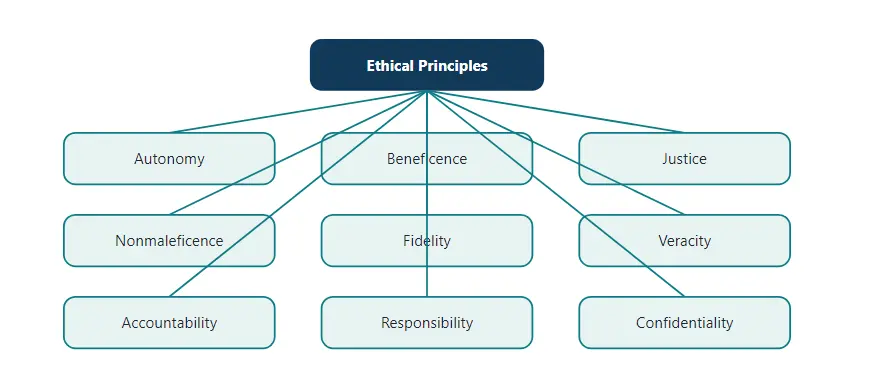
Ethics (Melanie and Evelyn): the moral code for nursing, based on the obligation to serve and respect human life. Nine ethical principlesEthical
| Principle | Meaning | Nursing example |
|---|---|---|
| Autonomy | Right of self-determination | Taking the patient’s informed decision about surgery |
| Beneficence | Doing good and right things | Giving pain relief on time |
| Justice | Treating all patients fairly and equally | Same quality of care to rich and poor |
| Nonmaleficence | Avoiding harm, intentional or unintentional | Checking the drug and dose before giving it |
| Fidelity | Faithfulness and keeping commitments | Doing what you promised to the patient |
| Veracity | Honesty and telling the truth | Giving correct information about condition |
| Accountability | Answerable for one’s actions | Documenting care truthfully |
| Responsibility | Obligation to perform assigned duties with knowledge and judgement | Completing handover |
| Confidentiality | Patient’s information is kept private | Not discussing a patient in public |
Code of ethics
A code of ethics is a set of ethical principles accepted by all members of a profession. It guides nurses to give high-quality care and offers guidelines when there is conflict about correct practice. INC has set a code of ethics for nursing practice and research in India. Purposes: set standards of professional behaviour; inform the public of minimum standards; show commitment to the public; outline major ethical considerations; give guidelines for professional development; protect the rights of individual, family and community; remind nurses of their special responsibility in caring for the sick; provide a base for self-regulation; and give policy and procedure for solving an ethical dilemma.
Legal Aspects in Nursing
Nurses must understand the law so that they can give safe, competent, high-quality care within legal limits. Nurses are accountable for their professional judgement and actions.
Nursing law: a rule of conduct, executive orders, regulations and legal precedents whose objective is the promotion and protection of the individual and the community through nursing practice.
Purposes of law in nursing: it gives a framework for nursing actions; helps maintain standards of practice; helps establish boundaries for nursing autonomy; and helps protect nurses from liabilities.
Types of law
| Law | Description |
|---|---|
| Public law | Relationship between the state and its citizens. |
| Constitutional law | Governs the state; the supreme law of the country that decides structure, powers and duties of the state. |
| Administrative law | Regulates managerial procedures and powers of administrative agencies; enforced by the executive branch (trade, pollution, taxation). |
| Criminal law | Deals with crimes (theft, assault, robbery, murder), punished by fine, imprisonment or death; concerns the whole society. |
| Civil (private) law | Protects legal rights of private persons (divorce, custody, property); punishment is usually compensation. |
| Contract law | Rules for agreements between two or more parties. |
Felony is a serious crime punishable by imprisonment of more than 6 months. A misdemeanour is a less serious crime punishable by fine or a short prison term or both.
Tort
A tort is a wrong committed by one individual against another person or the person’s property. A tort has four essentials: (1) an act or omission; (2) the wrongful act must be recognized by law; (3) legal damage; (4) it must give rise to a legal remedy in the form of action or damages.
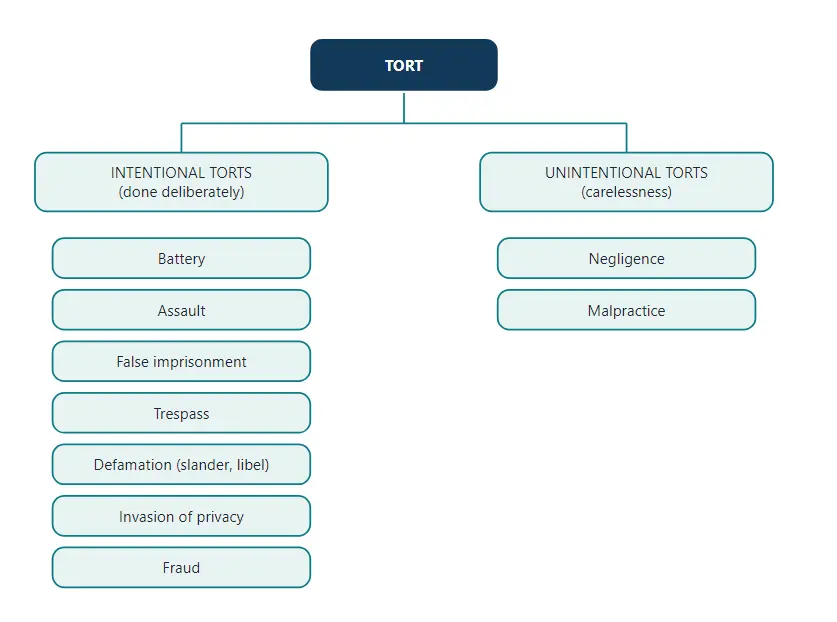
| Tort | Meaning |
|---|---|
| Battery | Actual, unwarranted contact with a person without consent. |
| Assault | An attempt or intentional threat to make harmful or offensive contact, causing the patient to be fearful. |
| False imprisonment | Restraining or restricting freedom of movement. Using a restraint without an order is false imprisonment. |
| Trespass | Unauthorized entry on another person’s land or unauthorized handling of property. |
| Defamation | A false statement that damages reputation. Slander is spoken; libel is written. |
| Invasion of privacy | Unjustified intrusion into personal life without consent (organizational, informational and workplace privacy). |
| Fraud | Deliberate act or failure to act to obtain an unauthorized benefit. |
| Negligence | Failure to meet accepted standards, or omission of an act that a reasonable person would do, causing suffering or harm. |
| Malpractice | Professional negligence: the nurse fails to perform duties as per set standard and the patient is harmed. |
Legal safeguards for the nurse
- Licensure: a valid license from the state nursing council or INC.
- Good Samaritan Law: exempts doctors and nurses from liability when giving care in an emergency.
- Standards of care: the desired level of nursing care used to evaluate quality.
- Informed consent: a legal document with details of the procedure, benefits, risks and alternatives, based on the patient’s full understanding.
- Documentation: records are legal evidence. Incorrect or outdated records are a legal liability. Remember: if it is not documented, it is not done.
Ethical and Legal Issues in Nursing
| Issue | Key points |
|---|---|
| Informed consent | Written consent before any procedure. Unconscious, mentally incompetent patients and children cannot give consent; the legal guardian does. |
| Misuse of controlled substances | Narcotics, depressants, antianxiety drugs and hallucinogens must be kept in custody with strict inventory. |
| Confidentiality | Keep records, reports and all information given by the patient confidential. |
| Organ transplantation | Based on laws and medical criteria. Nurses educate and counsel on donation. THOA was passed in India in 1994. |
| Euthanasia | Deliberate act to end life to relieve persistent suffering. Nurses must know the laws on it. |
| Records and reports | Clear, accurate and proper records of incidents and events. |
| Medical research | Research gives evidence for practice, but human rights must be protected. An Institutional Ethics Committee and ethical clearance are needed for research on human subjects. |
Quick Revision Points
- Nursing is an art, a science and a profession. Henderson’s definition is the most important one.
- Metaparadigm: Person, Nursing, Health, Environment.
- Criteria of profession: 9. Nursing profession needs Head, Hand, Heart.
- TNAI 1905/1908; INC Act 1947, INC 1949; first SNRC Chennai 1926.
- Nightingale: Scutari 1854, Notes on Nursing 1859, Training School 1860, died 1910.
- Ethical principles: Autonomy, Beneficence, Justice, Nonmaleficence, Fidelity, Veracity, Accountability, Responsibility, Confidentiality.
- Torts: intentional (battery, assault, false imprisonment, trespass, defamation, invasion of privacy, fraud) and unintentional (negligence, malpractice).
Nursing Foundation Practice MCQs
Q1. Who gave the definition: “The unique function of the nurse is to assist the individual, sick or well…”?
- Florence Nightingale
- Virginia Henderson
- Dorothea Orem
- Jean Watson
Answer: B. Virginia Henderson.
Q2. Which is NOT a concept of the nursing metaparadigm?
- Person
- Health
- Environment
- Hospital
Answer: D. The four are Person, Nursing, Health, Environment.
Q3. The Nightingale Training School was started in:
- 1836
- 1854
- 1860
- 1893
Answer: C. 1860 at St. Thomas’ Hospital, London.
Q4. International Nurses Day is celebrated on:
- 12 May
- 8 March
- 7 April
- 1 December
Answer: A. It is Florence Nightingale’s birthday.
Q5. The Indian Nursing Council Act was passed in:
- 1905
- 1926
- 1947
- 1949
Answer: C. Passed by Ordinance on 31 December 1947; INC was constituted in 1949.
Q6. The first State Nurses Registration Council was set up at:
- Delhi
- Mumbai
- Chennai
- Kolkata
Answer: C. Chennai, 1926, through the efforts of TNAI.
Q7. Term of the INC President is:
- 3 years
- 4 years
- 5 years
- 6 years
Answer: C. The President is elected by council members for 5 years.
Q8. The official journal of TNAI is:
- Nursing Times
- Nursing Journal of India
- Indian Journal of Nursing
- Health Review
Answer: B. Started in 1910 and published monthly.
Q9. PhD in Nursing started in India in:
- 1986
- 1992
- 1994
- 2004
Answer: B. At Rajkumari Amrit Kaur College of Nursing, Delhi University.
Q10. First MSc Nursing (2-year) program in India began in:
- 1950
- 1955
- 1960
- 1964
Answer: C. College of Nursing, Delhi, 1960.
Q11. Doing good for the patient is the principle of:
- Justice
- Beneficence
- Nonmaleficence
- Fidelity
Answer: B. Beneficence means taking positive action to help.
Q12. Avoiding harm to the patient is called:
- Autonomy
- Veracity
- Nonmaleficence
- Justice
Answer: C. Harm may be intentional or unintentional.
Q13. The patient’s right to decide about his own treatment is:
- Autonomy
- Fidelity
- Justice
- Responsibility
Answer: A. Self-determination.
Q14. Unauthorized touching of a patient without consent is:
- Assault
- Battery
- Libel
- Fraud
Answer: B. Assault is the threat or fear; battery is the actual contact.
Q15. Spoken defamation is called:
- Libel
- Slander
- Fraud
- Trespass
Answer: B. Libel is written defamation.
Q16. Professional negligence that causes harm to a patient is:
- Assault
- Battery
- Malpractice
- Trespass
Answer: C. Malpractice is professional negligence.
Q17. The law that protects doctors and nurses who help in an emergency is:
- Good Samaritan Law
- THOA
- INC Act
- Contract Law
Answer: A. It exempts them from liability when helping in good faith.
Q18. THOA (Transplantation of Human Organs Act) was passed in India in:
- 1947
- 1971
- 1994
- 2004
Answer: C. 1994.
Q19. Which is NOT one of the ‘3 H’ of nursing?
- Head
- Hand
- Heart
- Health
Answer: D. Head (knowledge), Hand (skills), Heart (attitude).
Q20. Continuous hospital-to-community care is called:
- Holistic care
- Continuum of care
- Primary care
- Rehabilitation
Answer: B. One of the characteristics of nursing practice.
Q21. The ‘backbone’ of nursing is:
- Nursing process
- Therapeutic communication
- Documentation
- Advocacy
Answer: B. As described in the chapter.
Q22. A crime punishable by more than 6 months’ imprisonment is a:
- Misdemeanour
- Felony
- Tort
- Libel
Answer: B. Misdemeanours are less serious.
Q23. TNAI became a member of the Commonwealth Nurses Federation in:
- 1908
- 1947
- 1950
- 1986
Answer: B. 1947.
Q24. Which body issues registration certificates to nurses in a state?
- INC
- TNAI
- SNRC
- WHO
Answer: C. SNRC issues certificates with a registration number.
Q25. Restraining a patient without a doctor’s order may amount to:
- Fraud
- False imprisonment
- Libel
- Trespass
Answer: B. It restricts freedom of movement unlawfully.
Nursing Foundation Important Questions as per INC Syllabus Pattern
Long answer questions (10 to 15 marks)
- Define nursing. Explain the criteria for nursing as a profession.
- Describe the objectives and functions of the Indian Nursing Council.
- Describe the contribution of Florence Nightingale to nursing.
- What are the ethical principles? Explain their importance in nursing practice.
- Explain the legal aspects of nursing. Describe the types of tort.
- Describe the history of nursing in India with important landmarks.
- Explain the scope of nursing practice and the factors affecting it.
Short answer questions (5 marks)
- Nursing metaparadigm
- Characteristics of a profession
- Functions of SNRC
- TNAI: history and objectives
- Qualities of a good nurse
- Professional values in nursing
- Purposes of code of ethics
- Differentiate negligence and malpractice
- Informed consent
- Expanded and extended roles of a nurse
- Aspects of nursing (holistic care)
- Good Samaritan Law and legal safeguards of a nurse
Very short answer questions (2 marks)
- Write Virginia Henderson’s definition of nursing.
- List the objectives of TNAI.
- Define battery, assault, slander and libel.
- Differentiate felony and misdemeanour.
- Differentiate civil law and criminal law.
- What is the Nightingale Pledge?
- Define values.
- Expand THOA.
- Define beneficence and nonmaleficence.
- What are the 3 H’s of the nursing profession?