
Documentation and Reporting: There is a famous saying in nursing: “If it is not documented, it is not done.” A nurse may give excellent care, but if it is not written correctly, no one else knows about it, and it cannot protect the nurse in a legal case. In this chapter you will learn what records and reports are, why we keep them, how to write them correctly, the different methods and formats of charting, the legal guidelines, handover (SBAR), incident reports, and the basics of electronic records and nursing informatics.
Learning objectives: understand the purposes and principles of records and reports; know the types of client records and common record-keeping formats; explain the guidelines of documentation (recording and reporting); describe legal guidelines; and explain the methods and systems of documentation.
Meaning and Definitions of Documentation
Documentation is a way of communicating information about the patient (assessment, diagnosis, planning, implementation and evaluation of care and treatment) in written form.
- Documentation is any written or electronically generated information related to the patient and his care and treatment. It is used for communication of observations, decisions, actions and outcomes. (Perry and Potter, 2010)
- Nursing documentation refers to written or electronically generated client information obtained through the nursing process. (Association of Registered Nurses of Newfoundland and Labrador, 2010)
Purposes of Documentation
| Purpose | Description |
|---|---|
| To facilitate communication | Nurses tell other nurses and care providers about the patient’s status, interventions done and results. Accurate documentation lowers the chance of miscommunication and errors. |
| To promote good nursing care | Encourages nurses to assess patient progress, find which interventions are effective, and record changes to the plan of care. |
| To promote nursing research | Documentation can improve the quality of nursing practice and patient care through research. |
| To meet professional and legal standards | It shows that the nurse used nursing knowledge, skills and judgement as per professional standards. Nursing documentation may be used as proof in lawsuits and disciplinary hearings. |
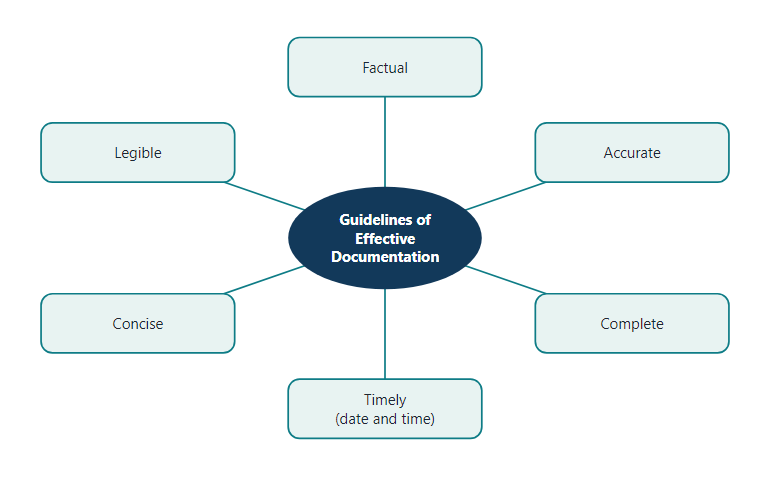
Guidelines of Effective Documentation
| Guideline | Meaning |
|---|---|
| Factual | Objective information about what the nurse sees, hears, feels, smells and thinks. Subjective data are documented in the client’s exact words. |
| Accurate | Use exact measurements. |
| Complete | Includes the patient’s response, communication with the family and entries on all assessment forms. |
| Timely | Document the date and time in each entry. Never record in advance. |
| Concise | Brief and complete. |
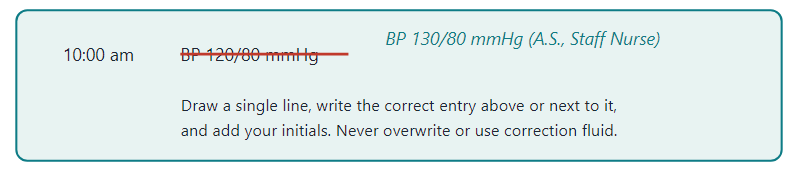
| Legible | Write clearly with a blue or black pen. If a mistake occurs, draw a line through it and write the correction above or next to it with your initials. |
Confidentiality
It is the nurse’s responsibility to keep the patient’s records and information confidential. She should not discuss assessment, examination, diagnosis or treatment with any other person or health personnel who is not involved. Only members of the health team directly involved in the patient’s care should have access to records. The patient may ask for a copy of his medical records, as he has a right to be informed. Nurses are legally and ethically bound to protect patient information from any unauthorized person or source. A valid reason and permission are needed when records are used for data collection, education or research. All records are stored by the medical record department of the hospital.
Records and Reports
| Record | Report |
|---|---|
| A permanent written communication that documents information relevant to a client’s health care management. It is a clinical, scientific, administrative and legal document about nursing care given to an individual, family or community. | An oral or written exchange of information shared between caregivers or workers. It is the summary of the services of a person or personnel and of the agency. |
Purposes of records and reports
| Purpose | Explanation |
|---|---|
| Communication | Between health team members about treatment, care, procedures done, needs and progress. |
| Planning patient care | Daily progress guides the team in planning care and treatment. |
| Quality improvement and audit | Reviewing records checks the standard and quality of care. |
| Research | Source of data for retrospective and prospective studies and for finding new nursing interventions. |
| Education | Used for case studies; helps students relate theory to practice. |
| Reimbursement | Source for receiving payment from government or insurance companies. |
| Legal documentation | A legal document that protects both patient and health care professional. |
| Quality of care | Helps identify the patient’s needs and goals and appraise the quality of care. |
| Decision analysis | Helps administration analyse decisions about client needs, finances, and overused and underused services. |
| Vital statistics | Useful to evaluate services given to the community. |
| Health service planning | Helps find the health problems people are suffering from. |
Types of Client Records
Client records are documents containing all the information about the health history of the client from the time of admission till discharge.
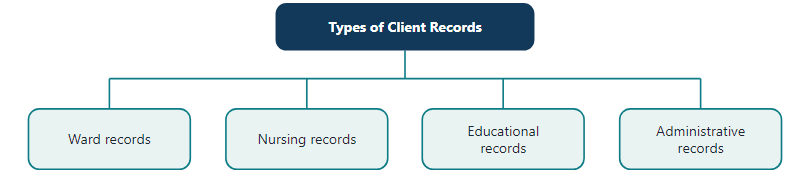
A. Ward records
| Record | Use |
|---|---|
| Patient clinical record | Includes inpatient as well as outpatient records. |
| Doctor’s prescription sheet | Doctor writes all the treatment to be started. |
| Lab investigation forms | Colour-coded slips sent with samples; reports are charted in these forms. |
| Consent form | Taking the patient’s consent for any therapeutic or diagnostic procedure. |
| Diet sheet | Prescription of the diet and daily dietary requirement. |
| Intake output chart | Records intake and output. |
| Reports of physiotherapy | Therapies like physiotherapy, occupational therapy or play therapy. |
| Instruction book | Special instructions related to the patient. |
| Census record | Total admissions, discharges, transfers in and out, absconding patients and deaths in the ward. |
| Admission and discharge book | Total admissions and discharges per day. |
| Call book | Earlier used to write the doctor’s name, date, time and purpose of a call for patient consultation. |
| Complaint book | Repairs needed, such as electricity or water supply. |
| Movement register | Movement of health care team members. |
| Indent book | Orders supplies from the stores: medicines, linen and other items. |
| Drug maintenance book | Supply and demand of drugs in the area. |
| Crash cart register | All drugs and equipment in the crash cart. |
| Death register | Number of patients who died in the ward. |
B. Nursing records
| Record | Use |
|---|---|
| Nursing assessment records | Data from history taking and physical examination. |
| Care plan | Outline of nursing care provided and interventions carried out. |
| Progress notes | Show the progress made and overall improvement. |
| Kardex | Series of cards in a portable index file or computer forms; information is quickly accessible to all health professionals. |
| Flow sheets | Record nursing data quickly and concisely, giving an easy view of the client’s condition over time. |
| Vital signs sheet | Temperature, pulse, respiration and blood pressure, shown graphically. |
| Medication record | Details of all medicines given. |
| Intake and output record | Measurement of fluid intake (oral, tube, IV) and output (urine, vomit, drain) per day. |
| Discharge and transfer summary | A note written by the nurse when the patient is discharged or transferred. |
C. Educational records
Records used by nursing institutes: course plans, unit plans, master rotation and clinical rotations of students and staff, minutes of committee meetings, student health records and cumulative records, annual reports, affiliation records, written policies, budget proposals, brochures, and staff development programme details.
D. Administrative records
Records kept by top management: philosophy, policies, vision and mission, staff details and job descriptions, records of treatments, admissions, equipment losses and replacements, personnel performance and other administrative records.
Electronic Health Records (EHR) and Computerized Documentation
EHR: “a collection of various medical records that get generated during any clinical encounter or events.” (Vikaspedia, 2019). It includes all information in a traditional health record, plus the patient’s health profile, behavioural and environmental information.
Benefits of EHR
- Easy availability and easy storage of patient records.
- Fewer lost records and better record quality.
- Improves accuracy and speed of diagnosis; easy transfer.
- Tracks clinical progress and improves patient compliance.
- Easy to update, used by many users, low-cost backup.
- Improves health care decisions, gives evidence-based care and supports research.
| Benefits to clinicians | Benefits to patients |
|---|---|
| Availability of information when and where needed; decision support; organization of information; easier preparation of reports; ease of order entry; no multiple entries of the same data. | Knowledge of who has access to their data; individualized treatment anywhere the computer-based record is available; ability to check their own record. |
Categories of computerized documentation
| Category | Features |
|---|---|
| Clinical systems | Data entry related to the client, data sorting and analysis by computer, communication among team members, and client safety. |
| Multinational infosys (management information systems) | Staff scheduling, finance, statistical and administration reports. |
| Education | Enable health education and passing of instructions. |
Pros and cons
| Pros | Cons |
|---|---|
| Focus on client outcomes; bedside terminals combine information from monitoring equipment; saves nurses’ time; links many sources of client information; fast sending and receiving of requests and results; legible; reinforces standards of care; standard terminology improves communication. | Client privacy may be violated if security measures are not used; breakdowns make information temporarily unavailable; the system is expensive; long training periods may be needed for a new or updated system. |
How to ensure confidentiality of computerized documents
- Always use your own ID password only and never leave the system unattended while logged in.
- Log out immediately when work is finished.
- Do not leave recording for the last moment; make the entry as the task is completed.
- Follow all policies for the hospital information management system (HIMS) or nursing information management system (NIMS).
- If you lose your ID password, report it at once to the authorities.
Principles and Guidelines for Documentation and Reporting
| Principle | Description |
|---|---|
| Date and time | Write date and time every time an entry is made, in 24-hour or conventional form as per institutional policy. |
| Correct spelling | Correct spelling of the patient’s name, diagnosis and medicines. |
| Timing | Frequency of documentation depends on institution policy or the patient’s condition. Never write notes before giving the care. |
| Appropriateness | Record only information that pertains to health, diagnosis, medication, treatment and care. Irrelevant information must not be recorded because it may invade privacy. |
| Legal prudence | Records are legal documents. Accurate and complete documentation protects nurses and can be used as evidence in court. |
| Accuracy | Include client name, UHID or CR number, gender, diagnosis, and page numbers. Use standard abbreviations and measurements. Describe wounds objectively (size, shape, edges, healing type, discharge colour, smell, viscosity). |
| Comprehensive yet specific | Complete but not lengthy; in chronological order; brief phrases and accepted abbreviations; do not leave blank spaces between lines. |
| Legibility | Clear handwriting that is easy to read. |
| Organizing | Chronological order by date, time and sequence, ideally following the nursing process. |
| Sequence and timeliness | Document on time or as early as possible; record the time of medication, treatment, procedures and assessments. |
| Correction | Do not cut or erase an error. Draw a single line, write the correct entry and put your initials. |
| Omission | Do not omit anything; do not leave blank spaces between words. |
| Signature | Sign after every entry with your name and designation. |
| Confidentiality | Only members of the team directly involved in care may see the record. |
| Terminology | Use standardized abbreviations, symbols and terms. Write the full form when in doubt. |
| Permanence | Use a dark-coloured ink pen. Follow hospital policy on pen colours (for example death is written in red ink). |
| Factual | Descriptive, objective data gathered by the nurse using her skill and competence. Subjective statements are recorded in the patient’s exact words. |
| Current | Keep documents up to date; chart immediately to avoid errors. |
Do’s and Don’ts (summary)
| Do | Don’t |
|---|---|
| Write date, time, and sign every entry. Use blue or black ink. Record facts and exact words. Chart as soon as care is given. Report errors promptly. Follow hospital abbreviation list. | Do not record in advance. Do not erase, scratch out or use correction fluid. Do not leave blank spaces. Do not write opinions, blame or irrelevant information. Do not share passwords. Do not photocopy an incident report. |
Legal Guidelines for Documentation and Reporting
Records are legal documents that can be used as evidence. Accurate and complete records give legal protection to nurses, other team members and the patient. Mistakes that lead to legal implications:
- Not following the guidelines of documentation.
- Documentation not fully completed.
- Failure to record prevention efforts, particularly for falls, side rails, call bell in reach, restraints (if used), smoking and other potential for injury.
- Failure to record treatments and care given.
- Failure to record the patient’s refusal of care, or the family’s refusal to accept care.
- Incomplete incident reports (and noting incident reports in the patient’s chart).
- Failure to record that the client did not follow orders (non-compliance).
Nurse’s responsibility for record keeping and reporting
- Records must be accurate to give a sound basis for care planning. Errors must be corrected promptly.
- In reporting a criminal act, the nurse should reveal information only to the police.
- Records should be descriptive, objective and reliable, complete, concise and thorough.
- Delay in recording and reporting can cause serious omissions and delay in care.
- Nurses are legally and ethically obliged to keep information confidential.
Methods and Systems of Documentation
A. Narrative documentation
The traditional method of recording nursing care in a story-like format. Disadvantages: repeated information, time-consuming, and the reader has to sort through much information to find the data needed.
B. Problem Oriented Medical Record (POMR)
Places emphasis on the client’s problems; data are organized by problem or diagnosis.

| Component | Description |
|---|---|
| Data base | All information known about the client when he first enters the health care agency. |
| Problem list | Derived from the data base; problems are listed in the order identified. |
| Plan of care | Initial list of orders or plan, made with reference to the active problem. |
| Progress notes | Chart entries made by all health professionals involved. The SOAP format is frequently used. |

Example of a SOAP note (added):
S: “I feel pain in my right leg when I walk.”
O: Right calf warm and red, mild swelling, pain score 6/10, pulse 88/min.
A: Acute pain related to inflammation of right calf.
P: Elevate the leg, give analgesic as prescribed, reassess pain after 30 minutes, inform the doctor.
C. Problems, Interventions and Evaluation (PIE)
Groups information into three categories (Problem, Intervention, Evaluation) and consists of a client care flow sheet and progress notes. PIE notes are numbered according to the client’s problems.
D. Focus charting (DAR)
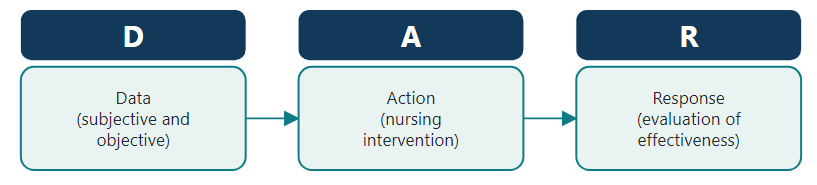
Uses DAR notes: Data (subjective and objective), Action or nursing intervention, Response of the client (evaluation of effectiveness). It helps track the client’s condition and progress.
Example (added): Focus: Fever. D: Temp 101 F, flushed face, patient says “I feel hot.” A: Tepid sponging given, paracetamol given as ordered. R: Temp 99.4 F after 1 hour, patient comfortable.
E. Charting by exception (CBE)
A system in which only abnormal or significant findings (exceptions to the norm) are recorded. Key elements: flow sheets, standards of nursing care, and keeping all flow sheets at the patient’s bedside.
F. Case management
Multidisciplinary care plans that include client problems, key interventions and expected outcomes within an established time frame.
Reporting
Purposes of report writing: to show the kind and quality of service given to the patient; to show the patient’s progress and the outcome of treatment and care; to help study health conditions; and to help plan further care.
Types of reports
- Oral reports: given when the information is for immediate use and not for permanence, for example the nurse assigned to the patient reporting to the nurse who will relieve her.
- Written reports: used when information will be used by several personnel and is of more or less permanent value, for example day and night reports, census, interdepartmental reports, and reports on situations, events and conditions.
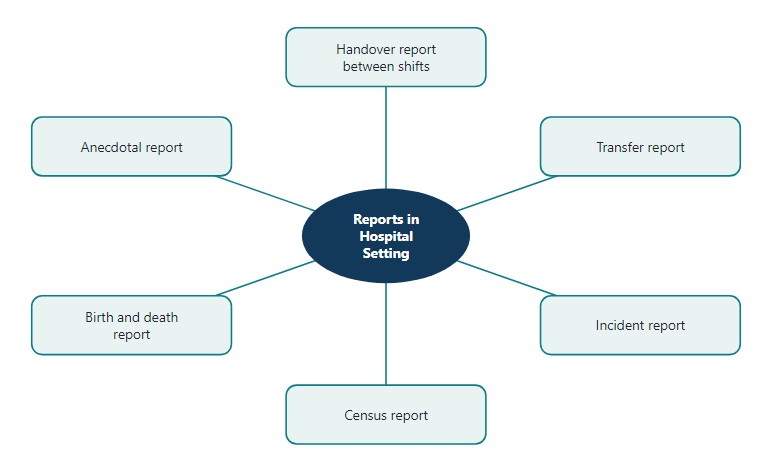
A. Handover report between shifts (change-of-shift report)
Objective: to maintain continuity of care so that patients get services quickly, precisely and accurately. It has two aspects: (1) patient handover preparation and implementation, and (2) documents, facilities and equipment (patient medical record and handover sheet).
Nurse giving the report (previous shift):
- Completes documentation of all patients (number of patients, those getting treatment, new, discharged, transferred or died).
- Documents all special events during the shift.
- Reviews and updates the care plan as per the patient’s response, needs and medical orders.
- Draws conclusions from what happened and what was found.
- Allocates patients to the next nurse.
Nurse receiving the report: looks at the patient allocation and briefly reads the medical records of the patients she will treat.
Implementation of handover:
- Hand over at the patient’s bedside using the SBAR method.
- Inform the patient about the handover and whether family may join; introduce the next shift nurse.
- The previous nurse explains the patient’s condition, things done and the next plan.
- Data reported should include: patient’s name, age, date of entry, treating doctor, medical and nursing diagnosis, laboratory and radiological results, complaints, diet, fluid balance, vital signs and action plans.
- Check all tubing connections and catheters attached to the patient.
- Do not hand over confidential data to the patient.
SBAR method

| Letter | Information to give |
|---|---|
| Situation | Patient’s name, age, length of stay, doctor in charge; nursing problem and diagnosis; other identification details and patient location. |
| Background | Current condition: chief complaint, re-assessment (vital signs and more), abnormal diagnostic test results, patient medication record. |
| Assessment | Assessment of the current condition including clinical signs and other specific conditions. |
| Recommendation | Interventions that can be done to manage the patient’s current condition. |
B. Transfer report
Communication of information about clients from the nurse on the sending unit to the nurse on the receiving unit. Include: client’s name, age, primary doctor and medical diagnosis; summary of medical progress up to transfer; current physical and psychosocial status; current nursing diagnoses or problems and care plan; any critical assessments or interventions to be done shortly; and need for special equipment.
C. Incident report
- The nurse who witnessed the incident files the report.
- Describe concisely what happened in objective terms.
- Do not try to explain the cause of the incident.
- Describe the client’s condition at the time of the incident objectively.
- Report actions taken by the nurse and doctor at the time.
- No nurse is blamed in an incident report.
- Submit it as soon as possible and never make a photocopy. Do not note the incident report in the patient’s chart.
D. Census report
A combined daily report that shows the total number of patients and the number of admissions, discharges, transfers, births and deaths.
E. Birth and death report
Nurses are responsible for sending the birth and death report to government authorities for registration within the specified time.
F. Anecdotal report
An anecdote is a brief account of some incident. Incident reports and reports on accidents, mistakes and complaints are legal in nature. A written record about some observation of a person or his or her work is called an anecdotal note.
Guidelines for report writing
- Be clear in your own mind before writing. Reports lacking facts may be biased or worthless.
- Conciseness, accuracy and completeness are essential.
- It is better to write several reports than one report with more than one main subject.
- Use simple, commonly used words for non-technical reports; scientific terms for reports to professional personnel; specific rather than general words; a single meaningful term instead of phrases.
- Use good sentences and paragraphs, observe margins, spell properly, use correct pronouns and punctuation, and be neat.
- Avoid abbreviations except in clinical charting.
- Write in a conversational manner, put the date on every report, and if it is typed by someone else, check it before signing.

FACO: Fact based, Accurate, Complete and correct, Organized.
Communication within the Health Care Team

- Different verbal and written communication takes place within the team.
- Written communication uses records such as the instruction book, call book and treatment book.
- Verbal orders are later recorded in written form.
- A consultation request is sent to a specialist who reviews the patient’s condition.
- Referral is written communication where patient details are sent to a department for further treatment. Example: a diabetic patient with kidney failure is referred to the nephrology department.
Nursing Informatics
Nursing informatics is a specialty that integrates nursing science, computer science and information science to manage and communicate data, information, knowledge and wisdom in nursing practice.
- “Application of computer technology to all fields of nursing: nursing services, nurse education and nursing research.” (Scholes and Barber, 1980)
- “A combination of computer science, information science and nursing science designed to assist in the management and processing of nursing data, information and knowledge to support the practice of nursing and the delivery of nursing care.” (Graves and Corcoran, 1989)
Purposes of nursing informatics: to support the use of the nursing process; computer-based scheduling to allocate staff; computers for patient education; computer-assisted learning in nursing education; nursing use of a hospital information system; and research on information nurses use in patient care decisions.
Chapter Focus Points
- Documentation is a communication tool. Systems include narrative, POMR, PIE, charting by exception and case management.
- A record is a permanent written communication; reports are oral or written exchanges of information.
- It is the nurse’s responsibility to keep records and information confidential.
- Nursing informatics integrates nursing, computer and information science.
Documentation and Reporting MCQs (Nursing Foundation Notes)
Q1. Documentation in nursing means:
- Writing or electronically recording information about the patient and care
- Only giving verbal reports
- Only billing
- Only photography
Answer: A. It communicates assessment, diagnosis, planning, implementation and evaluation in writing.
Q2. Which is NOT a guideline of effective documentation?
- Factual
- Accurate
- Concise
- Delayed
Answer: D. The six are factual, accurate, complete, timely, concise, legible.
Q3. Subjective data in a record should be written in:
- Nurse’s own words
- Client’s exact words
- Abbreviations
- Pencil
Answer: B. Objective data are what the nurse sees, hears, feels and smells.
Q4. Entries should be made with:
- Pencil
- Blue or black pen
- Red pen always
- Any colour
Answer: B. Death is written in red ink as per hospital policy.
Q5. If you make a mistake in a record, you should:
- Use correction fluid
- Tear the page
- Draw a single line, write the correct entry and initial it
- Overwrite it
Answer: C. Never erase or scratch out.
Q6. Recording in advance is:
- Acceptable
- Not allowed
- Compulsory
- Preferred
Answer: B. Document date and time each time and never in advance.
Q7. A record is best defined as:
- An oral exchange
- A permanent written communication of information relevant to a client’s care
- A bill
- A letter
Answer: B. A report is an oral or written exchange of information.
Q8. Reports can be:
- Only oral
- Only written
- Oral or written
- Only electronic
Answer: C. Oral reports are for immediate use; written for permanence.
Q9. Which purpose of records helps get payment from insurance?
- Research
- Reimbursement
- Education
- Audit
Answer: B. Records are a source for payment.
Q10. Which ward record shows total admissions, discharges, transfers and deaths?
- Census record
- Call book
- Indent book
- Complaint book
Answer: A. Also absconding patients.
Q11. The book used to order supplies like medicines and linen is the:
- Indent book
- Call book
- Instruction book
- Death register
Answer: A. From the stores.
Q12. Kardex is:
- A series of cards kept in a portable file giving quick information
- A lab report
- An X-ray
- A bill
Answer: A. It can be computer generated too.
Q13. Records of course plans, unit plans and student health records are:
- Ward records
- Nursing records
- Educational records
- Administrative records
Answer: C. Used by nursing institutes.
Q14. Philosophy, policies, vision and mission records are:
- Educational records
- Administrative records
- Nursing records
- Ward records
Answer: B. Maintained by top management.
Q15. EHR stands for:
- Electronic Health Record
- Emergency Health Report
- External Hospital Record
- Electronic Hospital Report
Answer: A. A collection of medical records generated during clinical encounters.
Q16. Which is a benefit of EHR?
- Easy availability and storage
- Higher chance of lost files
- Slower diagnosis
- No backup
Answer: A. Also easy update, multiple users and low-cost backup.
Q17. Which is a con of computerized documentation?
- Legible information
- Breakdowns make information temporarily unavailable
- Standard terminology
- Quick transfer of results
Answer: B. Also expensive and needs training.
Q18. To protect computerized records, a nurse should:
- Share her password
- Use own ID password and log out after work
- Leave the system logged in
- Make entries at the end of the day
Answer: B. Report a lost password immediately.
Q19. POMR has how many basic components?
- Two
- Three
- Four
- Five
Answer: C. Data base, problem list, plan of care, progress notes.
Q20. SOAP stands for:
- Subjective, Objective, Assessment, Plan
- Sign, Observe, Act, Plan
- Situation, Objective, Action, Plan
- Subjective, Order, Action, Plan
Answer: A. A progress note format used in POMR.
Q21. PIE stands for:
- Problems, Interventions and Evaluation
- Plan, Implement, Evaluate
- Patient, Illness, Examination
- Problem, Information, Entry
Answer: A. Notes are numbered according to the client’s problems.
Q22. DAR notes are used in:
- Focus charting
- Narrative charting
- Charting by exception
- Case management
Answer: A. Data, Action, Response.
Q23. In charting by exception, only the following are recorded:
- All findings
- Abnormal or significant findings
- Only normal findings
- Nothing
Answer: B. Uses flow sheets and standards of nursing care kept at the bedside.
Q24. The traditional story-like method of recording is:
- Narrative documentation
- POMR
- PIE
- CBE
Answer: A. Disadvantages: repetition and time-consuming.
Q25. SBAR stands for:
- Situation, Background, Assessment, Recommendation
- Sign, Bed, Action, Report
- Symptom, Biology, Action, Result
- Situation, Behaviour, Action, Review
Answer: A. Used for bedside handover.
Q26. In an incident report the nurse should:
- Blame the staff
- Describe the facts objectively and not explain the cause
- Make a photocopy
- Write it in the patient chart
Answer: B. No nurse is blamed; submit it as soon as possible.
Q27. Who files the incident report?
- Nurse who witnessed the incident
- Any visitor
- The patient
- Pharmacy
Answer: A. Describe what happened concisely.
Q28. The mnemonic FACO for report writing stands for:
- Fact based, Accurate, Complete and correct, Organized
- Fast, Able, Clear, Open
- Final, Actual, Concise, Orderly
- Fact, Action, Care, Outcome
Answer: A. Used for writing reports.
Q29. Information about a criminal act should be revealed only to:
- The media
- The police
- Relatives
- Other patients
Answer: B. Nurses are legally and ethically bound to keep other information confidential.
Q30. Nursing informatics integrates nursing science with:
- Computer science and information science
- Chemistry and physics
- Law and economics
- Art and music
Answer: A. To manage data, information, knowledge and wisdom.
Nursing Foundation Important Questions as per INC Syllabus Pattern
Long answer questions (10 to 15 marks)
- Define documentation. Describe the purposes and guidelines of effective documentation.
- Explain the types of client records with examples.
- Describe the methods and systems of documentation (narrative, POMR, PIE, DAR, CBE).
- Explain the legal guidelines for documentation and reporting.
- Describe the types of reports. Explain handover report with SBAR and incident report.
- Explain electronic health records and computerized documentation with their merits and demerits.
Short answer questions (5 marks)
- Purposes of records and reports
- Ward records
- Nursing records
- Principles of documentation
- Confidentiality of records
- SOAP format
- Focus charting (DAR)
- Charting by exception
- Incident report
- Transfer report
- SBAR method
- Nursing informatics
Very short answer questions (2 marks)
- Define documentation.
- Differentiate record and report.
- Expand SOAP, PIE, DAR and SBAR.
- What is a Kardex?
- What is an anecdotal note?
- Write the full form of EHR.
- How do you correct an error in a record?
- What is FACO?
- Define nursing informatics.
- List four benefits of EHR.
Also read:
CHAPTER 1: Introduction to Health and Illness, Nursing Foundation Unit 1 Notes PDF
CHAPTER 2: Health Care Delivery System, Nursing Foundation Unit 2 BSc Nursing Notes
Chapter 3: Nursing as a Profession and History of Nursing in India: BSc Nursing 1st Semester Notes (Nursing Foundation)
CHAPTER 4: Hospital Admission and Discharge: Complete BSc Nursing Notes | 1st Semester Notes (Nursing Foundation)
CHAPTER 5: Communication and Nurse Patient Relationship: Complete Notes | BSc Nursing 1st Semester Notes (Nursing Foundation)
Chapter 6: Patient Education in Nursing: Notes for BSc Nursing 1st Semester, Nursing Foundation Notes with MCQs & Important Questions
Chapter 7: The Nursing Process: Complete Notes for BSc Nursing, 1st Semester, Nursing Foundation