
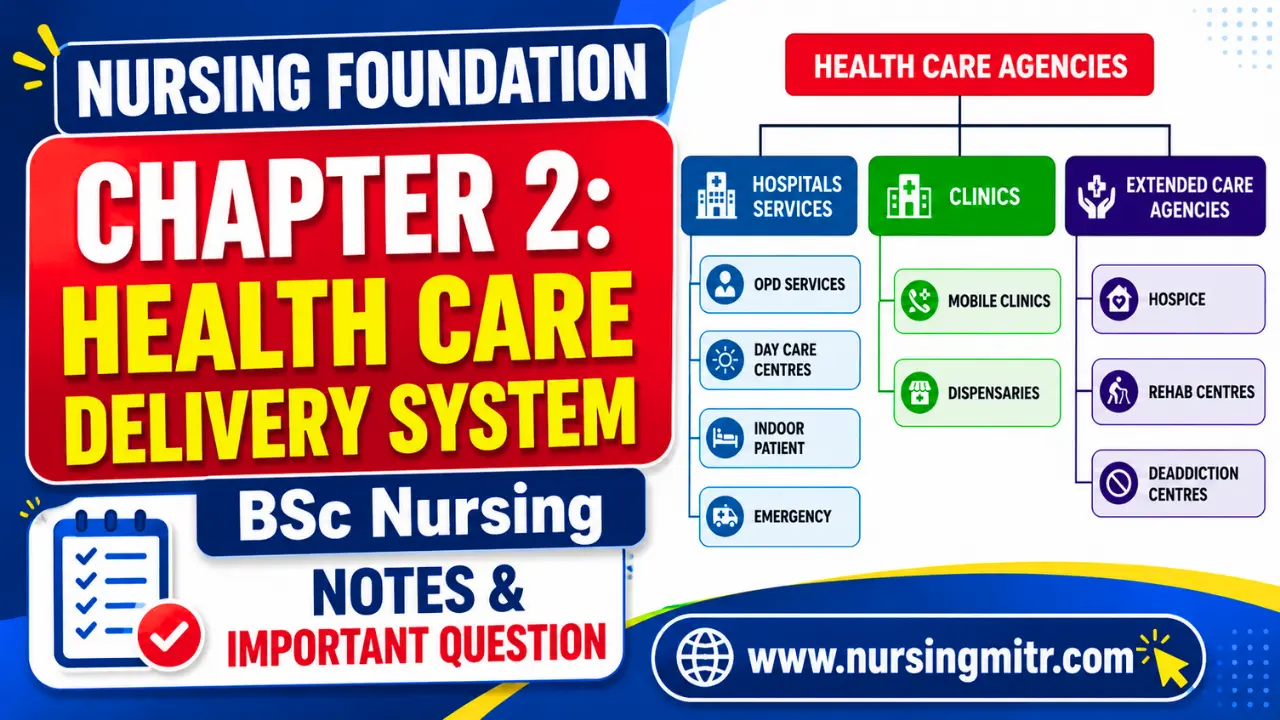

LEARNING OBJECTIVES
(Health Care Delivery System BSc Nursing 1st Semester Unit-2)
- Define prevention.
- Describe the levels of disease prevention.
- Discuss the various health care agencies.
- Describe the types of hospitals and their functions.
- Discuss Primary Health Care (PHC), its delivery, and the role of the nurse.
Also Check: CHAPTER 1: Introduction to Health and Illness, Nursing Foundation Unit 1 Notes
INTRODUCTION
Health Care Delivery System: Defined as the aggregate of institutions, organizations, and persons who enter the health care system with responsibilities including:
- Promotion of health
- Prevention of illness
- Detection and treatment of disease
- Rehabilitation
HEALTH PROMOTION
Definitions:
- McQueen (2000): A social and political process that empowers individuals through actions that strengthen skills and capabilities, changing social, environmental, and economic conditions to support health.
- O’Donnell (2009): The art and science of helping people strive for optimal health through learning experiences and a supportive environment.
- WHO: The process of enabling people to increase control over and improve their health to reach a state of complete physical, mental, and social well-being.
Health Promotion Activities (By Downie et al.):
- Preventive Services: e.g., Immunization, cancer screening.
- Preventive Health Education: e.g., Efforts to influence lifestyle and increase use of preventive services.
- Preventive Health Protection: e.g., Fluoridation of water, iodization of salt.
- Health Education for Preventive Health Protection: e.g., Lobbying for seat-belt laws, shifting polluting industries from residential areas.
- Positive Health Education: e.g., Encouraging productive use of leisure time, developing health-related life skills.
- Positive Health Protection: e.g., Workplace anti-smoking or anti-sexual harassment policies.
- Health Education for Positive Health Protection: e.g., Gaining support for anti-smoking legislation.
LEVELS OF DISEASE PREVENTION
Definition of Prevention: Activities designed to protect patients or the public from actual or potential health threats and their harmful consequences.
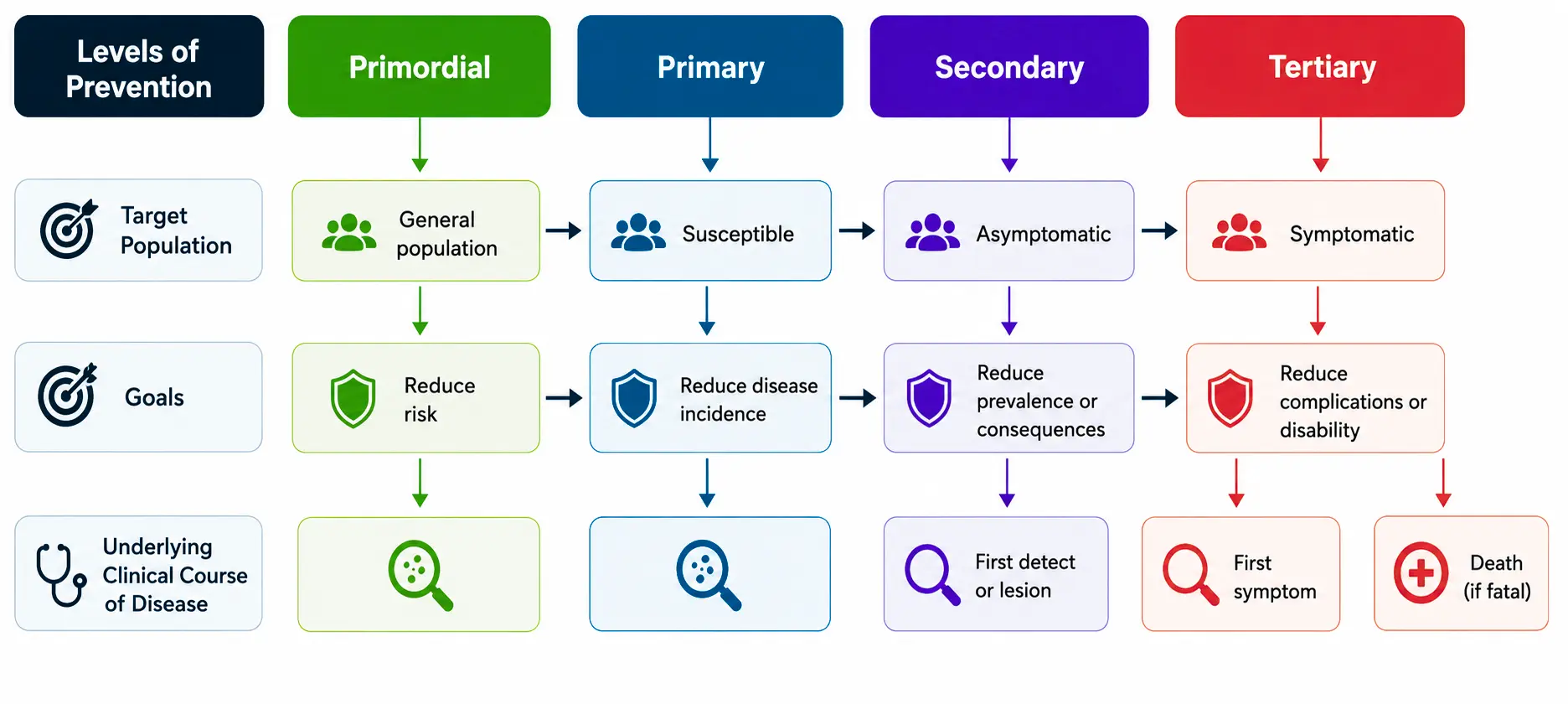
A. Primordial Prevention
- Coined by Strasser in 1978.
- Aims to prevent risk factors themselves from penetrating populations.
- Focuses on changing social and environmental conditions where risk factors develop in high-risk children, adolescents, and young adults.
B. Primary Prevention
- Action taken prior to the onset of disease to remove the possibility of it ever occurring (intervention in the pre-pathogenesis phase).
- Difference from Primordial: Primary prevention aims to modify existing risk factors, whereas primordial prevents the risk factors from developing in the first place.
- Achieved through two aspects:
- Health Promotion: Enabling people to increase control over health determinants (via health education, environmental modification, lifestyle/behavioral changes, nutritional changes).
- Specific Protection: Measures to prevent specific diseases (e.g., Immunizations like BCG/DPT/MMR, chemoprophylaxis like chloroquine for malaria, specific supplements like Vitamin A, drug safety, controlling environmental hazards).
C. Secondary Prevention
- Action that halts the progress of a disease at its incipient (early) stage and prevents complications.
- Aims to arrest the disease process, restore health, and treat before irreversible pathological changes occur.
- Achieved through:
- Early Diagnosis: Leads to better prognosis, stops disease process, reverses infectious spread. Utilizes screening surveys for chronic diseases (cancer, heart disease, stroke).
- Treatment: Various modalities like diet modification, environmental changes, or low-dose medication.
D. Tertiary Prevention
- Used when the disease process has advanced beyond its early stages.
- Focuses on reducing/limiting impairments and disabilities, and promoting patient adjustment to current conditions.
- Achieved through:
- Disability Limitation: Preventing the transition of disease from impairment to handicap.
- Rehabilitation: Combined use of medical, social, educational, and vocational measures to train/retrain the individual to their highest possible level of functional ability.
HEALTH CARE SERVICES
Definition: Services provided to individuals, families, or communities by health care professionals for health promotion, maintenance, monitoring, or restoration of health.
Characteristics of Health Care Services:
- Relevance: Should be need-based.
- Comprehensive: Must include promotion, protection, early diagnosis, treatment, disability limitation, and rehabilitation.
- Adequacy: Proportionate to the requirement.
- Availability: Available to the whole population without discrimination.
- Accessibility: Geographically, physically, economically, and culturally accessible to all.
- Affordability: Affordable to all strata of society.
Types of Health Care Agencies:
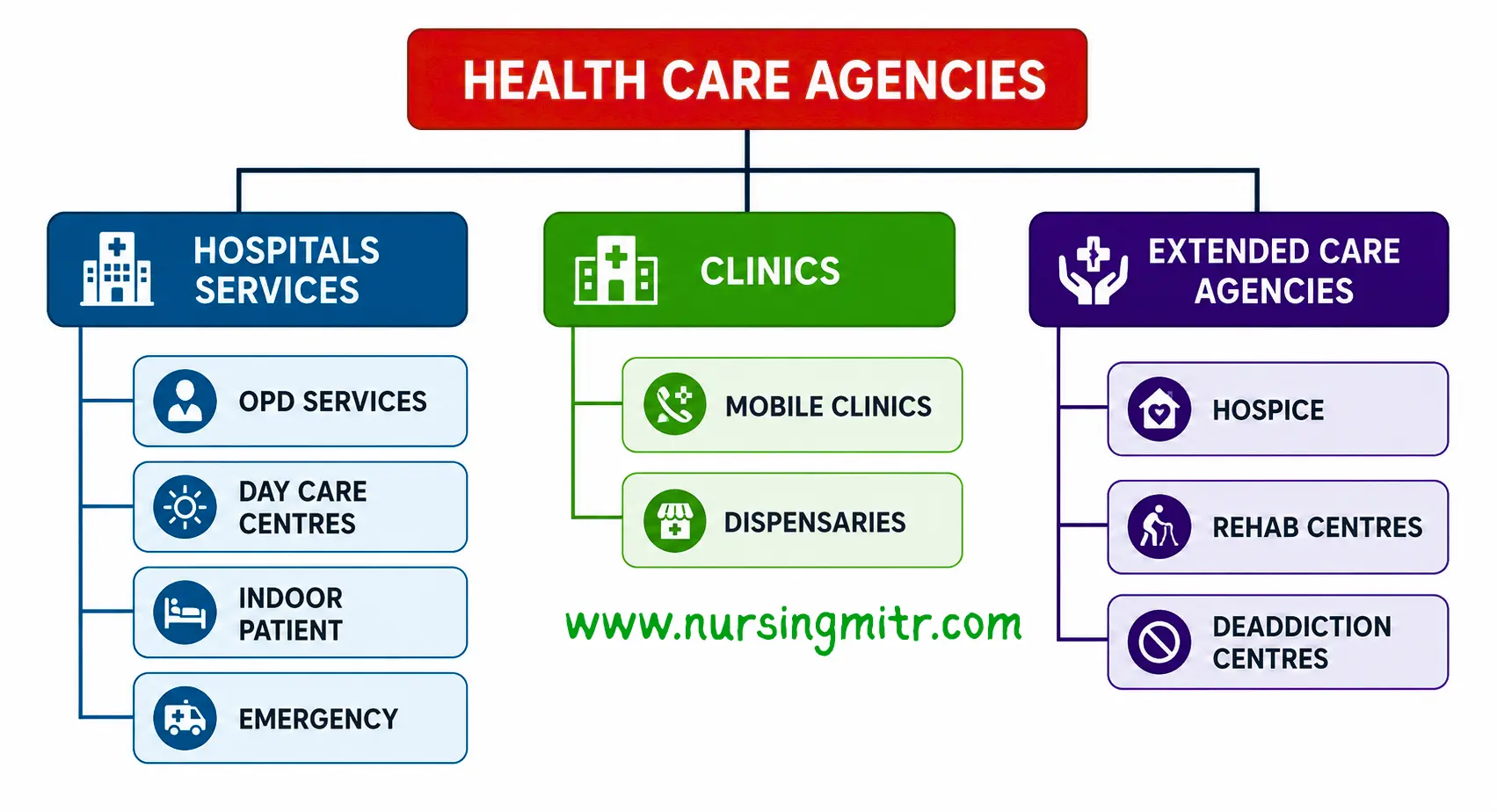
- Clinics / Day Care Centers: Provide medical care on an OPD basis without hospitalization (e.g., Chemo Day Care, Pain Clinic).
- Ambulatory Care Centers / Mobile Clinics: Outpatient care facilities (hospital-based or freestanding) offering walk-in services and non-traditional hours. Nurses provide technical services, prioritize care, and teach patients.
- Extended-Care Agencies: Provide medical/non-medical care for people with chronic illnesses/disabilities who cannot care for themselves independently.
- Hospice Services: Palliative and supportive care providing physical, psychological, social, and spiritual care for dying people and their families.
- Rehabilitation Centers: Specialize in physical/emotional rehabilitation and chemical dependency treatment using a multidisciplinary team (nurses, physiotherapists, occupational therapists, counselors).
- Outpatient Services (OPD): Short-term care for patients not needing hospitalization (e.g., doctor consultations, wound dressing).
HOSPITALS: TYPES, ORGANIZATION, AND FUNCTIONS
Definition: Derived from Latin hospitalis / French hospes (host/guest). A licensed health care institution providing diagnostic and therapeutic services for medical/surgical conditions by an organized physician staff with continuous nursing care under registered nurses.
Types of Hospitals:
- Based on Objective:
- General Hospitals
- Special Hospitals
- Teaching-cum-Research Hospitals
- Based on Length of Stay:
- Short-term / Short-stay Hospitals
- Long-term / Long-stay Hospitals
- Based on WHO Classification:
- Regional Hospitals
- Intermediate / District Hospitals
- Rural Hospitals
Health Care Team Members in Hospitals:
Assistive personnel, Dietician, Physical therapist, Respiratory therapist, Occupational/Speech therapist, Pharmacist, Social worker.
PRIMARY HEALTH CARE (PHC) AND ITS DELIVERY
Definition (WHO): The first level of contact with the national health system for individuals, families, and the community, bringing health care as close as possible to where people live and work.
Elements of Primary Health Care:
- Education concerning prevailing health problems and methods of preventing/controlling them.
- Promotion of food supply and proper nutrition.
- Adequate supply of safe water and basic sanitation.
- Maternal and child health care, including family planning.
- Immunization against major infectious diseases.
- Prevention and control of locally endemic diseases.
- Appropriate treatment of common diseases and injuries.
- Provision of essential drugs.
Key Facts & Figures:
- PHC covers the majority of a person’s health needs throughout life (prevention, treatment, rehab, palliative care).
- At least half of the world’s people lack full coverage of essential health services.
- There is a global estimated shortfall of 18 million health workers.
- Almost 50% of people lack some or all essential professional health services.
Delivery of Primary Health Care (3 Levels)
- Primary Level: First level of contact. Care provided at Sub-centers, PHCs. Staff includes ANM, ASHA, Anganwadi Worker (AWW), Village Health Guide (VHG), and Traditional Birth Attendant (TBA).
- Secondary Level: Handles more complex problems requiring secondary preventive and curative services. Provided at District Hospitals and Community Health Centers (CHCs). Acts as First Referral Units (FRUs).
- Tertiary Level: Provided at State/Regional/Central level institutions. Requires highly specialized professionals and specific facilities. Serves as referral units for primary and secondary levels.
ROLE OF THE NURSE IN PRIMARY HEALTH CARE
- Health Education: Organizing appropriate health education programs based on community needs and coordinating with other health personnel.
- Food Supply & Proper Nutrition: Monitoring child growth charts, ensuring provision of iodized salt and Vitamin A supplements, providing supplementary food for malnourished children, promoting breastfeeding and safe weaning.
- Water Supply & Basic Sanitation: Educating the public on hygienic practices, personal habits, safe drinking water, germ theory, causes of insanitation, and garbage disposal.
- Maternal & Child Health Care (Including Family Planning): Carrying out antenatal, perinatal, and postnatal care. Educating on adequate child spacing.
- Immunization: Educating families on the importance and schedule of immunization (for children and pregnant women) and monitoring the implementation of immunization programs.
- Prevention & Control of Endemic Diseases: Collecting data on communicable diseases, conducting follow-up visits, and providing surveillance over target populations.
- Treatment of Minor Ailments: Treating patients under a physician’s standing orders to provide emergency treatment and primary care, reducing morbidity and mortality rates.
- Provision of Essential Drugs: Being aware of resources and facilities to acquire essential drugs and informing clients about them promptly.
Health Care Delivery System Important Questions
Q1. What is the process of enabling people to increase control over and improve their health called?
(a) Prevention
(b) Health Promotion
(c) Primary Health Care
(d) Tertiary Prevention
Answer: (b) Health Promotion
Q2. Preventing the penetration of risk factors into populations comes under which level of prevention?
(a) Primary Prevention
(b) Secondary Prevention
(c) Tertiary Prevention
(d) Primordial Prevention
Answer: (d) Primordial Prevention
Q3. Primary prevention is achieved by following which two components?
(a) Environmental modification and lifestyle changes
(b) Health promotion and Specific protection
(c) Early diagnosis and treatment
(d) Disability limitation and rehabilitation
Answer: (b) Health promotion and Specific protection
Q4. Which of the following is NOT an example of specific protection?
(a) Chloroquine for malaria
(b) Vitamin A supplements for children
(c) Fluoridation of water and iodization of salt (Environmental modification)
(d) Immunization i.e., BCG, DPT
Answer: (c) Fluoridation of water and iodization of salt
Q5. Halting the progress of a disease at its incipient stage and preventing complications is called:
(a) Primary Prevention
(b) Secondary Prevention
(c) Tertiary Prevention
(d) Primordial Prevention
Answer: (b) Secondary Prevention
Q6. Disability limitation and rehabilitation are interventions in which level of prevention?
(a) Primary Prevention
(b) Secondary Prevention
(c) Tertiary Prevention
(d) Primordial Prevention
Answer: (c) Tertiary Prevention
Q7. Health care services available for the whole population without any discrimination is known as:
(a) Availability
(b) Affordability
(c) Accessibility
(d) Adequacy
Answer: (a) Availability
Q8. Care providing physical, psychological, social, and spiritual care for dying people is called:
(a) Extended-care Agencies
(b) Rehabilitation centers
(c) Hospice services
(d) Ambulatory Care Centers
Answer: (c) Hospice services
Q9. According to WHO classification, which hospital is located at the district level?
(a) Regional Hospital
(b) Intermediate/District Hospital
(c) Rural Hospital
(d) Teaching cum research hospital
Answer: (b) Intermediate/District Hospital
Q10. According to WHO, what is the first level of contact with the national health system?
(a) Secondary health care
(b) Tertiary health care
(c) Primary health care
(d) Extended care services
Answer: (c) Primary health care
Q11. Who is NOT included in primary level care delivery?
(a) Sub-centers
(b) PHCs
(c) District Hospital
(d) ASHA
Answer: (c) District Hospital
Q12. Which supplement is provided by nurses for malnourished children in PHC?
(a) Vitamin C
(b) Vitamin A
(c) Iron
(d) Calcium
Answer: (b) Vitamin A
Q13. What does the nurse do for prevention and control of endemic diseases?
(a) Early diagnosis and treatment
(b) Surveillance over the target population and follow-up
(c) Referring patients to tertiary centers
(d) Diagnosis in operation theaters
Answer: (b) Surveillance over the target population and follow-up
FAQs
What is Health Care Delivery System in Nursing?
Health Care Delivery System refers to the organized network of health services that provides promotive, preventive, curative, rehabilitative, and palliative care to individuals and communities.
Which unit covers Health Care Delivery System in BSc Nursing?
Health Care Delivery System is taught in Nursing Foundation Unit 2 during the 1st Semester of BSc Nursing.
Where can I download Health Care Delivery System Notes PDF?
You can download Health Care Delivery System Notes PDF, assignments, MCQs, and important questions from NursingMitr.
What are the levels of Health Care Delivery System?
The three levels are Primary Health Care, Secondary Health Care, and Tertiary Health Care.
Is Health Care Delivery System important for BSc Nursing exams?
Yes. It is one of the most important units in Nursing Foundation and is frequently asked in university examinations, viva, and competitive nursing exams.