
The nursing process is the heart of nursing practice. It is the method a nurse uses to think, decide and act for each patient in an organized way. Once you understand it, every other nursing subject becomes easier, because care plans in medical-surgical, child health, mental health and community nursing all follow these same five steps. In this chapter we study critical thinking, then each step in detail: assessment, nursing diagnosis, planning, implementation and evaluation.
Learning objectives: relate the nursing process to critical thinking; define its steps; describe types of assessment; differentiate objective and subjective data; identify sources of data; distinguish nursing and medical diagnosis; write nursing diagnoses; prioritize problems; develop a care plan with outcomes and interventions; and describe evaluation.
Critical Thinking and Nursing Judgement
“Thinking like a nurse” was first introduced in 2006 by Dr Christine Tanner. To think like a nurse, critical thinking (CT) and clinical reasoning must be well understood, and nurses use them constantly during patient care.
Critical thinking: “the process of deliberate higher level thinking to define a problem, analyze the evidence based practice in patient care and make alternatives in the delivery of nursing care.” Heffner and Rudy (2008) describe it as a continuous process characterized by open-mindedness, continual inquiry and perseverance, with a willingness to look at each unique patient situation and decide which assumptions are true and relevant.
Clinical reasoning is the application of critical thinking to the clinical situation (Victor-Chmil, 2013).
Attitudes for critical thinking
| Attitude | Meaning |
|---|---|
| Intellectual courage | Willingness to listen to the patient and fairly evaluate ideas, beliefs and views of others, even when the nurse does not agree. |
| Empathy | Understanding another person’s perspective correctly. |
| Orderly interpretation | Collect data systematically, look for patterns to categorize data, and clarify uncertain findings. |
| Critical judgment | Be open-minded. Do not make clueless assumptions. Check whether data reveal what you believe or whether there are other options. |
| Inference | Look at the meaning and significance of findings. Are there relationships between findings? Do data show an actual or potential problem? |
| Integrity | Being honest with strong moral principles; comparing positive and negative outcomes of your actions. |
| Explanation | Support findings and conclusions with evidence-based studies, knowledge and experience. |
| Self-regulation | Reflect on your experiences and find ways to improve your performance. |
Skills for critical thinking: inductive reasoning, deductive reasoning, valid inferences, critical analysis, clarifying concepts and recognition of assumptions.
Levels of critical thinking in nursing
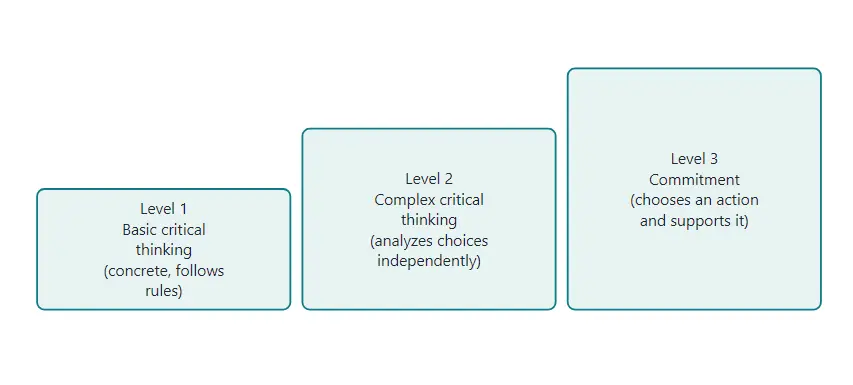
- Level 1, Basic: thinking is concrete and based on a set of rules or principles (typical for students).
- Level 2, Complex: thinkers begin to separate from experts and analyze choices more independently.
- Level 3, Commitment: the nurse chooses an action or belief based on the alternatives and supports it.
Critical thinking competencies
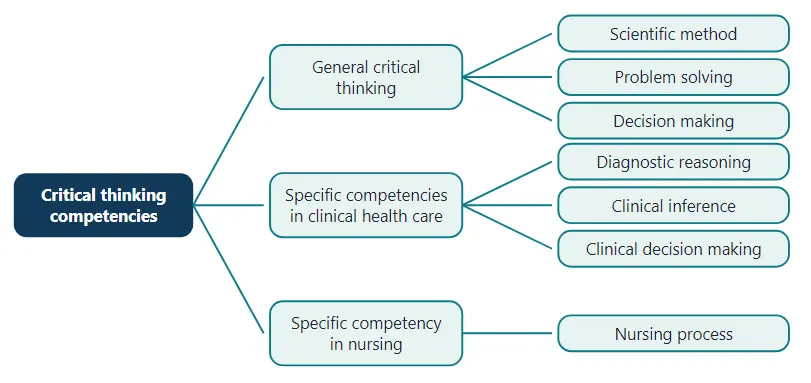
A. General critical thinking:
- Scientific method: a systematic, ordered process to solve problems using reasoning.
- Problem solving: defining a problem, finding its cause, identifying, prioritizing and selecting alternatives, and implementing a solution.
- Decision making: a product of critical thinking that focuses on problem resolution.
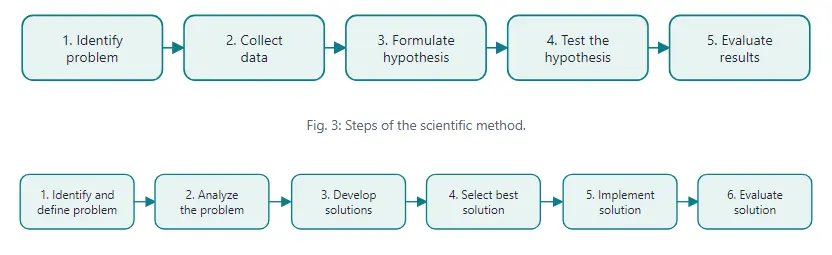
B. Specific competencies in clinical health care: diagnostic reasoning (analytical process for determining a patient’s health problems, starting when the nurse interacts with the patient and makes physical or behavioural observations), clinical inference (drawing conclusions from related pieces of evidence and previous experience) and clinical decision making (a problem-solving activity of defining a problem and selecting an appropriate action).
C. Specific competency in nursing: the nursing process, a systematic problem-solving process that guides all nursing actions and gives goal-directed, patient-centred care.
The Nursing Process: Overview
Nursing process was first developed by Ida Jean Orlando in 1958. It is a dynamic and systematic process to provide nursing care, operated through five interrelated steps: assessment, diagnosis, planning, implementation and evaluation.
American Nurses Association (2010): “a critical thinking process that professional nurses use to apply the best available evidence to caregiving and promoting human functions and responses to health and illness.
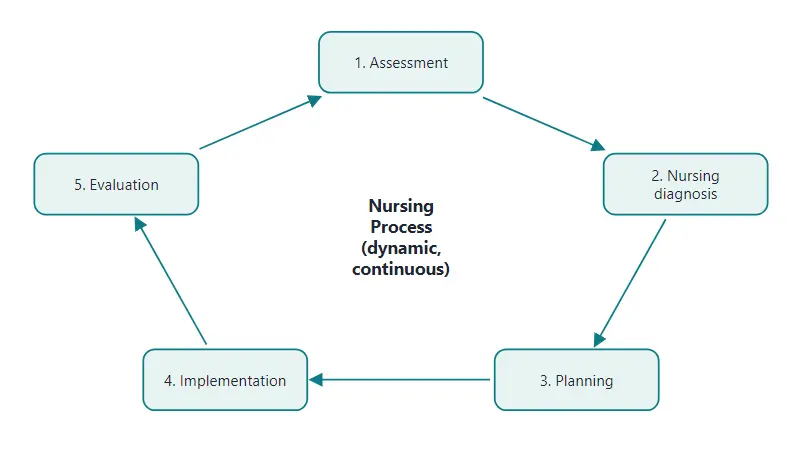
Characteristics of the nursing process
| Characteristic | Meaning |
|---|---|
| Legal scope | Practising nursing independently to solve the patient’s problem, with understanding of legal responsibility. |
| Based on knowledge | Critical thinking is involved and the process rests on a body of knowledge. |
| Planned | Organized, orderly and systematic. |
| Client-centred | Care is planned around that particular patient, who takes an active part. |
| Goal-directed | The nurse works with the client to develop goals and outcomes. |
| Prioritized | Focuses first on serious health or risk factors. |
| Dynamic | Constant changes in health status need evaluation, data collection and revaluation. |
Note: some textbooks credit other nurse theorists (such as Lydia Hall, Johnson and Wiedenbach) for the early use of the term. For your exam, follow your textbook: Orlando, 1958.
3. Step 1: Nursing Assessment
Nursing assessment is the continuous and systematic collection, organization, validation, analysis, documentation and communication of patient data, compared against a standard or norm. It is the first step and continues through all phases of the nursing process.
Purposes of nursing assessment
- Collect baseline data about the patient’s health condition.
- Form a picture of health status and the patient’s ability to manage self-care needs.
- Identify the need for nursing care.
- Plan thoughtful, person-centred nursing care.
- Deliver care that draws on the patient’s strengths and promotes maximum functioning, independence and well-being.
- Refer the patient to another provider if required.
- Monitor the effectiveness of the nursing care given.
- Alert the nurse to changes in the patient’s response so that the care plan can be changed.
Types of nursing assessment
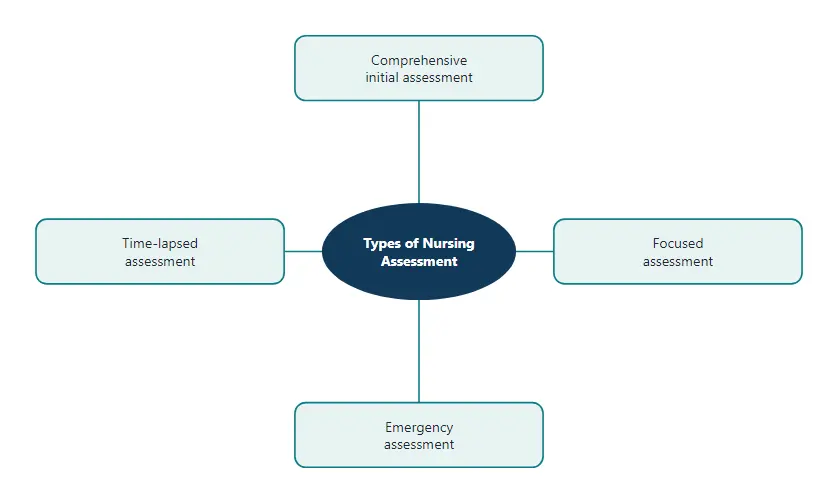
| Type | Meaning |
|---|---|
| Comprehensive initial assessment | Carried out shortly after admission to a health care facility. |
| Focused assessment | Data about a specific health problem that has already been identified. |
| Emergency assessment | A quick and specific assessment in acute conditions. |
| Time-lapsed assessment | Done after some time to compare the current health status with baseline data obtained earlier. |
Characteristics of good assessment: purposeful, complete, prioritized, systematic, factual, accurate, relevant and properly documented.
Types of data
| Area | Objective data | Subjective data |
|---|---|---|
| Other name | Overt data, signs | Covert data, symptoms |
| Meaning | Measurable and observable data seen, heard, felt or measured by someone other than the person experiencing them. | Information from the patient’s point of view: feelings, perceptions and concerns, elicited and verified by the client. |
| Sources | Nurse’s observation and physical assessment, client records, observations by family | Patient, family and significant others, patient record, other health professionals |
| Method | Observation and physical examination | Patient interview |
| Skills needed | Inspection, palpation, percussion, auscultation | Interview and therapeutic communication, caring attitude, empathy, listening |
| Verification | Can be observed, detected, tested or measured against an accepted standard | Cannot be measured or verified; only described by the person experiencing it |
| Example | Weight 100 kg on 9/18/19 and 90 kg on 2/4/20; posterior left mid-calf is warm and red | “My leg hurts when I walk.” “I feel better about myself now that I’m losing weight.” |
Sources of data
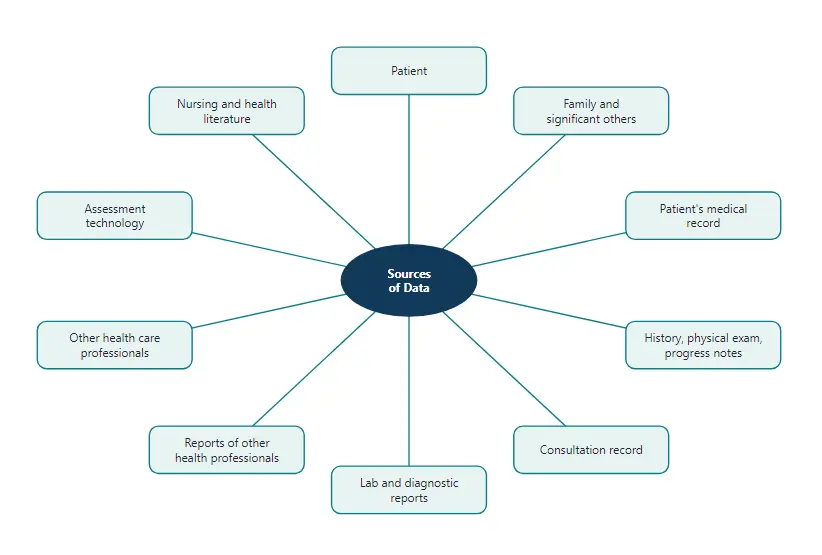
Methods of data collection
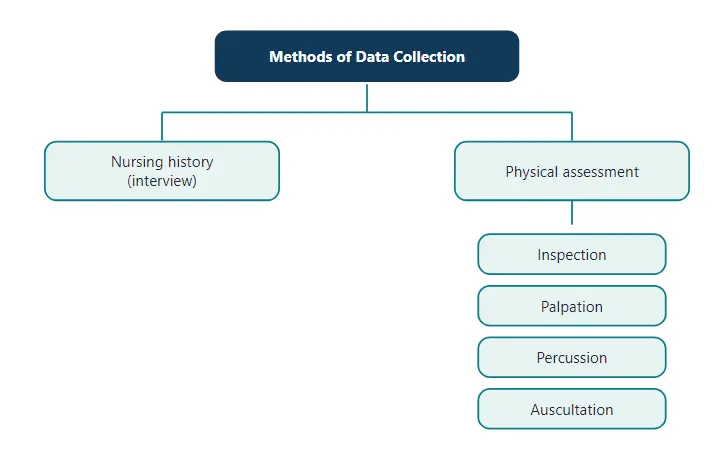
Nursing history (interview): The nurse obtains the nursing history as soon as possible after the patient presents for care and follows it with the physical assessment. Strong interviewing skills are needed to build a working relationship with the patient and to get essential data.
Components of the health history: patient profile (name, age, sex, race, marital status, religion, occupation, education); reason for seeking health care; health literacy and communication skills; usual health habits; cultural considerations; current health status; past health history; current medicines and allergies; immunization record and exposure to communicable diseases; perception of health and illness and coping patterns; developmental history; family history; environmental history; psychosocial history; financial income and work pattern; expectations of nursing care; educational needs; advance directives; personal strengths and deficits; and potential for injury.
Physical assessment: examination of all body systems in an orderly manner, usually head-to-toe or body system-wise, using four methods: inspection, palpation, percussion and auscultation (IPPA).
Organizing data
- Gordon’s framework (1994) has 11 functional health patterns: health perception and management, nutritional-metabolic, elimination, activity-exercise, sleep-rest, cognitive-perceptual, self-perception and self-concept, role-relationship, sexuality-reproductive, coping and stress tolerance, and value-belief. (The 11 names are added from standard sources.)
- Maslow’s hierarchy of needs is the other common holistic model: physiological, safety, love and belonging, esteem, self-actualization.
- The medical model organizes data by body systems and physiological problems, but neglects psychosocial and spiritual strengths and problems.
Validating and documenting data
Validation: data must be verified when there are discrepancies, for example a patient says he is fine but looks uncomfortable, guards his abdomen and has abdominal rigidity. Data are also verified when they lack objectivity or look suspicious, for example if hearing seems reduced in the left ear, test both ears.
Documentation: an essential part of assessment. It allows communication among health professionals.
Problems related to data collection
- Inappropriate organization; pertinent data omitted.
- Irrelevant or duplicate data collected; erroneous or misinterpreted data.
- Failure to establish rapport; failure to update the database.
- Recording interpretation of data instead of observed behaviour.
Step 2: Nursing Diagnosis
Diagnosing is the second step. Its purposes are to identify how a person, group or community responds to actual or potential health and life processes; to identify factors that cause health problems; and to identify resources the person can use to prevent or solve problems.
NANDA definition: “Nursing diagnosis is a clinical judgment about individual, family or community responses to actual and potential health/life processes. Nursing diagnosis provides the basis for selection of nursing interventions to achieve outcomes for which the nurse is accountable.”
Types of nursing diagnoses
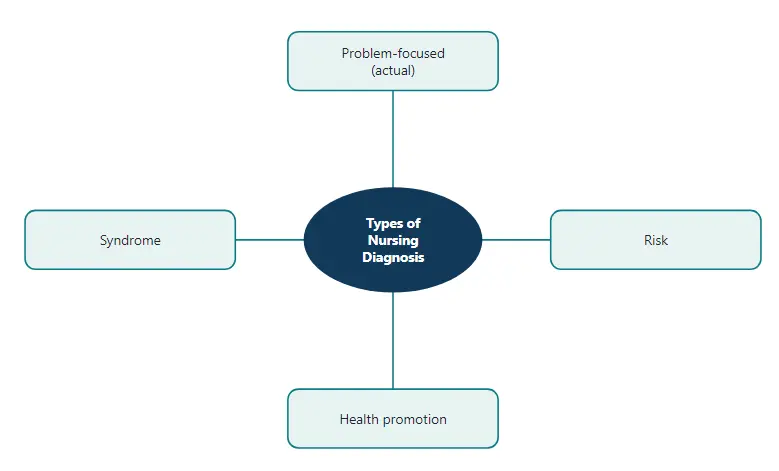
| Type | Meaning |
|---|---|
| Problem-focused (actual) | A clinical judgment about an undesirable human response that already exists. Four components: label, definition, defining characteristics, related factor. |
| Risk | A clinical judgment about vulnerability to develop an undesirable response to a health condition or life process. |
| Health promotion | A clinical judgment about the desire and motivation to increase well-being and actualize health potential, expressed as readiness to enhance specific health behaviours. Can be used in any health state. |
| Syndrome | A specific cluster of nursing diagnoses that occur together and are best addressed together through similar interventions. |
Difference between medical and nursing diagnosis (added from standard sources)
| Medical diagnosis | Nursing diagnosis |
|---|---|
| Identifies the disease or pathology. | Identifies the patient’s response to the illness. |
| Made by the physician. | Made by the nurse. |
| Remains the same until the disease is cured. | Changes as the patient’s responses change. |
| Directs medical treatment (medicines, surgery). | Directs nursing interventions. |
| Example: Diabetes mellitus. | Example: Deficient knowledge about insulin administration. |
Components of a nursing diagnosis statement

| Component | Definition | Example |
|---|---|---|
| Problem | What is unhealthy, showing the need for change (clear and concise). | Self-care deficit |
| Etiology | Factors maintaining the unhealthy state (contributing or causative factors). | Related to (R/T) fear of falling in the bathroom and obesity |
| Defining characteristics | Subjective and objective data (cues) showing the problem exists. | As evidenced by (AEB) strong body odour, unclean hair, weight 98 kg and patient’s statement of being afraid of falling |
Full example: Self-care deficit (bathing) related to fear of falling in the bathroom and obesity, as evidenced by strong body odour, unclean hair, weight 98 kg and the patient’s statement of being afraid of falling.
Guidelines for writing nursing diagnoses
- Phrase it as a patient problem or change in health state, not as a patient need.
- The problem comes first, then the etiology, linked by “related to” (R/T).
- Defining characteristics follow the etiology, linked by “as evidenced by” (AEB).
- Use legally advisable terms and nonjudgmental language.
- The problem statement must show what is unhealthy or what the patient wants to change.
- Do not use defining characteristics, medical diagnoses or something that cannot be changed in the problem statement.
- Re-read it to check that the problem suggests patient outcomes and the etiology directs the choice of nursing measures.
Common errors in writing nursing diagnoses
- Writing in terms of a need, not a response.
- Making legally inadvisable statements.
- Calling a healthy response a problem.
- Calling signs and symptoms the problem.
- Choosing a problem or etiology that cannot be changed.
- Identifying environmental factors rather than patient factors.
- Reversing the clauses; having both clauses say the same thing.
- Including value judgments or the medical diagnosis.
Step 3: Planning
After collecting and interpreting data and forming nursing diagnoses, it is time to plan nursing actions. A patient outcome is an expected conclusion to a health problem (or to a health expectation in a wellness diagnosis). The words goal, objective and outcome are often used interchangeably. Sometimes goal or objective means what is wanted, and outcome means what was achieved.
Expected outcome: a specific and measurable criterion used to evaluate the degree to which a goal has been met. The nurse, patient and family should work together as much as possible in this stage.
Types of planning
| Type | Meaning |
|---|---|
| Initial planning | Done with the admission nursing history and physical assessment. A comprehensive plan that addresses each prioritized nursing diagnosis with goals and related nursing care. |
| Ongoing planning | Keeps the plan up to date: stating diagnoses more clearly, developing new diagnoses, making outcomes more realistic, adding new outcomes and finding better interventions. |
| Discharge planning | Best done by the nurse who knows the patient and family most closely, possibly with a social worker. In acute care it begins when the patient is admitted, or even before. |
Steps of planning

Guidelines for establishing goals and expected outcomes
Patient-centred outcomes should be realistic and consider: the patient’s health state and prognosis; expected length of stay; values and cultural considerations; other planned therapies; human, material and financial resources; risks, benefits and scientific evidence; changes in status that need modified outcomes; and family involvement.
Quality outcomes should be safe (avoid injury), effective (avoid overuse and underuse), patient-centred, timely (reduce waits), efficient (avoid waste) and equitable (same quality for all).
| Type of outcome | Meaning |
|---|---|
| Cognitive | Increase in patient knowledge or intellectual behaviours. |
| Psychomotor | Achievement of new skills. |
| Affective | Changes in values, beliefs and attitudes. Hard to write and evaluate but can be critical in complex problems. |
Writing a good outcome statement (added from standard sources)
A well-written outcome has a subject (the patient), an observable verb, a condition, a criterion (how much or how well) and a time. Example: “The patient will demonstrate correct insulin self-injection on an orange before discharge (within 3 days).” A SMART check (Specific, Measurable, Achievable, Realistic, Time-bound) is a useful shortcut.
Common errors in outcomes
- Writing the outcome as a nursing intervention.
- Using verbs that cannot be observed or measured (such as “understand” or “know”).
- Including more than one patient behaviour in a short-term outcome.
- Writing vague outcomes that other nurses cannot understand.
NOC and NIC
- Nursing Outcomes Classification (NOC): one of the standardized languages recognized by the American Nurses Association. A standardized list of expected patient outcomes influenced by nursing care. An outcome is a measurable individual, family or community state, behaviour or perception monitored along a continuum in response to nursing interventions.
- Nursing Interventions Classification (NIC): a research-based, standardized classification of interventions nurses perform, both independent and collaborative, direct and indirect, physiological (for example acid-base management) and psychosocial (for example anxiety reduction).
Nursing interventions
“A nursing intervention is any treatment based upon clinical judgment and knowledge that a nurse performs to enhance patient/client outcomes.” (NIC)

| Type | Description |
|---|---|
| Direct | Performed directly on the patient. |
| Indirect | Performed on behalf of the patient (for example arranging supplies, coordinating with other teams). |
| Nurse-initiated (independent) | The nurse has authority to start without a prescription. |
| Physician-initiated (dependent) | The nurse needs the physician’s prescription to start. |
| Collaborative (interdependent) | Interventions initiated by other health team members such as a physiotherapist, carried out by the nurse with them. |
Selecting appropriate nurse-initiated interventions
Interventions should be valued by patient and family; appropriate to the diagnosis and outcomes, safe and efficient; consistent with research and standards of care; realistic for the time, abilities and resources available; compatible with the patient’s values, beliefs and culture; and compatible with other planned therapies.
Focus of interventions by type of diagnosis
| Diagnosis | Focus |
|---|---|
| Actual | Reduce or eliminate contributing factors; promote higher-level wellness; monitor and evaluate status. |
| Risk | Reduce or eliminate risk factors; prevent the problem; monitor and evaluate status. |
| Possible | Collect more data to rule out or confirm the diagnosis. |
| Collaborative problems | Monitor for changes; manage changes with nurse and physician-prescribed interventions; evaluate response. |
Protocols and standing orders
- Protocols are written plans detailing the nursing interventions to be carried out in specific situations (for example admission or discharge routines, hypoglycemia protocol, chest pain protocol, alcohol withdrawal protocol). They must be ordered by health care providers first, and the nurse then acts “per protocol”.
- Standing orders empower the nurse to start actions that usually need a provider’s order. They are used in urgent or emergency situations (such as an emergency department). They are reviewed and approved yearly, and the responsible provider (usually the attending physician) signs them at the time or as soon as possible after execution. Example: a patient suddenly develops chest pain and the nurse follows the chest pain standing orders before consulting, because delay could be harmful.
Nursing care plan (NCP)
The nursing care plan is the written guide that directs the nursing team to meet the patient’s health goals. It lists nursing diagnoses, outcomes and interventions. An ideal plan reflects an effective philosophy of nursing; is prepared by the nurse who best knows the patient; fits the patient’s values and culture; identifies the nursing assistance needed; is based on scientific principles and research; and creates a record for evaluation, research, reimbursement and legal purposes.
| Part of care plan | Content |
|---|---|
| Care related to basic human needs | Usual health habits and patterns from the nursing history (for example whether a toddler is toilet trained and what words he uses). |
| Care related to nursing diagnoses or problems | Outcomes and interventions for every diagnosis and a place to note the patient’s responses. This is the heart of the plan because it is the independent part of nursing. |
| Care related to the medical and interdisciplinary plan | Current medical orders for diagnostic studies and treatment, and the related nursing care. |
Formats of care plans: computerized care plans (easy access, better documentation, audit and quality assurance); multidisciplinary (collaborative) care plans, which are clinical pathways for case management; concept map care plans (a diagram of patient problems and interventions); change-of-shift reports (to communicate critical patient information); and student care plans (to help students learn the five steps).
Sample nursing care plan (added as a worked example)
| Assessment | Nursing diagnosis | Outcome | Interventions | Evaluation |
|---|---|---|---|---|
| S: “I am afraid of falling.” O: weight 98 kg, strong body odour, unclean hair | Self-care deficit (bathing) related to fear of falling and obesity, AEB body odour, unclean hair and verbal fear | Patient will bathe with minimal help and no fall within 3 days | Provide a shower chair and grab bars; non-slip mat; stay near during the bath; encourage self-bathing; praise efforts | Goal met: bathed with supervision on day 3, no fall. Continue plan or terminate as per outcome. |
Step 4: Implementation
Implementation means carrying out the planned care. The plan works best when patients who are able and willing take part and have maximum opportunity for self-care. Family, support people and other health professionals may also be involved. During implementation the nurse continues to collect data, modifies the plan as needed and documents all activities in the facility’s format.
Focus: while implementing, the nurse keeps using clinical reasoning. Because a patient’s condition can change dramatically in minutes, the nurse assesses for changes that may need different interventions and keeps monitoring the patient’s response so the plan can be modified.
Process of implementing the care plan: reassessing the patient and reviewing the plan of care; using a patient board or whiteboard; clarifying prerequisite nursing competencies; and ensuring patient safety.
Implementing guidelines
- Act in partnership with the patient.
- Reassess before acting to check that the action is still needed.
- Approach the patient competently: know how to do the action, why it is done and the possible adverse responses.
- Have all equipment and supplies ready.
- Approach the patient caringly and explain in language the patient understands.
- Modify interventions to the patient’s individual characteristics.
- Make sure interventions follow standards of care and legal and ethical guides.
- Develop a repertoire of skilled nursing interventions.
Types of care: direct care is done directly on the patient; indirect care is done on behalf of the patient, away from the bedside.
Step 5: Evaluation
Evaluation is the fifth step, where the nurse and patient together measure how well the patient has achieved the outcomes in the care plan. Its purpose is to let the patient’s achievement of expected outcomes direct future nurse-patient activities. Based on the patient’s responses, the nurse decides to:
- Terminate the care plan when each expected outcome is met.
- Modify the plan if there are difficulties in meeting outcomes.
- Continue the plan if more time is needed.
Types of evaluation
| Basis | Type | Meaning |
|---|---|---|
| When care is evaluated | Concurrent | While the patient is receiving care. |
| Retrospective | After the patient has been discharged. | |
| Time criteria | Ongoing | After each day or task, to find any deviation from the plan. |
| Intermittent | At specific intervals. | |
| Summative | At the end of the task. |
Process of evaluation

Modifying the care plan
After finding the factors that stopped outcomes from being met, revisions may include: deleting or modifying the nursing diagnosis; making the outcome more realistic; increasing the complexity of the outcome; adjusting time criteria; and changing the nursing interventions. Reassessment after each intervention is important because it tells you whether the intervention worked and whether the patient’s condition has changed.
Chapter Focus Points
- The nursing process (Orlando, 1958) is a systematic, critical-thinking, patient-centred, goal-oriented, evidence-based approach to care.
- Assessment is the first and continuous step: subjective and objective data.
- Diagnosis identifies the problem and the patient’s strengths and weaknesses.
- Planning: set priorities, write expected outcomes, select evidence-based interventions, communicate the care plan.
- Implementation: delegation and execution of the plan.
- Evaluation: feedback on the whole process, ongoing, intermittent or summative, against protocols and standards. The care plan may be modified on new assessment data.
Mnemonic for the steps: ADPIE
Assessment, Diagnosis, Planning, Implementation, Evaluation.
Your outline also lists “Nursing process format: INC”. The slides do not give a separate INC format, so use the five-step format above and follow your college’s care plan format in practice.
The Nursing Process MCQs (BSc Nursing, 1st Semester, Nursing Foundation, Chapter 7)
Q1. The nursing process was first developed by:
- Florence Nightingale
- Ida Jean Orlando (1958)
- Virginia Henderson
- Dorothea Orem
Answer: B. As per the textbook.
Q2. How many steps does the nursing process have?
- Three
- Four
- Five
- Six
Answer: C. Assessment, diagnosis, planning, implementation, evaluation.
Q3. The first step of the nursing process is:
- Diagnosis
- Assessment
- Planning
- Evaluation
Answer: B. It is also continuous through all phases.
Q4. ‘Thinking like a nurse’ was first introduced in 2006 by:
- Dr Christine Tanner
- Dr Rega
- Dr Orlando
- Dr Gordon
Answer: A. Concept of critical thinking and clinical reasoning.
Q5. Which critical thinking attitude means understanding another person’s perspective correctly?
- Integrity
- Empathy
- Inference
- Self-regulation
Answer: B. Empathy.
Q6. Reflecting on your experience to improve your performance is:
- Self-regulation
- Explanation
- Integrity
- Inference
Answer: A. Also asks what will make you believe you were successful.
Q7. Level 3 of critical thinking is:
- Basic
- Complex
- Commitment
- Concrete
Answer: C. The nurse chooses an action based on alternatives and supports it.
Q8. Which is the first step of the scientific method?
- Data collection
- Identification of problem
- Hypothesis
- Evaluation
Answer: B. Then data collection, hypothesis, testing, evaluating results.
Q9. Which is the specific critical thinking competency in nursing?
- Scientific method
- Problem solving
- Nursing process
- Decision making
Answer: C. The nursing process is a systematic problem-solving process.
Q10. A nursing process characteristic meaning ‘focus on more serious health problems first’ is:
- Dynamic
- Prioritized
- Planned
- Goal-directed
Answer: B. Also: legal scope, knowledge-based, client-centred.
Q11. An assessment done shortly after admission is a:
- Focused assessment
- Comprehensive initial assessment
- Emergency assessment
- Time-lapsed assessment
Answer: B. Baseline data.
Q12. Comparing current health status with baseline data is:
- Focused assessment
- Emergency assessment
- Time-lapsed assessment
- Initial assessment
Answer: C. Performed at a later time.
Q13. Subjective data are also called:
- Signs or overt data
- Symptoms or covert data
- Lab values
- Vital signs
Answer: B. Objective data are signs or overt data.
Q14. ‘My leg hurts when I walk’ is:
- Objective data
- Subjective data
- Diagnostic data
- Secondary data
Answer: B. Only the patient can describe it.
Q15. Which is objective data?
- Pain described by the patient
- Weight 90 kg
- Feeling tired
- Feeling anxious
Answer: B. It can be measured.
Q16. Which skill is used to collect objective data?
- Inspection
- Interview
- Empathy only
- Listening only
Answer: A. Also palpation, percussion, auscultation.
Q17. Which are the four methods of physical assessment?
- Inspection, palpation, percussion, auscultation
- Interview, listening, reading, writing
- Weight, height, BP, pulse
- Look, ask, wait, note
Answer: A. IPPA.
Q18. Gordon’s framework has how many functional health patterns?
- 5
- 7
- 11
- 14
Answer: C. Gordon (1994).
Q19. Data need validation when:
- There are discrepancies
- The patient is asleep
- Data are normal
- Visitors arrive
Answer: A. Also when data lack objectivity or seem suspicious.
Q20. Nursing diagnosis is defined by:
- NANDA
- WHO
- INC
- ICN
Answer: A. A clinical judgment about responses to actual and potential health problems.
Q21. A diagnosis about vulnerability to develop a problem is a:
- Problem-focused diagnosis
- Risk nursing diagnosis
- Syndrome
- Health promotion diagnosis
Answer: B. No signs and symptoms are present yet.
Q22. Which diagnosis has four components: label, definition, defining characteristics, related factor?
- Risk
- Problem-focused
- Health promotion
- Possible
Answer: B. Actual diagnosis.
Q23. In a nursing diagnosis statement, ‘R/T’ means:
- Related to
- Rule to
- Report to
- Reason total
Answer: A. It links the problem and the etiology.
Q24. ‘AEB’ in a nursing diagnosis means:
- As evidenced by
- And then evaluate
- After eating breakfast
- As evaluated by
Answer: A. Links to defining characteristics.
Q25. Which is a common error in writing nursing diagnosis?
- Including a medical diagnosis in the statement
- Using nonjudgmental language
- Using R/T
- Stating a patient problem
Answer: A. Others: writing as a need, reversing clauses.
Q26. An expected outcome is best described as:
- Specific and measurable criteria to evaluate a goal
- A medical order
- A guess
- A nursing diagnosis
Answer: A. As per the chapter.
Q27. Increase in patient knowledge is which type of outcome?
- Cognitive
- Psychomotor
- Affective
- Physical
Answer: A. Psychomotor is a new skill; affective is values and attitudes.
Q28. Interventions done directly on the patient are:
- Indirect
- Direct
- Collaborative
- Dependent
Answer: B. Indirect ones are on behalf of the patient.
Q29. Another name for nurse-initiated intervention is:
- Dependent
- Independent
- Interdependent
- Collaborative
Answer: B. The nurse needs no prescription.
Q30. Physician-initiated interventions are also called:
- Independent
- Dependent
- Interdependent
- Indirect
Answer: B. The nurse needs a prescription.
Q31. Interventions carried out with other team members, like physiotherapists, are:
- Independent
- Dependent
- Interdependent (collaborative)
- Indirect
Answer: C. As per the chapter.
Q32. Standing orders are used mainly in:
- Urgent or emergent situations
- Routine discharge
- Admission billing
- Visiting hours
Answer: A. Example: chest pain standing order.
Q33. The ‘heart’ of the nursing care plan is the section on:
- Basic human needs
- Nursing diagnosis/problem with outcomes and interventions
- Medical orders
- Billing
Answer: B. It shows the independent component of nursing.
Q34. Before implementing an action, the nurse should first:
- Reassess the patient
- Discharge the patient
- Skip documentation
- Call the cashier
Answer: A. To see whether the action is still needed.
Q35. Which evaluation is done after discharge?
- Concurrent
- Retrospective
- Ongoing
- Intermittent
Answer: B. Concurrent is done while the patient receives care.
Q36. When expected outcomes are all met, the nurse should:
- Terminate the care plan
- Modify the plan
- Continue the plan
- Restart assessment only
Answer: A. Modify if there are difficulties; continue if more time is needed.
Q37. Evaluation done at the end of the task is:
- Ongoing
- Intermittent
- Summative
- Concurrent
Answer: C. Ongoing is after each day or task.
Nursing Process BSc Nursing, 1st Semester, Nursing Foundation Important Questions as per INC Syllabus Pattern
Long answer questions (10 to 15 marks)
- Define the nursing process. Explain its steps with the characteristics and advantages.
- Describe nursing assessment: types, data collection methods and sources of data.
- Define nursing diagnosis. Explain its types and how to write a nursing diagnosis statement.
- Describe the planning step: types of planning, priorities, goals and outcomes, interventions.
- Explain implementation and evaluation in the nursing process.
- Discuss critical thinking in nursing and its relation to the nursing process.
- Write a nursing care plan for a patient (give the example from your clinical posting).
Short answer questions (5 marks)
- Characteristics of the nursing process
- Differentiate objective and subjective data
- Types of nursing assessment
- Differentiate medical and nursing diagnosis
- Components of a nursing diagnosis statement (PES)
- Types of nursing diagnosis
- Types of nursing interventions
- Protocols and standing orders
- NANDA, NIC and NOC
- Types of evaluation
- Attitudes for critical thinking
- Levels of critical thinking
Very short answer questions (2 marks)
- Define the nursing process.
- Define nursing diagnosis (NANDA).
- Define critical thinking.
- What are signs and symptoms?
- Name the four methods of physical assessment.
- What is a risk nursing diagnosis?
- Expand R/T and AEB.
- Define expected outcome.
- What is a nursing care plan?
- Differentiate concurrent and retrospective evaluation.
Also read:
CHAPTER 1: Introduction to Health and Illness, Nursing Foundation Unit 1 Notes PDF
CHAPTER 2: Health Care Delivery System, Nursing Foundation Unit 2 BSc Nursing Notes
Chapter 3: Nursing as a Profession and History of Nursing in India: BSc Nursing 1st Semester Notes (Nursing Foundation)
CHAPTER 4: Hospital Admission and Discharge: Complete BSc Nursing Notes | 1st Semester Notes (Nursing Foundation)
CHAPTER 5: Communication and Nurse Patient Relationship: Complete Notes | BSc Nursing 1st Semester Notes (Nursing Foundation)
Chapter 6: Patient Education in Nursing: Notes for BSc Nursing 1st Semester, Nursing Foundation Notes with MCQs & Important Questions