
A patient spends only a few days in hospital but lives with the disease for months or years. What happens at home depends on what the patient knows and can do. That is why teaching the patient is one of the most important duties of a nurse. In this chapter we study the meaning, concept, purposes and importance of patient education, the ASSURE model of the education process, the nurse’s role, and how teaching is built into every step of the nursing process.
Learning objectives: define patient education; understand its concept, purposes and importance; explain the process of patient education; describe the role of the nurse in patient education; and explain how to integrate patient teaching in the nursing process.
Introduction
“Patient education starts with disease oriented patient education (DOPE) to prevention oriented patient education (POPE) and ultimately health oriented patient education (HOPE).” (Grueninger, 1995)
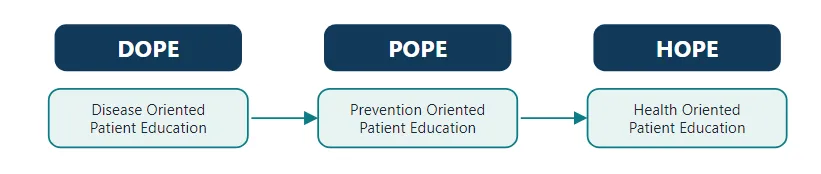
Understanding the three stages:
| Stage | Focus | Example |
|---|---|---|
| DOPE | Teaching about the disease that has already occurred. | Explaining what diabetes is and how to take insulin. |
| POPE | Teaching how to prevent complications or new disease. | Foot care to prevent a diabetic ulcer. |
| HOPE | Teaching to improve overall health and a healthy lifestyle. | Diet, exercise, stress management for lifelong wellness. |
Note: the examples above are added by the author to help you understand. The slides give only the definition.
Quick recall: Aspects of nursing care (from Chapter 3)
Patient education supports all four aspects of holistic care: physical (bodily care, the most visible need), emotional (empathy and compassion), social (healthy relationships, no prejudice) and spiritual (support for faith, coping with illness, loss or pain). When a nurse teaches, she addresses the patient’s fears and beliefs as well as his bodily condition.
Patient Education and Health Education
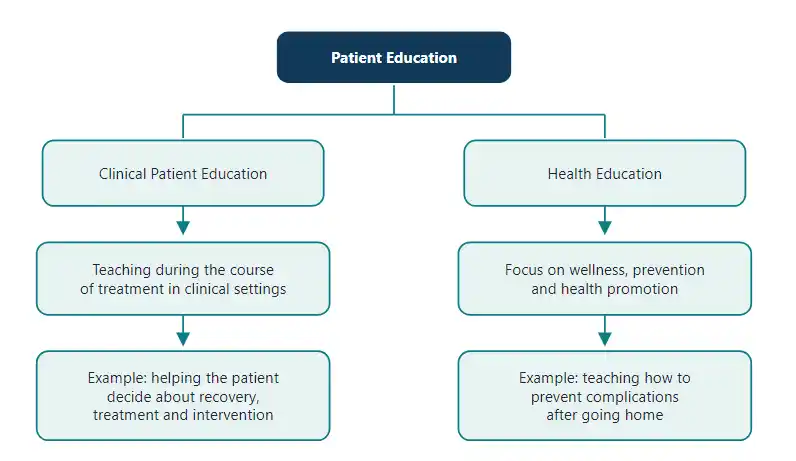
| Clinical patient education | Health education |
|---|---|
| Teaching provided to the patient during the course of treatment in clinical settings. | Also involves teaching and learning, but mainly focuses on wellness, prevention and health promotion. |
| A continuous teaching-learning process involving the health team and the patient (including family). | Given as additional information. |
| Focus is the patient’s assessment, diagnosis, treatment, prognosis and meeting the patient’s needs. | Addresses general needs such as prevention of illness and promotion of wellness; focuses on social health behaviour change. |
| Aim: to help the patient in decision making related to recovery, treatment and intervention choices. | Explanation by a health team member is not mandatory; can be given through printed material or role plays. |
| Example: helping the patient decide about treatment options. | Example: health teaching on prevention of complications after going home. |
Exam tip: In a “difference” question, always write both columns side by side and add one example for each. Remember: Clinical = treatment, decision making. Health = wellness, prevention.
Concept and Importance of Patient Education
- Patient education has always been considered part of competent nursing care. The role of the nurse as an educator has grown along with the nursing profession.
- As early as 1918, the National League of Nursing Education in the US identified the importance of patient education and recognized that nurses can act as agents for promotion of health and prevention of illness.
- This is why today “Nurse Educator” is a certified course, which raises the visibility and status of the nurse educator role as a separate discipline.
Why is it important? (Teacher’s explanation) An informed patient takes medicines on time, notices warning signs early, avoids complications, goes for follow-up, and trusts the health team. The hospital benefits from shorter stay and fewer readmissions, and the family feels confident to care at home.
Purposes of Patient Education
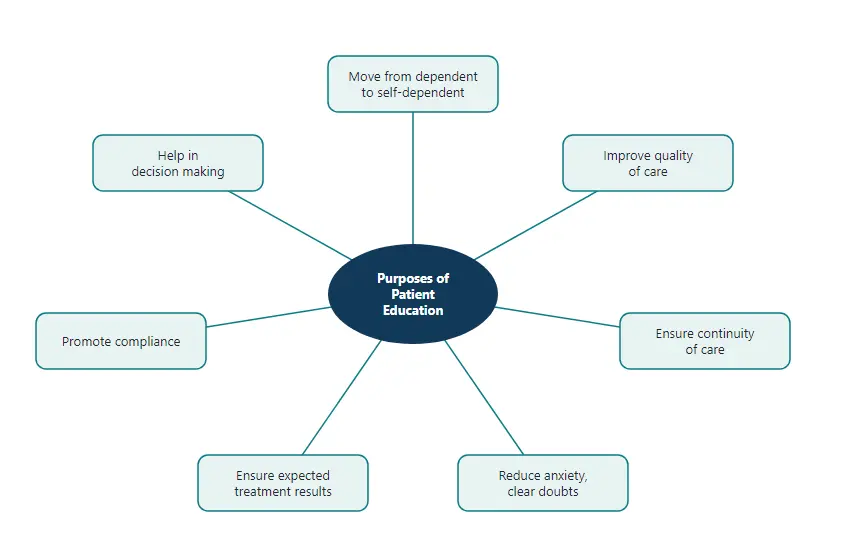
- To move the patient from fully dependent to self-dependent, so that he is ready for self-care and can resume the routine of life.
- Improve the quality of care.
- Ensure continuity of care.
- Reduce anxiety and clear the doubts of the patient.
- Ensure the expected results of treatment through patient education and participation.
- Promote compliance to treatment therapy or intervention.
- Help the patient in decision making.
Patient Education Process
The patient education process is a systematic, sequential, planned course of action consisting of two major components, teaching and learning, leading to the best decision making. The participants are the health team members and the patient. The nurse has the main responsibility for imparting patient education, together with the patient.
Rega’s ASSURE paradigm (1993)
Rega gave a paradigm to help nurses impart patient education. The acronym ASSURE stands for:
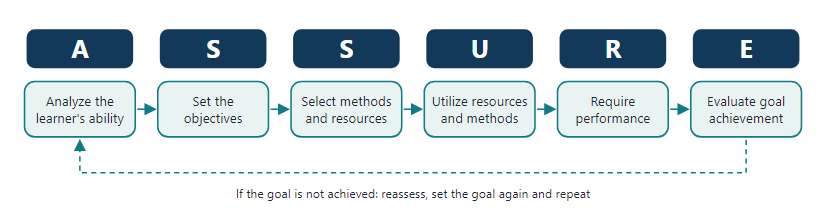
| Step | Nurse’s role | Patient’s role |
|---|---|---|
| Analyze the learner’s ability | Be open and free from prejudice so that the patient’s strengths and weaknesses can be identified. | Verbalizes doubts and anxiety. |
| Set the objectives | The nurse-patient relationship plays a role; a mutual agreement occurs. | Dependent role. |
| Select methods of teaching and resources | Explore learning options such as demonstration, showing a video, or meeting a patient who has learned the skill. | Partially dependent; involved in decision making about how to learn. |
| Utilize resources and methods | Active supportive role and act of teaching; instructional media are used to help the patient develop skills or learn what is intended. | Partially dependent; overcomes anxiety and fears and learns. |
| Require performance of the learner | Passive yet supportive role; lets the patient try what is learned. | Self-dependent; tries what is learned under nurse’s supervision and gains confidence (may need some help). |
| Evaluate goal achievement | Evaluates whether the goal is achieved. If not, the goal is set again mutually; if achieved, the process is terminated. | Independent; able to perform without assistance. |
Teacher’s note: Notice how the patient moves from dependent to independent across the six steps. This is exactly the main purpose of patient education.
Clinical example: diabetic patient learning insulin administration (ASSURE)
| Step | What happens |
|---|---|
| A | The patient is diabetic and does not know how to give insulin at home. The nurse checks whether the patient (or a relative) has the ability to learn and assesses cognitive abilities. |
| S | Goal: self-administration of insulin. |
| S | Nurse and patient decide together how much time learning will take and how it will be done. |
| U | First the nurse shows a video, then demonstrates on a model or patient, then asks the patient to handle the syringe and practise on an orange. |
| R | The patient first performs insulin administration on the orange, then tries on himself. |
| E | The nurse assesses the skill. If adequate, patient teaching is terminated. If not, feedback is analysed and the whole process is repeated. |
Note: the slide title calls this a “clinical example of health education”, but it is really an example of clinical patient education.
Role of the Nurse in Patient Education
The nurse should make learning participatory, with an approach to help. As a facilitator, she follows a learner-centred approach, which makes patient education effective. She should use innovative styles to make education acceptable and long-lasting, include education in holistic care (an empowered patient follows treatment better and avoids complications), clear doubts to improve patient satisfaction, and use interactive teaching to make the patient aware of his own responsibility in recovery.
| Role | Description |
|---|---|
| Helper | Always available. Patients and relatives consider the nurse the right source of information. |
| Facilitator | Teaching and learning go hand in hand and need a conducive environment. The nurse facilitates learning using resources and the patient’s participation. |
| Communicator | Not just a traditional information giver. The shift from teacher-centred to learner-centred approach is a must. Adopt innovative methods to suit the patient’s learning ability and style. |
| Care coordinator | Nurses give holistic care, so teaching is a unique part of the profession. Nurses are consistently available, so they can coordinate care and support the patient towards optimal health. |
| Teacher | The role is not primarily to teach, but to promote learning using the process above, effective communication techniques and a good nurse-patient relationship. |
Integrating Patient Education in the Nursing Process
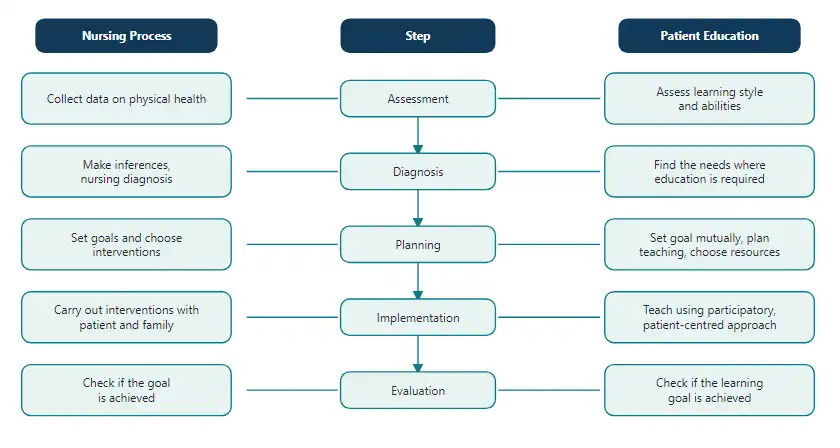
| Step | How patient education is integrated |
|---|---|
| Assessment | The first step of the nursing process. Here the patient’s ability to learn, limitations and learning style are identified. This is the first step of patient education. |
| Diagnosis | All assessment is reviewed and a nursing diagnosis is made on unmet needs. The area of patient education is identified and added to the plan of care. |
| Planning | Goals for patient care are set, and with the patient the nurse sets patient education goals. She also decides how the education will be given and what resources are needed for imparting knowledge and skill. |
| Implementation | The planned activities are carried out and resources are actually used. Example: while giving skin care, the nurse can interact and teach, but the information must suit the situation. |
| Evaluation | Check whether the set goal is achieved. If not, give feedback, reassess, set the goal again, implement and teach again. If achieved, patient education and the nurse-patient relationship are terminated. |
Extra Points for Better Understanding (Added from Standard Nursing Sources)
These points are not in the chapter slides, but they help in exams and in practice.
- Domains of learning: cognitive (knowledge, “head”), affective (attitude, “heart”) and psychomotor (skills, “hand”). Teach all three.
- Common teaching methods: individual teaching, demonstration and return demonstration, group discussion, role play, video or audio-visual aids, and printed leaflets or posters.
- Teach-back method: ask the patient to explain or show in his own words what he has learned. It is a simple way to check understanding.
- Factors affecting learning: readiness, anxiety, pain, age, education level, language, culture, vision or hearing problems, and family support.
- Documentation: always record what was taught, who was taught, the method used and the patient’s response.
Chapter Summary
- Patient education is a process of assisting patients to learn health-related activities and knowledge, helping them gain self-dependence in everyday life.
- It has two parts: clinical patient education and health education.
- It is based on cooperative communication, where options are discussed and talks aim at solution and decision making.
- Open communication during education builds a better therapeutic relationship and gives the patient self-dependence.
- The ASSURE model guides the process, and teaching is integrated into every step of the nursing process.
Quick Revision Points
- DOPE, POPE, HOPE (Grueninger, 1995).
- Clinical patient education: treatment and decision making. Health education: wellness and prevention.
- 1918: National League of Nursing Education (US) recognized patient education.
- 7 purposes of patient education.
- ASSURE (Rega, 1993): Analyze, Set objectives, Select methods, Utilize, Require performance, Evaluate.
- Roles of nurse: helper, facilitator, communicator, care coordinator, teacher.
Patient Education in Nursing MCQs (Nursing Foundation)
Q1. Patient education is best described as:
- A process of helping patients learn health-related knowledge and activities
- Giving medicines
- Only discharge advice
- Only billing information
Answer: A. It helps patients gain self-dependence in daily life.
Q2. DOPE stands for:
- Disease Oriented Patient Education
- Drug Oriented Patient Education
- Diet Oriented Patient Education
- Doctor Oriented Patient Education
Answer: A. Grueninger, 1995.
Q3. POPE stands for:
- Prevention Oriented Patient Education
- Practice Oriented Patient Education
- Procedure Oriented Patient Education
- Policy Oriented Patient Education
Answer: A. The second stage after DOPE.
Q4. The final stage of patient education as per Grueninger is:
- DOPE
- POPE
- HOPE
- COPE
Answer: C. Health Oriented Patient Education.
Q5. Teaching given during the course of treatment in clinical settings is:
- Health education
- Clinical patient education
- Mass education
- Informal education
Answer: B. Its aim is to help in decision making about recovery and treatment.
Q6. Which focuses mainly on wellness, prevention and health promotion?
- Clinical patient education
- Health education
- Discharge summary
- Triage
Answer: B. It can be given through printed material or role plays.
Q7. Which of these is mandatory for clinical patient education but not for health education?
- Explanation by a health team member
- Printed material
- Role play
- Poster
Answer: A. Health education may be given without a direct explanation.
Q8. In which year did the National League of Nursing Education (US) identify the importance of patient education?
- 1818
- 1918
- 1968
- 2008
Answer: B. Nurses were recognized as agents of health promotion and illness prevention.
Q9. Which is a purpose of patient education?
- Move the patient from dependent to self-dependent
- Increase hospital stay
- Increase bill
- Avoid questions
Answer: A. Others: quality, continuity, reduce anxiety, compliance, decision making.
Q10. Patient education process has two major components:
- Teaching and learning
- Admission and discharge
- Assessment and billing
- Input and output
Answer: A. It is systematic, sequential and planned.
Q11. Who has the main responsibility for imparting patient education?
- Housekeeping staff
- Nurse
- Cashier
- Security guard
Answer: B. Along with other health team members and the patient.
Q12. The ASSURE paradigm was given by:
- Rega (1993)
- Grueninger (1995)
- Henderson
- Travelbee
Answer: A. It assists nurses in imparting patient education.
Q13. In ASSURE, the first ‘A’ stands for:
- Assess the disease
- Analyze the learner’s ability
- Apply medicine
- Administer
Answer: B. Identify the patient’s strengths and weaknesses.
Q14. In ASSURE, the first ‘S’ stands for:
- Select methods
- Set the objectives
- Summarize
- Supervise
Answer: B. The second ‘S’ is Select methods of teaching and resources.
Q15. In ASSURE, ‘U’ stands for:
- Understand
- Utilize resources and methods
- Update
- Unite
Answer: B. Teaching media is used actively.
Q16. In ASSURE, ‘R’ stands for:
- Record
- Require performance of the learner
- Report
- Review
Answer: B. The patient tries what is learned.
Q17. In ASSURE, ‘E’ stands for:
- Educate
- Evaluate the goal achievement
- Examine
- Enter
Answer: B. If not achieved, go back to analyze.Q18. If the learning goal is NOT achieved in ASSURE, the nurse should:
- Terminate teaching
- Go back to analysis and repeat the process
- Discharge the patient
- Ignore it
Answer: B. Set the goal again mutually.
Q19. In the ‘Require performance’ step the nurse plays a:
- Passive yet supportive role
- Dominant role
- No role
- Punishing role
Answer: A. The patient tries what is learned.
Q20. In the clinical example, the diabetic patient learns insulin injection first on:
- An orange
- A banana
- The nurse
- A pillow
Answer: A. Then tries on himself, as per the slide.
Q21. Patient education is integrated into which step of the nursing process first?
- Evaluation
- Assessment
- Planning
- Implementation
Answer: B. Assess learning ability, limitations and style.
Q22. Teaching about skin care while giving skin care is an example of integrating teaching in:
- Diagnosis
- Planning
- Implementation
- Evaluation
Answer: C. Use the opportunity during care.
Q23. The shift required in patient education is from teacher-centred to:
- Learner-centred
- Doctor-centred
- Disease-centred
- Hospital-centred
Answer: A. The nurse is a communicator and facilitator.
Q24. The role of the nurse as educator is primarily to:
- Promote learning among patients
- Only deliver lectures
- Only give handouts
- Only test patients
Answer: A. Not primarily to teach but to promote learning.
Q25. When the goal is achieved in evaluation, the nurse:
- Terminates patient education and the NPR
- Repeats everything
- Changes the doctor
- Cancels discharge
Answer: A. Otherwise reassess and repeat.
Patient Education in Nursing Important Questions as per INC Syllabus Pattern
Long answer questions (10 to 15 marks)
- Define patient education. Explain the process of patient education with the ASSURE model.
- Describe the purposes and importance of patient education.
- Discuss the role of the nurse in patient education.
- Explain how patient education is integrated in the nursing process.
Short answer questions (5 marks)
- Difference between clinical patient education and health education
- DOPE, POPE and HOPE
- Purposes of patient education
- ASSURE model with a clinical example
- Role of nurse as facilitator and communicator
- Integrating patient education in assessment and planning
Very short answer questions (2 marks)
- Define patient education.
- Expand ASSURE.
- What is DOPE?
- Name four roles of a nurse in patient education.
- What is the aim of clinical patient education?
- What is learner-centred approach?
- Name two examples of health education.
Also read:
CHAPTER 1: Introduction to Health and Illness, Nursing Foundation Unit 1 Notes PDF
CHAPTER 2: Health Care Delivery System, Nursing Foundation Unit 2 BSc Nursing Notes
Chapter 3: Nursing as a Profession and History of Nursing in India: BSc Nursing 1st Semester Notes (Nursing Foundation)
CHAPTER 4: Hospital Admission and Discharge: Complete BSc Nursing Notes | 1st Semester Notes (Nursing Foundation)
CHAPTER 5: Communication and Nurse Patient Relationship: Complete Notes | BSc Nursing 1st Semester Notes (Nursing Foundation)