
Communication and Nurse Patient Relationship: Good nursing is not only about skills like giving injections or taking blood pressure. It is also about how we talk, listen and connect with patients, families and colleagues. A patient who feels heard shares correct information, trusts the nurse, and follows the treatment better. In this chapter we study communication step by step: its meaning, process, types, barriers, therapeutic techniques, professional communication, and the five phases of the nurse-patient relationship.
Learning objectives: define communication; explain its process and elements; list types and modes; explain factors influencing communication; describe methods and barriers of effective communication; understand professional communication; explain the phases of nurse-patient relationship; and communicate effectively with patients, families and team members.
Meaning of Communication
Communication is a process of generating, exchanging, understanding and transmitting information between two individuals.
Communication is the base of a community, because only through communication do people understand each other properly. In nursing, communication is the tool through which we collect the history, explain treatment, teach, counsel and give emotional support.
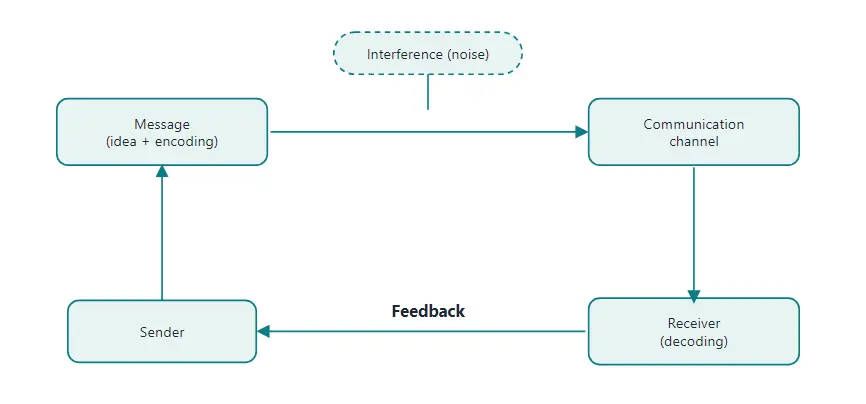
Elements and Process of Communication
| Element | Meaning | Nursing example |
|---|---|---|
| Sender | The person who starts the communication. | Nurse explaining a procedure |
| Message | The idea after encoding (converting an idea into words, signs or symbols). | “We will check your blood sugar now.” |
| Channel | The medium used to send the message. | Spoken words, written chart, phone |
| Receiver | The person who receives and decodes (understands) the message. | The patient |
| Feedback | The receiver’s response that tells the sender whether the message was understood. | Patient says “Yes, I understand” or looks confused |
| Interference (noise) | Anything that disturbs the message: noise, pain, fear, language difference. | A noisy ward |
Exam tip: Draw Fig. 1 in every answer on the process of communication. The cycle is Sender, Message (idea + encoding), Channel, Receiver (decoding), Feedback.
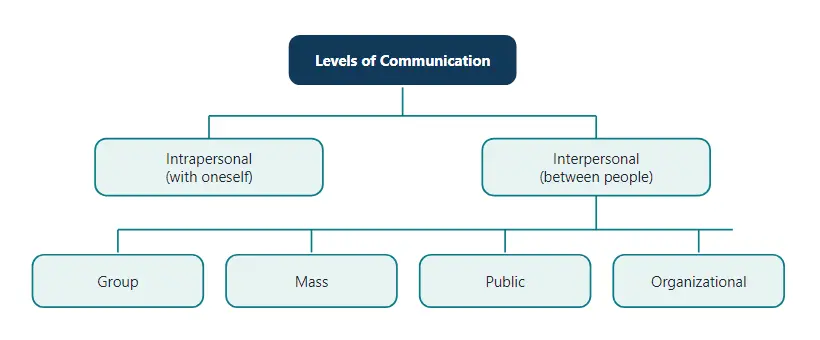
3. Levels of Communication
| Level | Meaning |
|---|---|
| Intrapersonal | Also called self-talk. Example: deciding what to wear. Nurses use it to focus on and improve a positive interaction. |
| Interpersonal | Communication between two or more individuals, always with a goal of exchanging messages. |
| Group | Communication within a small group, such as a ward team meeting. |
| Mass | Communication to a large audience through media such as TV, radio or newspapers. |
| Public | One speaker to a large live audience, such as a health talk at a camp. |
| Organizational | Communication within and between levels of an organization, such as hospital notices and circulars. |
Classification of Communication
A. According to the channel
1. Verbal communication
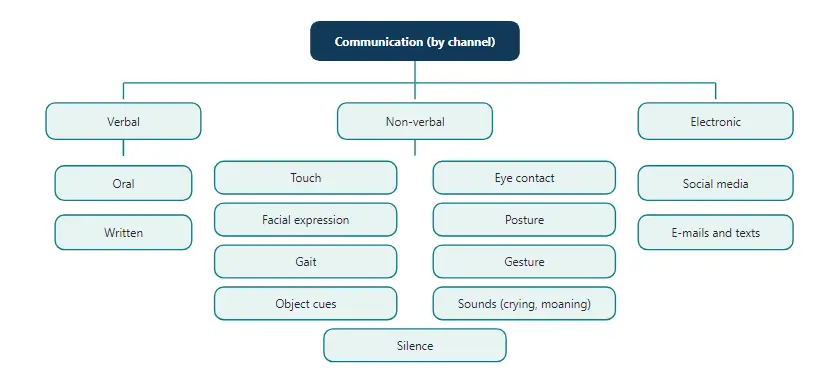
The traditional way of communication where language is the channel. It can be oral (spoken words, word of mouth) or written (letter, memo, report).
| Oral communication | Written communication |
|---|---|
| Advantages: quick feedback is available; allows observation of non-verbal cues too. | Advantages: can be saved, edited and revised many times before sending; helps the receiver understand fully and give proper feedback. |
| Disadvantage: deep thought is usually not involved in encoding the message. | Disadvantages: no immediate feedback; time-consuming and needs writing skills. |
2. Non-verbal communication
Wordless communication, also called body language. Often it tells more than words.
| Type | Description |
|---|---|
| Touch | Use in an appropriate, therapeutic manner. |
| Eye contact | If avoided or not maintained, it signals that the person is not interested in the conversation. |
| Facial expression | Reflects thoughts and feelings, such as a happy person having a pleasant face. |
| Posture | Reflects attitude, such as anxious or confident. |
| Gait | The specific way of walking. A happy person often walks with a bouncy step. |
| Gesture (action cues) | Movement of body parts like hands or face; shows authenticity of the information. |
| Object cues | Patient’s dress, furnishings and possessions. Can change due to illness. |
| Sounds (vocal cues) | Sobbing, crying, moaning and sighing. |
| Silence | Used in a therapeutic manner. |
| Physical appearance | Grooming and dress also send a message. |
3. Electronic communication
- Social media (WhatsApp, Twitter, Facebook): even official information is now exchanged here, but nurses must protect privacy and confidentiality and follow the policies of the governing body.
- E-mails and texts: effective within an organization. Keep them specific and concise and maintain the professional code of conduct.
B. According to style and purpose
| Formal communication | Informal communication |
|---|---|
| Follows rules and principles; official style; used in professional settings; slang and jargon are prohibited. Flows through official channels. | Does not follow authority lines; casual exchange; mostly face-to-face with friends and family; slang is not restricted. |
- Vertical communication: flows through formal channels. Upward goes from subordinate to superior; downward goes from superior to subordinate.
- Horizontal communication: lateral communication among people of equal authority.
C. Based on flow of information
| One-way | Two-way |
|---|---|
| Information passes from one side to the other only. Example: a lecture where the teacher teaches and the student only learns. | Equal participation of sender and receiver; active and democratic. Example: discussion or brainstorming where both express facts and opinions. |
Principles of Communication
- Appropriateness: suitable to the situation.
- Clarity: clear message with no ambiguity.
- Channel: chosen carefully so that clarity is kept.
- Feedback: always seek it to prevent doubts and confusion.
Factors Influencing Communication
| Factor | Explanation |
|---|---|
| Attitude of the nurse | Attitude sets the mood. A nurse with a positive attitude approaches the patient in an unhurried manner, avoids abrupt answers and makes the patient feel valued. |
| Cultural background | Be aware of different sociocultural beliefs and practices. |
| Gender | Men and women may communicate, perceive and interpret information differently. |
| Status or role | The patient’s role in society or occupation can affect the nurse-patient relation. |
| Environment, space, territory | A suitable place helps. Taking history in a waiting area makes the patient uncomfortable because it is a public space. |
| Physical, mental, emotional state | Assess first. Communication is effective only if the person is fit for it. |
| Values | Personal values of nurse and patient may differ and disturb communication. |
| Developmental stage | Understanding changes with age, so communication should match the age. |
Therapeutic Communication
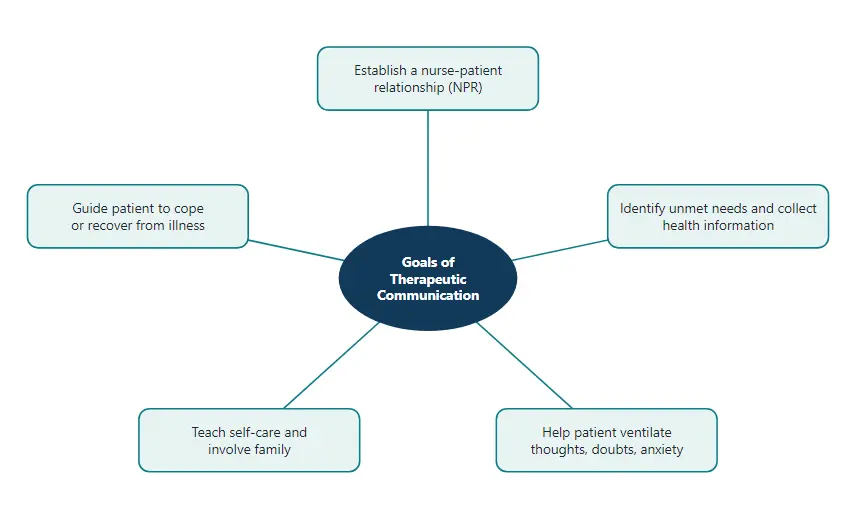
Therapeutic communication is a purposeful interpersonal interaction between nurse and patient where the nurse focuses on the patient’s unmet needs and collects information to promote health. It is the face-to-face process of interacting that focuses on advancing the physical and emotional well-being of a patient.
Techniques of therapeutic communication
| Technique | Meaning | Example |
|---|---|---|
| Active listening | Being attentive to what the client says, verbally and non-verbally (face the client, open posture, lean forward, eye contact, relax). | Sitting facing the client |
| Broad openings | Let the patient choose the topic. | “What is on your mind today?” |
| Sharing observations | Commenting on how the person looks, sounds or acts. | “You look tired.” |
| Accepting | Acknowledging what the patient says. Acceptance is not the same as agreement. | “Yes, I understand.” |
| Offering self | Spending time with the patient. | Offering to stay for lunch or sit with the patient |
| Sharing empathy | Understanding another person’s reality and communicating that understanding. | “How did you react when you had such an experience?” |
| Sharing hope | Communicating a sense of possibility, without false reassurance. | “I believe you will find a way to face your situation.” |
| Sharing humor | Light fun to release negative energy. | Remembering childhood fun |
| Theme identification | Identifying main issues that keep coming up. | “It seems the main issue is being cheated by friends.” |
| Giving recognition | Acknowledging behaviour without giving an overt compliment. | “I noticed you took all of your medications.” |
| Reflection | Directing the patient’s idea or feeling back to the patient. | “You are feeling stressed and anxious.” |
| Using touch | Placing hands on or near the patient to help or heal. | Holding a hand |
| Silence | Stopping talking for a moment, then asking about what the patient is thinking. | Sitting with open posture |
| Informing | Giving relevant information. Reduces anxiety. | Explaining ECT or a procedure |
| Focusing | Noticing a single idea or even a single word. | “Let’s talk more about your relationship with your wife.” |
| Clarifying | Restating an unclear message to clarify its meaning. | “I’m not sure I understand what you mean by sicker than usual.” |
| Paraphrasing (restating) | Repeating the main idea briefly in fewer, fresher words. | “You’re having difficulty concentrating?” |
| Questioning | Asking one question at a time and fully exploring one topic before moving on. | “What is your main problem at the moment?” |
| Summarizing | Pulling together information, good for documentation. Gives a sense of closure. | “My understanding is that your major concern is financial crisis.” |
| Self-disclosure | Nurse intentionally reveals personal experience to show similarities or differences. | “That happened to me once, too.” |
| Confrontation | Sharing inconsistencies in the patient’s feelings, attitudes or behaviour. Use only after trust is established, gently and with sensitivity. | “You say you’ve decided, yet you’re still talking a lot about your options.” |
| Suggestion | Discussing all possible options with pros and cons so the patient can decide. | “Let’s discuss the pros and cons of both alternatives.” |
Barriers to Effective Communication (Non-therapeutic Techniques)
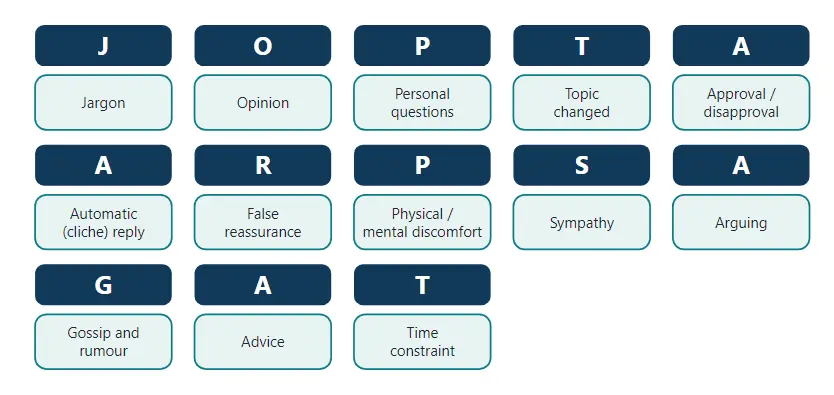
Communication is the base of the nurse-patient relationship, but it is easily disrupted by the following barriers:
| Barrier | Meaning | Better approach |
|---|---|---|
| Jargon | Medical or technical terms confuse the patient and reduce trust. | Use simple words |
| Giving personal opinion | Hinders the patient’s own decision making. | Help the patient explore options |
| Asking personal questions | Irrelevant questions or questions to satisfy curiosity are unprofessional. | Ask only what is needed for care |
| Changing the topic | Shows the nurse is uncomfortable or not interested. | Stay with the patient’s topic |
| Approval or disapproval | Agreeing or disagreeing tells the patient that what they said is right or wrong. | Stay non-judgemental |
| Cliche or automatic response | Stereotyped answers such as “everybody is afraid of needles” reflect poor judgement. | Respond to this patient’s own feelings |
| False reassurance | Telling a relative “everything will be fine” and the patient later deteriorates causes mistrust. | Be honest and supportive |
| Physical or mental discomfort | Pain, anxiety or discomfort blocks communication. | Ensure comfort first |
| Sympathy | Focuses on the nurse’s feelings, not on the patient. The patient stops sharing. | Show empathy instead |
| Arguing | Leads to defensive communication and incomplete information. | Stay calm, understand the situation |
| Gossip and rumour | Discussing patient details for non-professional reasons is unethical. | Maintain confidentiality |
| Giving advice | May cause defensive talk or hiding of information. | Offer options, not orders |
| Time constraints | One nurse has many patients, so expectations may not be met. | Plan and prioritize communication time |
Mnemonic from the textbook: “J has Opinion on Personal Topic And Automatically Reassures, Physical Sympathy, Arguing, Gossiping, Advising with Time.” (J-O-P-T-A-A-R-P-S-A-G-A-T = 13 barriers.)
Sympathy vs Empathy: sympathy means “I feel sorry for you” (focus on the nurse). Empathy means “I understand how you feel” (focus on the patient). Therapeutic communication needs empathy.
Professional Communication
Professional communication is oral, written, visual or digital communication in the workplace. In nursing it builds rapport with the patient, trust among team members and between nurse and patient, and helps in achieving productivity and objectives.
Zones of communication
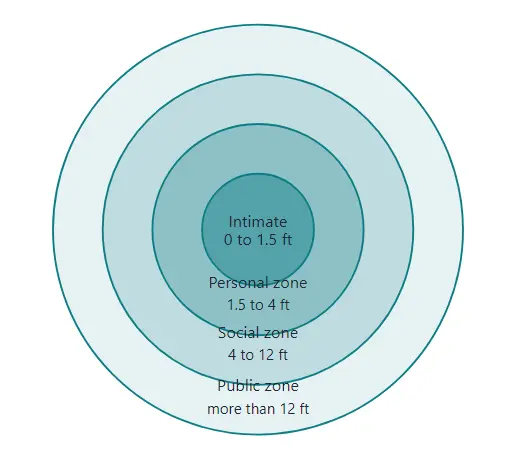
- Intimate zone: close contact, such as parents and children or partners.
- Personal zone: distance kept between close friends.
- Social zone: distance kept with acquaintances, such as colleagues.
- Public zone: distance in meetings or public speaking.
Teacher’s note: Nurses must often enter the patient’s intimate zone (bathing, injections). Always explain and take permission first, because intruding without warning makes patients uncomfortable.
Principles of professional communication
| Principle | Meaning |
|---|---|
| Communication is a process | It includes encoding, sending the message, channel, effect of environment, receiving, decoding and feedback. |
| Communication is circular, not linear | The receiver decodes and gives feedback, through which the sender checks whether the message was understood as intended. |
| Communication is complex | Every message gets a response and action. If unclear, the sender clarifies based on feedback. |
| Communication is irreversible | Once sent, a message cannot be undone. Think before you speak or write. |
| Communication involves personality | A positive person communicates positively; a dominating person communicates in a commanding way. |
Nurse-Patient Relationship (NPR)
Joyce Travelbee: “The nurse-patient relationship is the result of a series of interactions between the nurse and the patient over a period of time with the nurse focusing on the needs and problems of the patient and his family while using the scientific knowledge and scientific skills of the nursing profession.”
Purposes of NPR: to build trust, to understand the patient’s needs and problems, to promote health and recovery, to involve the family in care, and to improve patient satisfaction and cooperation with treatment.
Elements of nurse-patient relationship
| Element | Meaning |
|---|---|
| Altruism | Passion for serving patients, family or community. |
| Ethics and responsibility | Behaviour, decisions and activities reflect professional ethics and accountability. |
| Communication skills | Skill in verbal and non-verbal communication. |
| Genuineness | Being sincere and honest, clear and concrete in communication. |
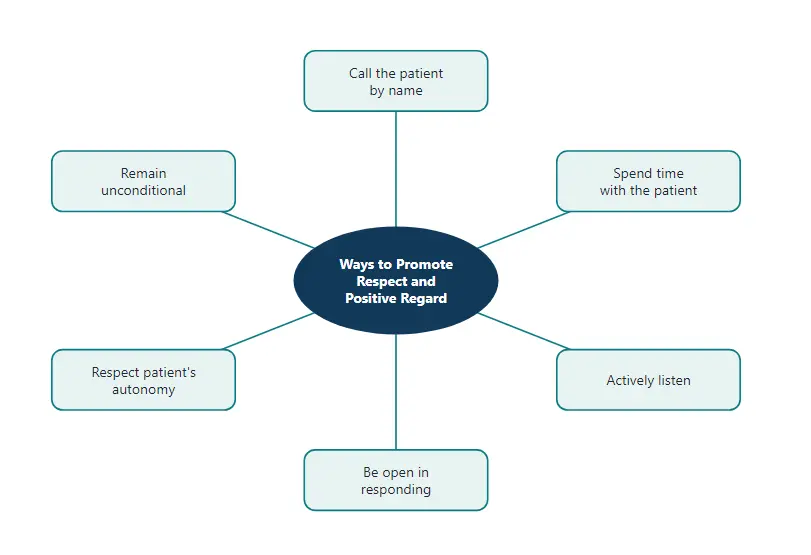
| Respect | Unconditional positive regard. Behaviour toward the client does not depend on the client’s behaviour. |
| Empathy | Accurately understanding the person’s current feelings and their meanings, and communicating that understanding. |
| Concreteness | Clear language and specific terms according to the patient’s level of understanding. |
| Confrontation | Helping the client become aware of inconsistencies in feelings, attitudes, beliefs and behaviours. Possible only with high empathy and respect. |
| Immediacy | Sensitivity to the patient’s feelings and willingness to deal with them rather than ignore them (focus on here and now). |
| Nurse self-disclosure | Intentionally revealing personal experience to show similarities and differences. |
Phases of Nurse-Patient Relationship

Phase 1: Pre-orientation
The nurse does preliminary work: becomes aware of her own feelings, fears and worries, plans how to approach the patient, and learns about the patient’s disease condition. This self-preparation lets her approach the patient in an unbiased and unprejudiced manner.
Phase 2: Introductory
- The nurse introduces herself and orients the patient to hospital routine and how to call for help. This reduces anxiety.
- She collects general information and chooses the ideal time to talk in detail.
- Pleasant greeting, eye contact, acceptance of the patient’s behaviour, and not intruding into the personal zone help develop rapport.
- The phase is short and concise but the nurse must never show hurried gestures.
Phase 3: Orientation
| Item | Meaning |
|---|---|
| Purpose and duration | The nurse tells the purpose of the interaction and how long it may take. Family may be involved with the patient’s consent. |
| Parameters of the relationship | The patient should know who the nurse is, her background and the purpose of meetings. |
| Formal or informal contract | A mutual agreement between nurse and patient about meetings and their roles in meeting treatment goals. |
| Confidentiality | The patient has a right to know how information will be shared. It must not be violated. |
| Termination | Should be clear and discussed from the beginning. |
Phase 4: Working
The main phase, in which most interaction occurs. Nurse and patient work together to meet the set health goals. Different therapeutic communication techniques are used. The nurse assumes roles such as counsellor and teacher to motivate the patient. The patient moves from dependent to interdependent to independent.

Barriers (problems) in the working phase
- Anxiety: exploring old conflicts may raise high anxiety.
- Intense emotions: anger, self-hate, hopelessness and helplessness.
- Maladaptive behaviours: acting out anger inappropriately, withdrawing, intellectualizing, manipulating, denying.
- Resistance: unwillingness to change even when the need for change is recognized.
Phase 5: Termination
When the patient is ready for discharge or the set goals are achieved, the relationship ends. It can also mean the end of a shift or the patient’s discharge. This phase includes summarizing the work done and how to proceed further. Reasons for termination should be discussed with the patient.
Reasons for termination: goals have been accomplished; illness symptoms are relieved; social functioning has improved; the patient shows greater independence; the patient has developed adaptive behaviours; the patient is emotionally stable with a greater sense of identity.
Communicating Effectively with Patients, Families and Team Members
With the patient
- Assessment collects all information using effective communication skills.
- Before the assessment, make sure the patient has no physical limitation such as hearing or speech problems.
- Identify the language spoken by the patient to avoid a language barrier.
- Follow the principles and techniques of effective communication.
| Speaking skills | Listening skills |
|---|---|
| Use appropriate pace and tone; give accurate information about the patient and disease; do not be rigid, interact on the topic the patient wishes to discuss; be clear and specific, avoid ambiguity; speak truthfully, no false hope; interact with an open mind; use opportunities while giving care. | Do not change the topic; listen actively and attentively; do not respond impulsively or judgementally; never show hurried gestures; do not offend cultural beliefs; look for non-verbal cues to validate verbal data. |
With vulnerable groups
| Group | How to communicate |
|---|---|
| Children | Be playful and approachable. A coloured uniform helps. |
| Women | Be respectful and non-judgemental. Give privacy while discussing sensitive issues. |
| Physically and mentally challenged | Respect the challenge faced. A mentally challenged patient should be accompanied by the primary caregiver and appropriate consent taken. |
| Elderly | Have patience. Be sensitive to hearing impairment or cognitive decline. |
With family and team members
- Keep the family informed in simple language, with the patient’s consent, and listen to their concerns.
- With the team, use formal, clear and respectful communication: accurate handover reports, clear documentation and proper reporting to the supervisor.
- A structured tool like SBAR (Situation, Background, Assessment, Recommendation) is widely used for handover and reporting. (Added from standard nursing practice; not in the slides.)
Quick Revision Points
- Process: Sender, Message (encoding), Channel, Receiver (decoding), Feedback. Interference disturbs it.
- Levels: intrapersonal and interpersonal (group, mass, public, organizational).
- Channels: verbal (oral, written), non-verbal, electronic.
- Principles: appropriateness, clarity, channel, feedback.
- Therapeutic communication is purposeful, goal-directed and patient-centred.
- 13 barriers: J-O-P-T-A-A-R-P-S-A-G-A-T.
- Phases of NPR: pre-orientation, introductory, orientation, working, termination.
Communication and Nurse Patient Relationship MCQs
Q1. Communication is defined as a process of:
- Generating, exchanging, understanding and transmitting information
- Only speaking
- Only writing
- Only listening
Answer: A. It is a two-way process between individuals.
Q2. Which is NOT an element of the communication process?
- Sender
- Message
- Channel
- Prescription
Answer: D. Sender, message, channel, receiver, feedback (and interference).
Q3. Converting an idea into a message is called:
- Decoding
- Encoding
- Feedback
- Interference
Answer: B. The receiver does the decoding.
Q4. Anything that disturbs the message is called:
- Feedback
- Interference
- Channel
- Encoding
Answer: B. Also called noise.
Q5. Self-talk is which level of communication?
- Interpersonal
- Intrapersonal
- Mass
- Public
Answer: B. Example: deciding what to wear.
Q6. Communication between a lecturer and a large audience is:
- Intrapersonal
- Public communication
- Organizational
- Informal
Answer: B. Public speaking.
Q7. Language, oral or written, is the channel of:
- Verbal communication
- Non-verbal communication
- Electronic only
- Informal only
Answer: A. Verbal can be oral or written.
Q8. Body language is also called:
- Verbal communication
- Non-verbal communication
- Written communication
- Formal communication
Answer: B. Includes touch, eye contact, posture, gait, gesture.
Q9. Quick feedback is an advantage of:
- Oral communication
- Written communication
- Mass media
- Memo
Answer: A. Written communication can be saved and edited.
Q10. Communication from subordinate to superior is:
- Downward
- Upward
- Horizontal
- Informal
Answer: B. It is a type of vertical communication.
Q11. Communication among people with equal authority is:
- Vertical
- Horizontal
- Upward
- Downward
Answer: B. Lateral communication.
Q12. A lecture where only the teacher speaks is:
- Two-way communication
- One-way communication
- Informal
- Intrapersonal
Answer: B. Discussion and brainstorming are two-way.
Q13. Which is a principle of communication?
- Clarity
- Jargon
- Gossip
- Arguing
Answer: A. Appropriateness, clarity, channel, feedback.
Q14. Therapeutic communication is a:
- Face-to-face process that advances physical and emotional well-being
- Phone chat with friends
- Written order
- Public speech
Answer: A. As defined in the chapter.
Q15. Which is a goal of therapeutic communication?
- Establish the NPR
- Gossip with the patient
- Give personal advice
- Win arguments
Answer: A. Also identify needs, help ventilation, teach self-care, guide coping.
Q16. Repeating the patient’s main idea in fewer, fresher words is:
- Paraphrasing
- Confrontation
- Suggestion
- Summarizing
Answer: A. It validates the nurse’s understanding.
Q17. Sitting with the patient with an open posture without talking is:
- Silence
- Focusing
- Informing
- Gossip
Answer: A. A therapeutic technique.
Q18. Saying ‘Everything will be fine’ to a terminally ill patient’s relative is:
- Empathy
- False reassurance
- Active listening
- Focusing
Answer: B. It causes mistrust later.
Q19. Using medical terms the patient cannot understand is:
- Jargon
- Concreteness
- Clarifying
- Reflection
Answer: A. A barrier to communication.
Q20. The distance used while talking to colleagues is the:
- Intimate zone
- Personal zone
- Social zone
- Public zone
Answer: C. Public zone is for meetings and public speaking.
Q21. ‘The nurse-patient relationship is the result of a series of interactions’ was said by:
- Joyce Travelbee
- Henderson
- Orem
- Nightingale
Answer: A. Travelbee.
Q22. Which element means unconditional positive regard?
- Respect
- Immediacy
- Confrontation
- Self-disclosure
Answer: A. Behaviour does not depend on the patient’s behaviour.
Q23. Dealing with the ‘here and now’ feelings is:
- Concreteness
- Immediacy
- Genuineness
- Altruism
Answer: B. Sensitivity to the patient’s current feelings.
Q24. In which phase does the nurse become aware of her own feelings and learn about the disease?
- Pre-orientation
- Working
- Termination
- Orientation
Answer: A. Self-preparation before meeting the patient.
Q25. The main phase in which goals are achieved is the:
- Introductory phase
- Working phase
- Pre-orientation phase
- None
Answer: B. The patient moves from dependent to independent.
Communication and Nurse Patient Relationship Important Questions as per INC Syllabus Pattern
Long answer questions (10 to 15 marks)
- Define communication. Explain the process and elements of communication with a diagram.
- Describe the types and modes of communication.
- Explain therapeutic communication and its techniques.
- Discuss the barriers to effective communication.
- Describe the phases of nurse-patient relationship.
- Explain the factors influencing communication.
Short answer questions (5 marks)
- Levels of communication
- Verbal vs non-verbal communication
- Principles of communication
- Goals of therapeutic communication
- Active listening
- Elements of nurse-patient relationship
- Professional communication and zones
- Communication with vulnerable groups
- Termination phase of NPR
- Formal vs informal communication
Very short answer questions (2 marks)
- Define communication.
- Define therapeutic communication.
- What is feedback?
- Differentiate sympathy and empathy.
- Define encoding and decoding.
- Name four non-verbal communication cues.
- What is paraphrasing?
- What is false reassurance?
- Name the phases of nurse-patient relationship.
- Define Travelbee’s nurse-patient relationship.
Also read:
CHAPTER 1: Introduction to Health and Illness, Nursing Foundation Unit 1 Notes PDF
CHAPTER 2: Health Care Delivery System, Nursing Foundation Unit 2 BSc Nursing Notes
Chapter 3: Nursing as a Profession and History of Nursing in India: BSc Nursing 1st Semester Notes (Nursing Foundation)
CHAPTER 4: Hospital Admission and Discharge: Complete BSc Nursing Notes | 1st Semester Notes (Nursing Foundation)