

Hospital admission and discharge procedure in Nursing Foundation: Every patient’s hospital journey begins with admission and ends with discharge. These two moments are among the most important in nursing care. A good admission makes the patient feel safe and welcome, and a good discharge makes sure that the patient can continue to recover at home. In this chapter you will learn the meaning, purposes and types of admission, how to prepare the unit, the admission procedure, medicolegal issues, and then the full discharge process with the role of the nurse at each step.
Learning objectives: define admission; list the purposes and types of admission; list the steps of health assessment; explain the procedure of admission; describe the role of the nurse in admission; define discharge and explain its types; describe the procedure of discharge and the role of the nurse in discharge.
Part A: Admission to the Hospital
Meaning and Definitions of Admission
Admission of a patient means allowing and facilitating a patient to stay in the hospital unit or ward for observation, investigation and treatment of the disease he or she is suffering from.
- Hospitalization is admission to the hospital as a patient.
- Admission is the entry of a patient into the hospital for diagnostic or therapeutic purposes.
- Admission is the process where a patient needs to stay in the hospital for observation, investigation, treatment and care.
Teacher’s note: The key words in every definition are observation, investigation, treatment (and care). Use them in your exam answer.
Purposes of Admission
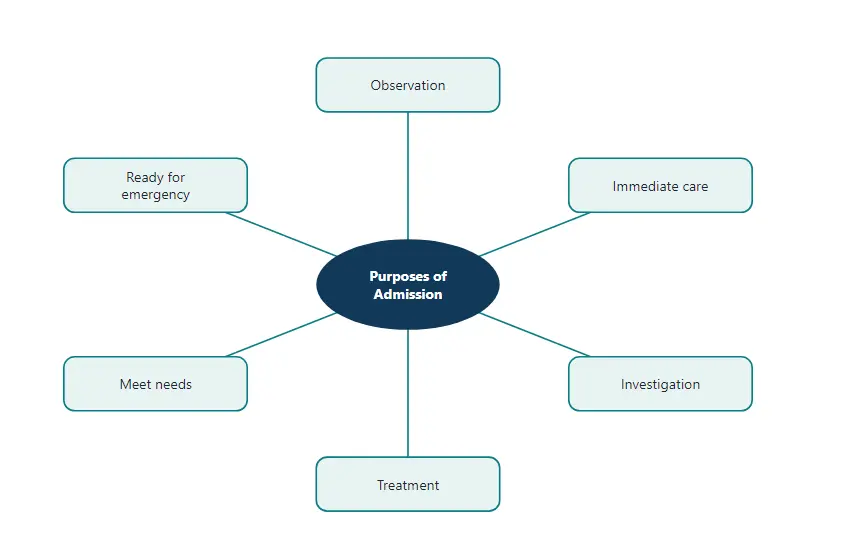
| Purpose | Explanation and example |
|---|---|
| Observation | The patient needs round-the-clock supervision. Example: a patient with chest pain or palpitations. |
| Immediate care | Urgent medical treatment is needed, for example cardiac arrest, respiratory arrest and accident cases. |
| Investigation | The patient is admitted to carry out certain medical tests before a line of treatment can be started. |
| Treatment | For further management after the diagnosis has been made. |
| Meet needs | Patients who cannot meet their physical needs on their own, such as terminally ill patients and patients with chronic diseases. |
| Ready for emergency | Patients who need watchful monitoring by medical experts in case sudden hospital care is needed. |
Types of Hospital Admission
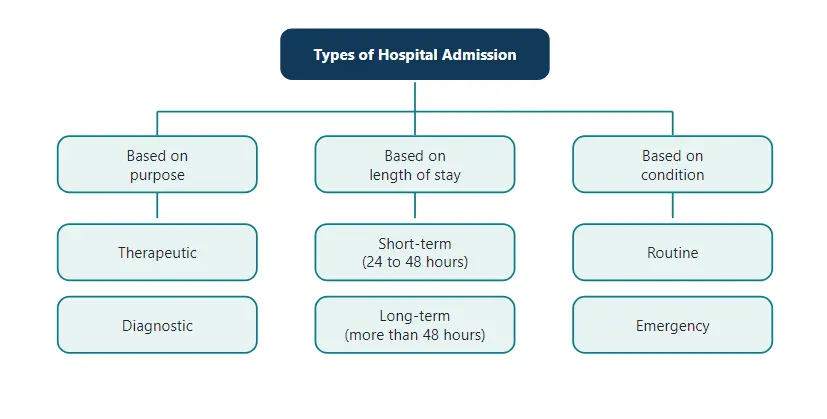
| Basis | Type | Meaning |
|---|---|---|
| Purpose | Diagnostic admission | The patient has to undergo a procedure or investigation such as a biopsy. |
| Therapeutic admission | The patient is already diagnosed and needs medical care for improvement. | |
| Length of stay | Short-term admission | Stay of 24 to 48 hours. |
| Long-term admission | The disease needs more than 48 hours to recover. | |
| Condition of patient | Routine admission | A planned admission, for example cholelithiasis needing surgery. |
| Emergency admission | Life-threatening condition such as cardiac arrest or respiratory arrest needing immediate treatment. |
Exam tip: Draw Fig. 2 first. It gives you the three bases (purpose, length, condition) and six types in one picture.
Categories of Patients Admitted to the Hospital
| Category | Description |
|---|---|
| Entitled patient | Gets compensation or concession in treatment because of special status such as health insurance. Includes the employee, spouse, unmarried daughter, son up to 25 years of age, and parents having a valid medical service card. |
| Paying patient | Admitted by paying cash at the time of admission. |
| Third-party payer | An entity that pays the medical bills on behalf of the insured. Example: government schemes like the Central Government Health Scheme (CGHS). |
The Unit and Its Preparation
Unit or ward: a division of the hospital, or a room or hall in the hospital, that has a number of beds shared by patients who need similar care. Examples are medical and surgical wards.
How the nurse prepares the unit
| Area | What to do |
|---|---|
| Prepare the admission bed | The bed should function properly. Linen and blanket must be clean. Make an unoccupied bed. |
| Ensure equipment | Cardiac monitor, oxygen flow meter and suction machine should be working as per the needs of the patient. |
| Ensure privacy | Do not expose the patient unnecessarily. |
| Patient safety | Do the initial assessment of risk factors: risk of fall, risk of pressure sores, pain assessment. |
| Financial burden | Identify the category of patient, assess financial constraints and explain the estimated cost of treatment to the patient and family. |
| Patient isolation | Suspected or mild-symptom COVID-19 and tuberculosis patients need isolation. Chart the visiting time outside the unit. Family members must wear appropriate PPE while meeting the patient. |
Special Considerations: Dealing with Hospitalization Anxiety
For most people, coming to a hospital is frightening. They fear the unknown, pain, cost, separation from family and loss of independence. A nurse who understands this can make a big difference in the first hour. To reduce anxiety:
- Be empathetic with the patient.
- Orient the patient to the unit or ward.
- Maintain a good interpersonal relationship.
- Explain everything to the patient.
- Provide privacy and respect the patient’s dignity.
- Allow the patient to express feelings (ventilate) and clear his or her doubts.
Procedure of Admission of a Patient

Step 1: Meet and receive the patient
- Verify the patient’s data by checking the record sheet and chart.
- Introduce yourself and the other health team members on duty.
- Assist the patient to the treatment area.
- Ask the patient to change into a hospital gown if necessary.
- Put on the identity bracelet.
Step 2: Perform examination and initial assessment
- General head-to-foot examination.
- Check height and weight.
- Assess allergy history.
- Send investigations as prescribed by the physician.
- Initial assessment: pain assessment, pressure ulcer risk assessment and fall risk assessment.
Step 3: Coordinate with health care team members
- Coordinate with physician, physiotherapist and dietician.
- Carry out the initial orders given by the physician.
- Provide treatment as instructed.
Step 4: Orientation to the patient and others
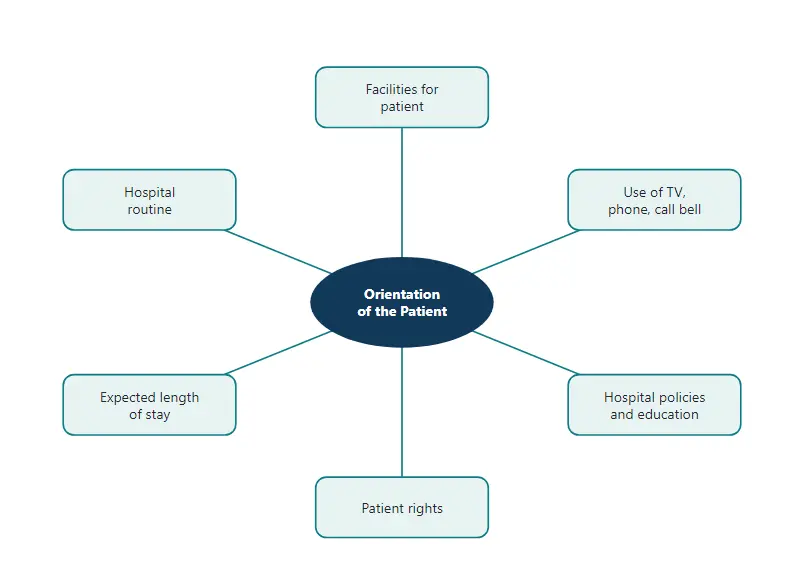
| Orientation topic | What the nurse does |
|---|---|
| Equipment | Orient the patient to the equipment and ask him not to touch it unnecessarily. |
| Call system and telephone | Teach use of the call bell and telephone. |
| Treatment schedule | Explain the treatment schedule. |
| Visitors’ timing | Explain hospital policy on visiting. |
| Other health team members | Introduce other health care team members. |
| Policies, rules and regulations | Inform the patient about hospital rules. |
| Care of valuables | Make a list in the patient valuables handover form and hand the valuables to family members at the time of admission. |
8Articles and Documents Required for Admission
| Ward admission: articles | Documents |
|---|---|
| Patient label, identity bracelet, allergy bracelet (if needed), hospital dress, thermometer, BP apparatus, stethoscope, pulse oximeter, weight scale, toiletries, hygienic under pad or mackintosh, blood vacutainer, blood culture bottle, articles for physical examination, oxygen source | Initial assessment form, general consent form, blood requisition form, radiology requisition form, admission form, and patient file (doctor’s progress sheet, nursing care plan, nursing notes, vital monitoring chart, intake and output chart, assessment scales such as pain scale and pressure ulcer risk scale, glucose monitoring chart, billing sheet, diet chart, physiotherapy progress sheet) |
| ICU or emergency: articles | Documents |
|---|---|
| Cardiac monitor, ventilator, oxygen source, suction apparatus, intubation trolley, crash cart, infusion pump, syringe pump, emergency drugs, intravenous fluids, peripheral catheters, dressing set, suturing set, gloves and gown, IV set and blood transfusion set | ICU flow sheets, consent form |
Procedure of Receiving a New Patient
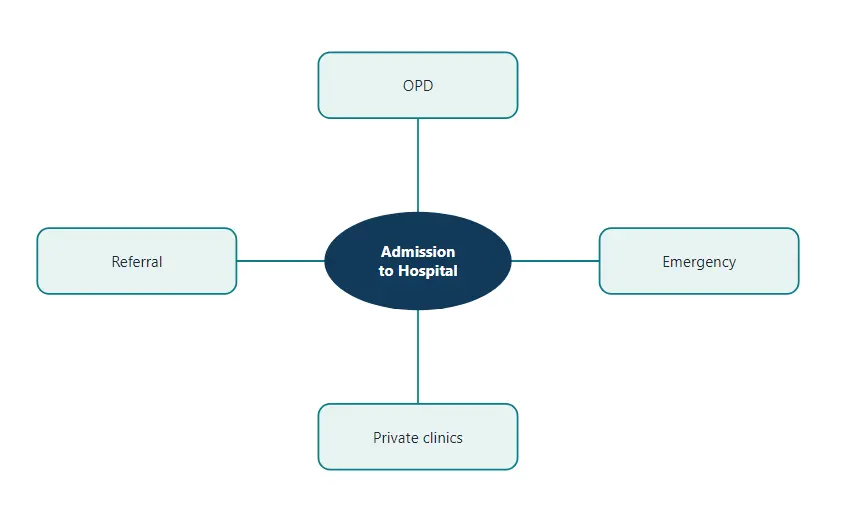
A patient can be admitted from the outpatient department (OPD), the emergency, a private clinic or by referral. The steps are:
- The duty manager informs the head nurse about the admission.
- The nurse prepares the needed equipment and checks that it works.
- Introduce yourself and welcome the patient.
- Adjust the bed height as per the patient’s condition.
- Escort the patient to the bed. Arrange help if the patient arrives on a stretcher.
- Identify the patient using at least two identifiers, such as patient name and UHID (Unique Hospital Identification Data) or MR number (Medical Record number).
- Orient the patient.
- Provide hospital clothes and do the initial assessment.
- Check medicines the patient has brought from home, record them and label them as patient’s own medication.
- Check the doctor’s order for treatment and send initial investigations.
- Inform the doctor on duty and the dietician about the admission.
- Tell the patient about any scheduled procedure or treatment.
- Complete the admission, change the bed status from vacant to occupied, and document the patient’s condition and the nursing action taken.
Admission in the ICU or Emergency Department
Here every second counts, so the nurse works in a fast but organized manner:
- Keep articles and equipment ready and check that they work. Keep the patient’s file ready.
- Perform the initial assessment and observe the patient’s condition.
- Reassure the patient and explain what is being done.
- Shift the patient to the ICU or emergency bed. Give privacy and put on the identity bracelet.
- Review allergy history and put an allergy bracelet if required.
- Make the patient wear hospital clothes.
- List the valuables, hand them to the primary caregiver and take a witness signature.
- Do a thorough physical examination and document.
- Connect the cardiac monitor.
- Access an IV line and start maintaining intake and output.
- Give the recovery position (left lateral). If unconscious, keep a mackintosh towel under the face to collect secretions.
Transfer of a patient to another unit
- Explain the transfer and its purpose to the patient and family.
- Inform the receiving unit and the receiving nurse about the patient’s condition and equipment needed.
- Choose the method of transfer: wheelchair, stretcher or bed.
- Update all documents before shifting.
- Transport the patient, match identification details with the record sheets and accompany the patient.
- Hand over all documents and valuables to the receiving nurse.
Medicolegal Issues in Admission
Medicolegal case (MLC): a case that has both medical and legal implications. Along with the medical treatment, an investigation by law is required to find out responsibility for the present state or condition of the patient. In other words, it needs treatment but must also be informed to law-enforcing authorities.
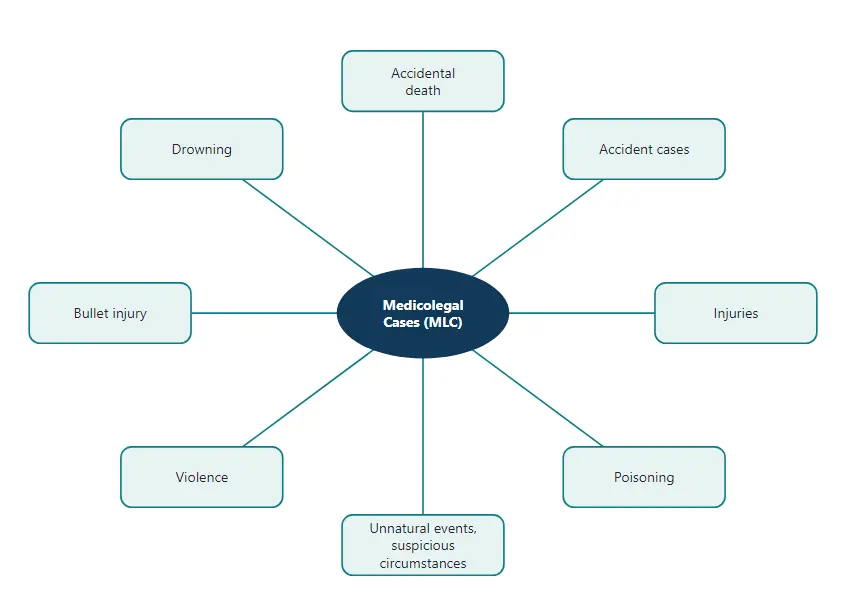
Other medicolegal issues during admission
| Issue | Meaning |
|---|---|
| Assault | An intentional act that makes another person fear that he or she is about to suffer physical harm. |
| Injuries | Damage to any part of the body caused by violence. |
| Disclosure of information | Telling the patient about his condition, methods of treatment and alternatives. |
| Medical negligence | Improper or unskilled treatment of a patient by a medical practitioner. |
Role of the nurse in admission of medicolegal cases
- Inform the medical officer immediately. The medical officer informs the police.
- Make sure that a patient’s death within 24 hours of admission is reported to the police by the medical officer.
- All communication should be in written form.
- Record a detailed history, physical and general examination findings, level of consciousness and vital parameters.
- If reports, X-ray films or images are given to the patient, take written proof.
- Record the MLC on the patient’s file in red ink at the right-hand top corner.
- Do not give any statement about the patient’s condition to the police, magistrate or media. Only a doctor is authorized to give information.
Role and Responsibilities of the Nurse in Admission
| Area | Responsibility |
|---|---|
| Preparation of unit or room | Prepare the unit, keep the bed ready, linen and blanket clean, position the bed. |
| Entry of the patient | Enter the patient’s information in the admission register and the computer system. |
| Availability of equipment | Make sure all articles and equipment are available and working. |
| Orientation | Orient to surroundings, hospital policies and protocols. |
| Meeting needs | Recognize and meet the various needs of the patient. |
| Care of valuables and clothes | Hand over valuables to family at the time of admission. |
| Treatment | Carry out the physician’s instructions. |
Part B: Discharge from the Hospital
Meaning and Purposes of Discharge
Discharge of a patient means departure of a patient from the hospital. It is also known as dismissal of the patient from the hospital.
Purposes of discharge:
- To ensure continuity of care.
- For a safe and effective return of the patient’s clothing and valuables.
- To help the patient adjust effectively to the change of environment.
- To make sure that the patient has information about his or her condition.
14. Types of Discharge
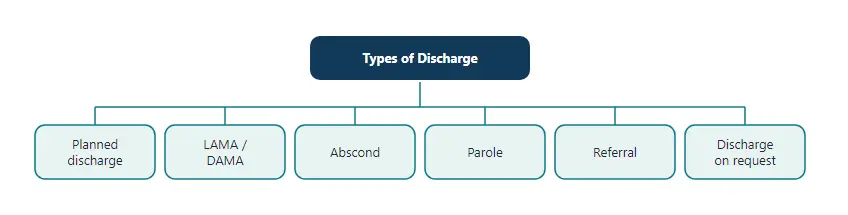
| Type | Meaning |
|---|---|
| Planned discharge | The attending doctor decides on discharge when the patient has completed the initial and actual management of the disease and no longer needs direct supervision. |
| LAMA (Leave Against Medical Advice, also called DAMA) | The doctor clearly explains that taking the patient out of hospital may risk the patient’s life, but the patient or family still wants to go home or to another hospital. They sign a declaration form saying the risks and consequences were explained. |
| Abscond | The patient leaves the hospital without informing the staff and without being discharged. The nurse informs the nursing supervisor, CMO and treating doctor. |
| Parole | Used in psychiatric hospitals. The patient is sent home for 2 to 4 days with the approval of the psychiatrist in charge. |
| Referral | Shifting the patient to another unit or hospital for further management. |
| Discharge on request | Treatment is not complete, but there is no immediate danger to the patient’s life in taking him out of hospital. |
LAMA vs Discharge on request: In LAMA there is a risk to life, so the declaration form is a must. In discharge on request there is no immediate danger. Note: some slides write “Leave Against Medical Request”, but the standard full form used in hospitals is Leave Against Medical Advice.
15. Discharge Planning: The IDEAL Mnemonic
Discharge planning starts at the time of admission, not on the day of discharge. The mnemonic IDEAL helps you remember it.
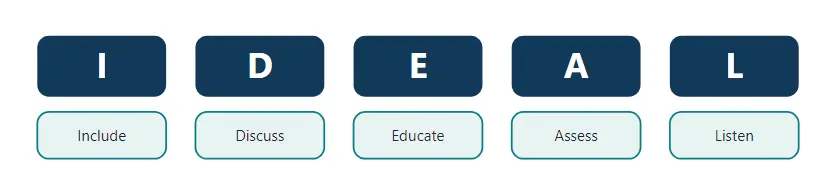
| Letter | Action |
|---|---|
| Include | Include the patient and family members in discharge planning. |
| Discuss | Discuss five main areas: life at home, medications, warning signs, test results and follow-up visits. |
| Educate | Educate the patient and family about the condition, diet, exercise and medications. |
| Assess | Assess how well doctors and nurses have explained the diagnosis, condition and steps in care. |
| Listen | Listen to the patient’s and family’s goals, preferences, observations and concerns. |
16. Procedure of Discharge
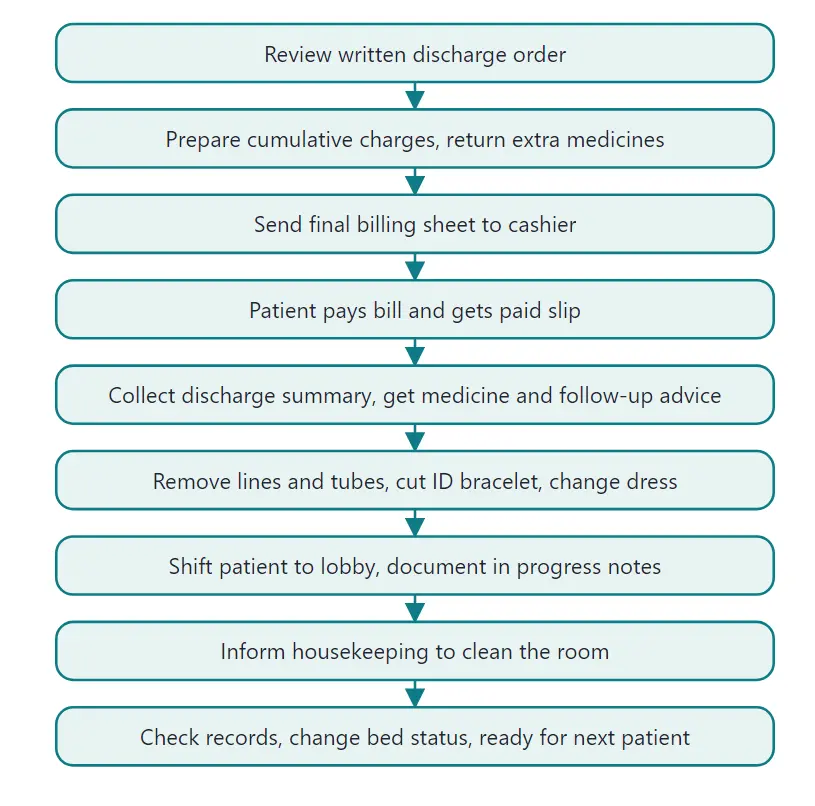
In simple words: the doctor writes the order, the billing is cleared, the discharge summary and medicine advice are explained, the lines are removed, the patient is safely shifted, and the room is cleaned and made ready. A discharge summary usually contains the diagnosis, a brief course in hospital, procedures and investigations done, medicines to continue, advice on diet and activity, and the follow-up date.
Role and Responsibilities of the Nurse in Discharge
- Provide health education on diet, medications, exercise, hygiene and follow-up.
- Ensure there is a written order for discharge.
- Return all belongings (money, clothing and other valuables) to the patient.
- Make sure hospital property given to the patient, including linen, is returned.
- Ensure the patient has paid all expenses and bills.
- Safely transfer the patient from ward to lobby or waiting hall by chair or stretcher.
- Make sure the discharge summary is complete.
- Document the discharge.
Role of the nurse in an MLC during discharge
- Inform the police on duty in the hospital and the Chief Medical Officer (CMO).
- Discharge only after clearance.
- If the patient absconds, inform the nursing supervisor, CMO and the treating doctor.
- No MLC patient can leave the hospital with LAMA.
- Document care in time, accurately, and sign the nurses’ notes.
- Store treatment records safely and hand them over to the authorized person designated by the hospital.
- In case of death, the body is not handed over to relatives. Label the body properly, send it to the mortuary and inform the CMO and the police officer.
Care of the Unit After Discharge
- Inform the housekeeping staff to clean the room and make it ready for the next patient.
- Clean furniture and windows, and send linen and blankets to the laundry.
- Send used articles to the utility room for cleaning, sterilization and disinfection.
- Discard unwanted material and disinfect the mattress.
- If the patient had a communicable disease, the room should be fumigated.
- Prepare the unit for the next patient as per hospital policy.
Quick Revision Points
- Admission = entry for observation, investigation, treatment and care. Six purposes. Types by purpose, length of stay and condition.
- Short-term stay is 24 to 48 hours. Long-term is more than 48 hours.
- Patient categories: entitled, paying, third-party payer.
- Admission procedure: receive, assess, coordinate, orient. Use two identifiers.
- MLC: inform the medical officer, write in red ink at top right, no statements to police or media, death within 24 hours is reported.
- Discharge types: planned, LAMA, abscond, parole (2 to 4 days), referral, on request.
- Discharge planning mnemonic: IDEAL. No discharge without a written doctor’s order. No LAMA for MLC.
Hospital Admission and Discharge MCQs (Nursing Foundation Important Questions)
Q1. Admission of a patient means:
- Allowing the patient to stay in the hospital for observation, investigation and treatment
- Sending the patient home
- Only registering in OPD
- Only giving first aid
Answer: A. This is the textbook meaning of admission.
Q2. Which is NOT a purpose of admission?
- Observation
- Immediate care
- Entertainment
- Investigation
Answer: C. The six purposes are observation, immediate care, investigation, treatment, meeting needs, being ready for emergency.
Q3. Admission for biopsy or other investigation is:
- Therapeutic
- Diagnostic
- Routine
- Long-term
Answer: B. Diagnostic admission is for investigation.
Q4. Patient already diagnosed and admitted for improvement is:
- Diagnostic admission
- Therapeutic admission
- Short-term admission
- Emergency admission
Answer: B. Therapeutic admission.
Q5. Short-term admission means a stay of:
- Less than 6 hours
- 24 to 48 hours
- 1 week
- 1 month
Answer: B. More than 48 hours is long-term.
Q6. Cardiac arrest patient admitted at once is a:
- Routine admission
- Emergency admission
- Diagnostic admission
- Short-term admission
Answer: B. Emergency admission needs immediate treatment.
Q7. Cholelithiasis patient planned for surgery is an example of:
- Routine admission
- Emergency admission
- LAMA
- Referral
Answer: A. Routine admission.
Q8. Patients who get treatment compensation because of health insurance or service status are:
- Paying patients
- Entitled patients
- Third-party payers
- Referral patients
Answer: B. Entitled patients include employee, spouse, unmarried daughter, son up to 25 years and parents.
Q9. CGHS is an example of a:
- Paying patient
- Entitled patient
- Third-party payer
- Referral
Answer: C. A third-party payer pays the bill on behalf of the insured.
Q10. Which equipment is checked in unit preparation?
- Cardiac monitor, oxygen flow meter, suction machine
- Only TV
- Only fans
- Only curtains
Answer: A. Equipment must work as per patient needs.
Q11. A patient with suspected COVID-19 or TB needs:
- Isolation
- Discharge
- Parole
- LAMA
Answer: A. Family should wear PPE when meeting.
Q12. The FIRST step of admission procedure is:
- Orientation
- Meet and receive the patient
- Discharge planning
- Billing
Answer: B. Verify data, introduce yourself, assist, gown, ID bracelet.
Q13. How many identifiers are used to identify the patient?
- One
- At least two
- Three
- None
Answer: B. For example name and UHID or MR number.
Q14. UHID stands for:
- Unique Hospital Identification Data
- United Health ID
- Unit Hospital Index Data
- Universal Health Insurance Data
Answer: A. Also MR No. (Medical record number).
Q15. Recovery position given to an emergency patient is:
- Prone
- Left lateral
- Supine flat
- Fowler’s
Answer: B. Mackintosh towel under the face if unconscious.
Q16. Medicolegal case (MLC) means a case that needs:
- Only treatment
- Treatment plus informing law enforcement
- Only billing
- Only isolation
Answer: B. Medical and legal implications.
Q17. An MLC is recorded on the patient file in:
- Black ink, left corner
- Red ink, right-hand top corner
- Blue ink, bottom
- Pencil
Answer: B. As per textbook.
Q18. Who is authorized to give information about an MLC patient to police or media?
- Staff nurse
- Ward boy
- Only a doctor
- Any relative
Answer: C. Nurse should not give statements.
Q19. Death of a patient within how many hours of admission must be reported to the police in MLC?
- 6
- 12
- 24
- 48
Answer: C. By the medical officer.
Q20. Which type of discharge is used in psychiatric hospitals?
- LAMA
- Parole
- Abscond
- Referral
Answer: B. Patient goes home for 2 to 4 days with approval of the psychiatrist in charge.
Q21. LAMA stands for:
- Leave Against Medical Advice
- Leave After Medical Approval
- Late Admission Medical Advice
- Leave As Medically Allowed
Answer: A. Also called DAMA. Risk is explained and a declaration form is signed.
Q22. The mnemonic for discharge planning is:
- IDEAL
- SOAP
- ABCDE
- SMART
Answer: A. Include, Discuss, Educate, Assess, Listen.
Q23. Which statement is true about an MLC patient?
- Can leave with LAMA
- Cannot leave with LAMA
- Can abscond freely
- Needs no documentation
Answer: B. Discharge only after clearance.
Q24. A room used by a communicable disease patient should be:
- Fumigated
- Left as it is
- Painted
- Locked
Answer: A. Also disinfect the mattress and send articles for sterilization.
Q25. Without which should a patient NOT be discharged?
- Visitor’s permission
- Doctor’s written order
- Nurse’s wish
- Pharmacy slip
Answer: B. Always check the written order first.
Nursing Foundation Important Questions (As Per INC New Syllabus)
Long answer questions (10 to 15 marks)
- Define admission. Explain the procedure of admission of a patient and the role of the nurse.
- Describe the types and purposes of hospital admission.
- Define discharge. Explain the types of discharge and the procedure of discharge.
- Describe discharge planning. What is the role of the nurse in discharge?
- What is a medicolegal case? Describe the role of the nurse in admission and discharge of MLC patients.
Short answer questions (5 marks)
- Purposes of admission
- Types of admission
- Categories of patients admitted to hospital
- Unit preparation for a new patient
- Ways to reduce hospitalization anxiety
- Orientation of a patient
- Admission of a patient in ICU or emergency
- Medicolegal cases (examples and nurse’s role)
- LAMA and parole
- Discharge planning (IDEAL)
- Care of the unit after discharge
Very short answer questions (2 marks)
- Define admission.
- Define discharge.
- List four examples of medicolegal cases.
- What is LAMA?
- What is parole?
- Differentiate routine and emergency admission.
- Differentiate short-term and long-term admission.
- Who are entitled patients?
- Expand UHID and MR No.
- Write the full form of IDEAL.
Also read:
CHAPTER 1: Introduction to Health and Illness, Nursing Foundation Unit 1 Notes PDF
CHAPTER 2: Health Care Delivery System, Nursing Foundation Unit 2 BSc Nursing Notes
Chapter 3: Nursing as a Profession and History of Nursing in India: BSc Nursing 1st Semester Notes (Nursing Foundation)