
Mobility is essential for independence, comfort, and daily living. A patient uses mobility when turning in bed, reaching for a glass, sitting in a chair, walking to the bathroom, or performing exercises.
When movement becomes restricted, nursing care must address more than walking difficulty. Immobility can affect muscles, joints, circulation, breathing, skin, elimination, and emotional wellbeing. A nurse therefore needs to understand how movement occurs, what limits it, how to assist safely, and how to prevent complications.
1. Meaning of mobility and immobility
Mobility
Mobility is the ability to move the body or its parts purposefully. It includes:
- Moving a joint.
- Changing position in bed.
- Sitting and standing.
- Transferring between a bed and a chair.
- Walking.
- Performing activities of daily living.
A patient who cannot walk may still have useful mobility. For example, a person with a leg injury may independently move the arms, turn in bed, and perform some self-care activities.
Immobility
Immobility is a limitation of independent movement. It may be:
- Local: Affecting one body part, such as a wrist immobilised in a cast.
- Extensive: Affecting several limbs or the whole body.
- Temporary: Associated with an injury, operation, or short illness.
- Prolonged: Associated with severe weakness, neurological damage, or another continuing condition.
The nursing assessment should identify the movements the patient can still perform and the assistance required.
Activity tolerance
Activity tolerance is the ability to perform an activity without an excessive or unsafe physiological or symptom response.
A patient may have normal joint movement but become dizzy or severely breathless after standing. In this situation, the difficulty involves tolerance of activity as well as movement itself.
Example: A postoperative patient can bend both knees but becomes light-headed when sitting at the bedside. The nurse should assess the symptoms before progressing to walking.
2. How the body produces movement
Normal movement depends on the coordinated action of the musculoskeletal and nervous systems.
Bones and joints
Bones support the body and act as levers. Joints allow movement between bones.
Ligaments connect bones to other bones. Tendons connect muscles to bones. Articular cartilage provides a smooth surface and helps distribute load within joints.
Skeletal muscles
Skeletal muscles produce force by contracting. Their pull on tendons moves bones.
Opposing muscle groups work together. During elbow flexion, for example, the elbow flexors generate the movement while the opposing muscles allow controlled bending.
Nervous system
The nervous system initiates movement, coordinates muscle activity, and processes information about body position.
Proprioception is awareness of the position and movement of body parts. It helps a person know where a foot or hand is without looking directly at it.
Vision, the vestibular system of the inner ear, and sensory feedback also contribute to balance.
Elements of normal movement
| Element | Meaning | Nursing relevance |
|---|---|---|
| Body alignment | Relationship of body parts during rest and movement | Appropriate support reduces unnecessary strain |
| Joint mobility | Movement available at a joint | Pain, swelling, injury, or stiffness may restrict it |
| Balance | Ability to maintain stability | Poor balance increases the support required during transfers and walking |
| Coordination | Muscles working together in a controlled sequence | Poor coordination can interfere with safe movement |
Common joint movements
| Movement | Simple meaning | Example |
|---|---|---|
| Flexion | Decreasing the angle at a joint | Bending the elbow |
| Extension | Increasing the angle at a joint | Straightening the knee |
| Abduction | Moving away from the midline | Raising the arm sideways |
| Adduction | Moving towards the midline | Bringing the raised arm back |
| Rotation | Turning around an axis | Turning the head sideways |
| Circumduction | Circular movement combining several joint actions | Making a circle with the arm |
| Supination | Turning the forearm so the palm faces upward when the elbow is bent | Holding a bowl |
| Pronation | Turning the forearm so the palm faces downward when the elbow is bent | Placing the palm on a table |
| Dorsiflexion | Bringing the top of the foot towards the shin | Lifting the toes |
| Plantar flexion | Pointing the foot downward | Pressing a pedal |
| Inversion | Turning the sole inward | Moving the sole towards the midline |
| Eversion | Turning the sole outward | Moving the sole away from the midline |
| Opposition | Bringing the thumb across the palm towards the fingers | Touching the little fingertip |
The permitted range varies between joints and patients. A joint should never be forced to reach an assumed textbook angle.
3. Factors affecting mobility
Mobility is influenced by physical condition, confidence, treatment restrictions, and the environment.
Pain and injury may limit movement directly. Fear of pain may also cause a patient to avoid activity.
Musculoskeletal conditions, such as arthritis, weakness, contractures, or fractures, can interfere with posture and movement. Excessive thoracic kyphosis increases upper-back rounding; excessive lumbar lordosis increases the inward lower-back curve; scoliosis involves sideways spinal curvature.
Neurological conditions may affect strength, sensation, coordination, and balance.
Cardiorespiratory problems may reduce endurance, even when the limbs move normally.
Medicines, fatigue, poor nutrition, and dehydration can contribute to weakness or difficulty tolerating activity.
Fear of falling, anxiety, and low mood may reduce confidence.
Environmental barriers, including clutter, poor lighting, unsuitable footwear, and inaccessible toilets, can restrict safe movement.
The nurse should identify the reason for reduced activity. A patient who is afraid of falling needs a different response from a patient with a prescribed non-weight-bearing restriction.
4. Body mechanics and safe patient handling
Body mechanics means using posture, balance, and coordinated movement to perform activities with less unnecessary strain. Useful principles include:
- Establishing a stable base of support.
- Keeping equipment within comfortable reach.
- Maintaining a supported, neutral posture.
- Adjusting the bed to an appropriate working height.
- Avoiding twisting while handling a load.
- Turning with the feet.
- Planning the task and communicating clearly.
Safe patient handling also requires appropriate equipment and trained assistance. Good body mechanics alone does not make manually lifting a dependent patient safe. The handling method should follow an assessment of the patient, the task, and the equipment required. CDC
Before moving a patient, consider their ability to follow instructions, sit steadily, bear the permitted amount of weight, and participate. Check pain, dizziness, wounds, lines, drains, and movement restrictions.
5. Types of exercise
Exercise is planned movement used to maintain or improve function.
Classification by muscle contraction
| Type | What happens | Example |
|---|---|---|
| Isotonic | Muscle length changes while a joint moves | Lifting and lowering a suitable weight |
| Isometric | Muscle tension develops without appreciable joint movement | Tightening the quadriceps while keeping the knee still |
| Isokinetic | Specialised equipment maintains a preset constant angular speed while resistance accommodates effort | Exercise on an isokinetic dynamometer |
Isotonic movement includes muscle shortening and controlled lengthening.
A continuous passive motion machine supplies passive joint movement. It should not be confused with active isokinetic strengthening.
Classification by purpose
Aerobic exercise supports endurance through rhythmic activity involving large muscle groups.
Strengthening exercise improves the force muscles can produce.
Flexibility and ROM exercises maintain or improve movement at joints.
Balance training improves stability during appropriate functional activities.
Benefits and precautions
Appropriate activity can support strength, flexibility, cardiovascular fitness, bowel function, sleep, mood, and independence.
During activity, heart rate and breathing commonly increase to meet demand. This immediate response differs from long-term training benefits, such as a lower resting pulse.
Progress gradually, allow rest, and respect prescribed restrictions. New chest pain, severe breathlessness, faintness, or marked deterioration requires stopping the activity and obtaining assessment.
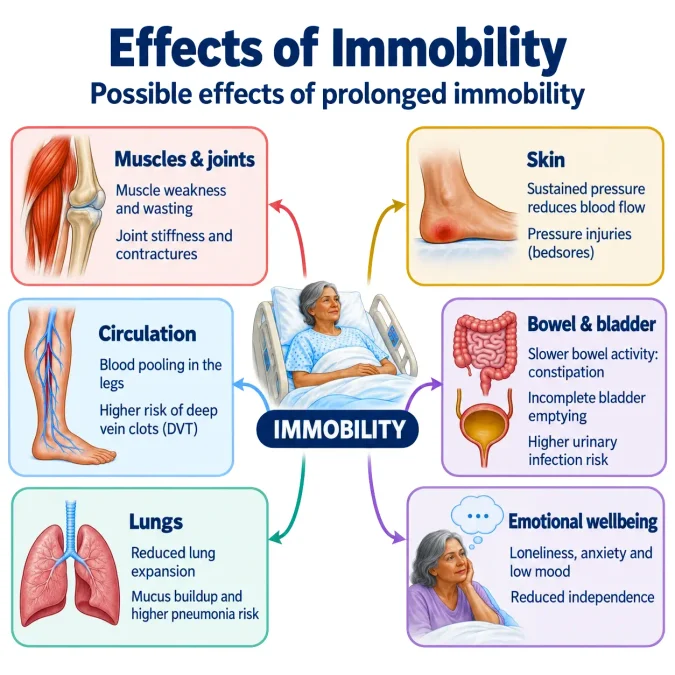
6. Effects and complications of immobility
Complications depend on the duration of immobility, underlying illness, nutritional status, and care provided. They are risks, not inevitable outcomes.
Muscles, joints, and bones
Reduced muscle use can cause disuse atrophy, meaning loss of muscle size and strength. The patient may then need more assistance with everyday tasks.
A contracture is a persistent restriction of joint movement caused by shortening or tightening of muscles and other soft tissues.
Reduced loading can also contribute to bone loss over time.
Foot drop means difficulty actively lifting the front of the foot. It often relates to nerve or muscle dysfunction. A fixed plantar-flexion contracture mechanically restricts ankle movement; these problems may coexist but are not identical. NHS
Cardiovascular system
Reduced leg-muscle activity can slow venous return and contribute to venous stasis.
Stasis increases the risk of deep vein thrombosis, or DVT. A clot that travels to the lungs may cause pulmonary embolism.
New one-sided swelling, warmth, pain, or discoloration needs assessment. Sudden breathlessness, chest pain, coughing blood, or fainting requires an emergency response. CDC
Some patients develop orthostatic hypotension after bed rest. They may become dizzy or weak when moving upright. Position changes should therefore progress according to the patient’s response.
Respiratory system
Pain, weakness, shallow breathing, and remaining in one position may reduce lung expansion and secretion clearance.
Possible consequences include retained secretions, atelectasis, and respiratory infection. Atelectasis means that part of the lung is inadequately expanded or collapsed.
Skin and soft tissues
Sustained pressure can damage tissue, especially over bony prominences.
Shear occurs when tissues are distorted as body layers move relative to one another, such as when a patient slides down the bed.
Inspect vulnerable areas, including the sacrum, heels, hips, elbows, and back of the head. Assessment should include persistent discoloration, warmth, firmness, and tenderness; redness alone is insufficient, particularly in darker skin.
Gastrointestinal and urinary systems
Reduced activity, medicines, altered intake, and difficulty reaching a toilet may contribute to constipation.
Poor positioning or inadequate assistance may make bladder emptying difficult. Urinary stasis and other factors can contribute to urinary complications.
Psychological effects
Dependence may affect confidence, sleep, social interaction, and mood.
Encourage participation in decisions and preserve activities the patient can still manage. Completing a small task independently may be an important achievement.
7. Nursing assessment of mobility
Begin with the patient’s usual function.
Ask how the patient moved before the illness, which aids they used, what help they required, and what has changed.
Assess:
- Pain, weakness, fatigue, dizziness, and breathlessness.
- Falls history and fear of falling.
- Cognition and ability to follow instructions.
- Sensation, vision, balance, and coordination.
- Joint movement and muscle strength.
- Current activity and weight-bearing restrictions.
- Ability to turn, sit, stand, transfer, and walk.
- Skin condition and self-care needs.
Muscle-strength grading
| Grade | Finding |
|---|---|
| 0 | No visible or palpable contraction |
| 1 | Trace contraction without joint movement |
| 2 | Movement with gravity eliminated or minimised |
| 3 | Movement against gravity without added resistance |
| 4 | Movement against gravity and some resistance |
| 5 | Normal strength against expected resistance |
Interpret strength alongside pain, understanding, and restrictions. A score alone does not determine whether a transfer is safe.
Assess activity tolerance
Observe symptoms and relevant vital signs before, during, and after activity.
Document the activity performed, distance or duration, assistance required, reason for stopping, and recovery.
Related reading: Vital Signs Assessment and Regulation.
8. Nursing care of an immobile patient
Preserve available movement
Encourage permitted movement and participation in daily activities. Coordinate prescribed pain relief, suitable exercise, rest periods, and rehabilitation support.
Provide help where needed while allowing the patient time to complete manageable tasks.
Protect the skin
Use an individual care plan covering skin inspection, moisture management, nutrition, pressure redistribution, and repositioning.
A pressure-redistributing mattress does not remove the need for repositioning. The schedule should reflect the patient’s condition, mobility, skin response, comfort, and support surface, with reassessment when needs change. International Guideline
Protect heels appropriately and use handling aids to reduce dragging and shear.
Reduce VTE risk
Encourage permitted mobilisation and leg movement, support appropriate hydration, and administer prescribed prophylaxis.
Anti-embolism stockings require correct measurement, application, and monitoring. Contraindications include suspected or proven peripheral arterial disease, sensory impairment, certain skin conditions, and an unsuitable fit. Device selection follows assessment and the clinical plan. NICE
Support breathing and elimination
Assist with appropriate positioning and the prescribed respiratory care plan.
Offer timely toileting, privacy, and suitable positioning. Monitor bowel patterns, urine output, and significant changes.
Support emotional wellbeing
Explain the plan, agree on realistic goals, offer choices, and keep essential items within reach.
Encourage suitable social contact and meaningful daily activities.
9. Range of motion exercises
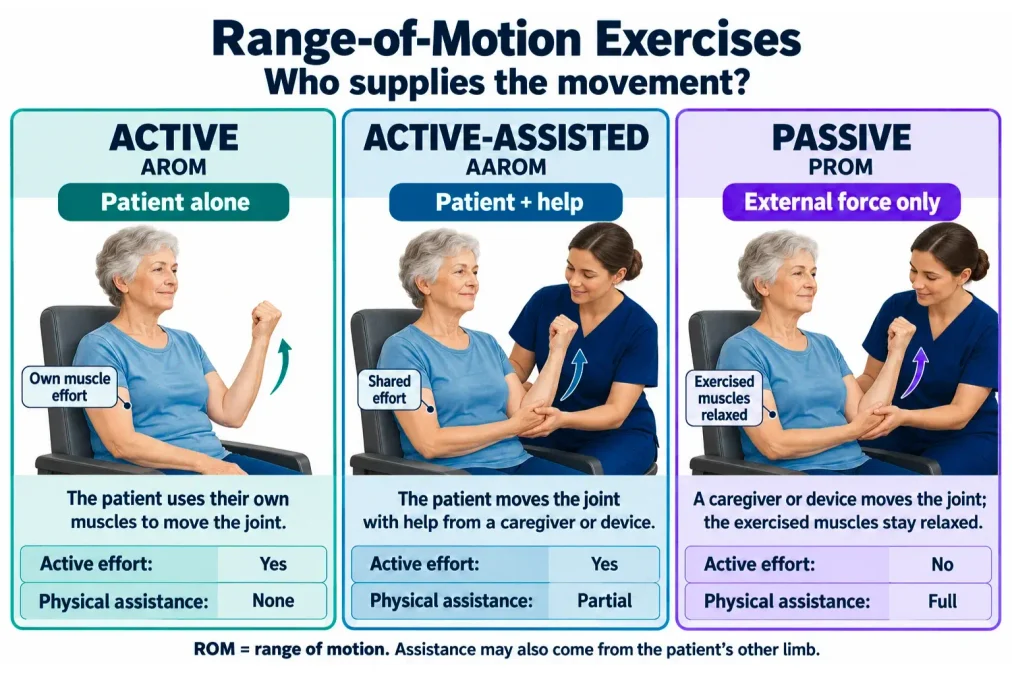
Range of motion, or ROM, is the extent of movement available at a joint.
ROM exercises move a joint through its permitted range to maintain or improve movement and function.
Active ROM
The patient performs the movement independently using their own muscles.
Example: Bending and straightening the elbow without assistance.
Active-assisted ROM
The patient contributes to the movement but needs help to complete or support the permitted range.
Example: A weak patient begins shoulder movement and receives assistance.
Passive ROM
A trained caregiver or prescribed device supplies the movement.
Passive ROM helps maintain joint movement but does not provide the same strengthening effect as active muscle work.
Principles of safe ROM
- Check the care plan, restrictions, pain, and joint condition.
- Explain the activity and encourage participation.
- Support the limb and joint.
- Move slowly within the assessed or prescribed range.
- Stop for pain, an unexpected block, or concerning symptoms.
- Return the limb to a supported position and document the response.
Frequency and repetitions depend on the patient and rehabilitation plan.
10. Positioning and body alignment
Positioning supports comfort, breathing, skin protection, and treatment.
| Position | Description | Main considerations |
|---|---|---|
| Supine | Lying on the back | Support alignment and assess the sacrum, heels, and back of the head |
| Lateral | Lying on the side | Support the upper arm and leg; avoid twisting |
| Sims’ | Semi-prone side position with the upper leg flexed | Protect the lower arm and shoulder |
| Semi-Fowler’s | Head elevated approximately 30–45° | Assess comfort, breathing, and sliding |
| Fowler’s | Commonly around 45–60° | Support the back and arms |
| High Fowler’s | Commonly around 60–90° | Assess tolerance and pressure areas |
| Prone | Lying on the abdomen | Requires assessment of airway, breathing, lines, and pressure points |
Angle ranges vary slightly between teaching references. Document the actual position and relevant bed angle.
Pillows, wedges, heel-offloading devices, and prescribed splints can support alignment and protect vulnerable areas.
Bed rails require individual assessment because they can introduce entrapment and climbing-related risks as well as provide support. FDA
11. Moving and transferring a patient
The transfer method should match the patient’s ability, restrictions, destination, and equipment needs.
Before moving, explain the plan, prepare the environment, manage lines and drains, and arrange the required trained assistance.
A patient able to participate may be suitable for an assessed stand or pivot transfer. A patient unable to participate safely may require a full-body lift. Lateral transfer equipment may be needed for bed-to-stretcher movement. Equipment selection and use should follow the assessment and manufacturer’s instructions. CDC
After the transfer, reassess comfort, alignment, symptoms, and attached equipment. Place essential items within reach and document the assistance required.
12. Ambulation and walking aids
Ambulation means walking.
Before walking, check activity orders, weight-bearing status, footwear, symptoms, the aid, and the assistance required.
Progress may involve sitting upright, sitting at the bedside, standing, and then walking. Pause when changing position to assess tolerance.
Common walking aids
| Aid | Main teaching point |
|---|---|
| Cane | Usually held opposite the affected leg |
| Walker | Requires suitable height, positioning, and an instructed walking sequence |
| Axillary crutches | Weight is supported through the hands, with clearance below the armpits |
| Forearm crutches | Require correct fit, coordination, and training |
| Brace or orthosis | Follow the prescribed wearing schedule and inspect the skin |
For example, a person with left-leg weakness usually holds the cane in the right hand. The walking pattern should be taught and checked for the individual. AAOS
Adaptive equipment such as reachers, dressing aids, shower chairs, and suitable grab bars may also support independence.
13. Nursing process and sample care plan
The nursing process connects assessment findings to goals, interventions, and evaluation.
An actual problem is supported by existing findings. A risk problem is supported by risk factors. An established pressure injury, for example, should not be described only as a future risk.
Example care plan
Situation: An adult recovering from surgery needs help turning and transferring because of pain and weakness. Assisted mobilisation is permitted.
| Identified need | Example goal | Nursing actions | Evaluation |
|---|---|---|---|
| Difficulty transferring | Complete the planned transfer with agreed support and no dizziness | Assess readiness, coordinate pain relief, select the aid, and arrange trained help | Record assistance and symptoms |
| Risk of pressure injury | Maintain intact skin during the review period | Follow the individual repositioning plan, inspect skin, manage moisture, and use suitable support | Compare findings with baseline |
| Limited self-care | Complete agreed parts of washing or dressing | Provide time, suitable aids, and assistance where needed | Record tasks completed |
| Reduced endurance | Tolerate planned activity with appropriate rest | Monitor symptoms, allow rest, and adjust activity | Record distance, duration, and recovery |
Set realistic review times and revise goals when the patient’s condition changes.
Related reading: Nursing Process Notes for BSc Nursing.
14. Care of patients with casts and splints
A cast is a rigid support that usually surrounds the injured part.
A splint generally provides support without a complete rigid circumferential shell, allowing more accommodation for swelling.
Assess distal pain, sensation, movement, colour, temperature, swelling, capillary refill, and accessible pulses. Inspect skin at the edges and the condition of the device.
Follow instructions for elevation, movement of exposed fingers or toes, keeping the device dry, and weight bearing. Keep objects out of the cast and report damage, drainage, or unusual odour. A dry cast does not automatically mean weight bearing is permitted. AAOS
Increasing severe pain, new numbness or tingling, tightness, marked swelling, or loss of movement needs urgent assessment. Pain out of proportion to the injury raises concern for compartment syndrome. A palpable pulse does not exclude it. AAOS
15. Documentation and evaluation
Useful documentation describes what the patient actually did and how they responded.
Record the activity, device, assistance level, distance or duration, symptoms, relevant observations, education, and ongoing plan.
Example: “Walked 10 metres with a walker and one trained assistant. Paused once because of fatigue. No dizziness reported. Returned to the chair with feet supported and call bell within reach.”
Evaluate progress against agreed goals and update the care plan when necessary.
Quick revision
- Mobility includes joint movement, bed movement, transfers, and walking.
- Activity tolerance describes how well the patient copes with activity.
- Isotonic exercise involves movement; isometric exercise develops tension without appreciable joint movement.
- Isokinetic exercise uses a preset constant angular speed.
- Active, active-assisted, and passive ROM differ in who supplies movement.
- Immobility can affect several body systems.
- Safe handling requires assessment, suitable equipment, and trained assistance.
- Repositioning remains necessary with a pressure-redistributing mattress.
- Weight-bearing restrictions guide exercise, transfers, and walking.
- Evaluation should describe actual performance and tolerance.
Mobility and Immobility in Nursing FAQs
What is the difference between mobility and immobility?
Mobility is purposeful movement of the body or its parts. Immobility is a limitation of that movement. Nursing assessment identifies what the patient can do independently and what assistance is required.
What are the main complications of prolonged immobility?
Possible complications include muscle weakness, contractures, pressure injury, VTE, respiratory complications, constipation, urinary problems, and reduced confidence or social interaction.
What is the nursing care of an immobile patient?
Care includes assessment, permitted movement, positioning, skin protection, prescribed VTE prevention, respiratory care, nutrition, hydration, toileting, emotional support, and evaluation.
What is the difference between active and passive ROM?
In active ROM, the patient supplies the muscle effort. In passive ROM, another person or a prescribed device supplies the movement. Active-assisted ROM combines the patient’s effort with help.
How often should an immobile patient be repositioned?
Follow an individual documented plan based on the patient’s condition, mobility, skin response, comfort, and support surface. Reassess when needs change. International Guideline
How do isotonic, isometric, and isokinetic exercises differ?
Isotonic exercise involves muscle length change and movement. Isometric exercise develops tension with little or no joint movement. Isokinetic exercise uses specialised equipment to maintain a preset constant angular speed.
What should a nurse assess before ambulation?
Assess activity restrictions, weight-bearing status, alertness, pain, balance, strength, symptoms, footwear, walking aids, lines, and the assistance required.
Which hand should hold a cane when one leg is weak?
A cane is usually held opposite the affected leg, according to the individually taught walking pattern. AAOS
Which symptoms under a cast require urgent attention?
Increasing pain, tightness, numbness, tingling, marked swelling, colour or temperature changes, and inability to move exposed digits need prompt assessment. AAOS
Is Mobility and Immobility included in BSc Nursing first semester?
Yes. It appears as Unit XII of Nursing Foundation I in the INC first-semester curriculum. The book’s chapter number and the curriculum’s unit number are different systems of organisation. thc.nic.in
MCQs on Mobility and Immobility
Choose the single best answer.
1. What does mobility mean in nursing?
A. The ability to move the body or its parts purposefully
B. The ability to sustain activity without undue fatigue
C. The maximum force a muscle can produce
D. The ability to maintain stability in a fixed posture
Answer: A. Mobility includes purposeful movement such as turning, sitting, standing, and walking.
2. Which condition generally improves stability?
A. A narrow base of support with the body leaning outside it
B. A wider base of support with the line of gravity within it
C. Standing on the toes with both feet together
D. Raising the centre of gravity while reaching sideways
Answer: B. A wider base supports stability when the line of gravity remains within it.
3. Which structure connects a skeletal muscle to a bone?
A. Cartilage
B. Ligament
C. Tendon
D. Joint cavity
Answer: C. Tendons transmit muscle force to bones. Ligaments mainly connect bones to other bones.
4. A patient knows the position of a leg without looking at it. Which sense makes this possible?
A. Visual accommodation
B. Vestibular perception of head movement
C. Cutaneous pain sensation
D. Proprioception
Answer: D. Proprioception is awareness of the position and movement of body parts.
5. A patient tightens the quadriceps while keeping the knee still. What type of exercise is this?
A. Passive ROM
B. Isometric exercise
C. Isokinetic exercise
D. Aerobic endurance exercise
Answer: B. Isometric exercise develops muscle tension without appreciable joint movement.
6. Which activity is an example of dynamic isotonic exercise?
A. Lifting and lowering a light dumbbell through a permitted range
B. Holding a contraction without moving the joint
C. Resting a supported limb on a pillow
D. Having a therapist move a relaxed joint
Answer: A. Dynamic isotonic exercise involves muscle shortening or lengthening as a joint moves against a load.
7. What is the defining feature of isokinetic exercise?
A. Complete absence of muscle contraction
B. Passive movement produced by a caregiver
C. Fixed muscle length throughout the activity
D. Movement at a controlled constant speed using suitable resistance equipment
Answer: D. Isokinetic equipment maintains a preset constant angular speed while resistance adapts to effort.
8. A patient begins shoulder movement but needs help to complete the permitted range. This is:
A. Passive ROM
B. Resisted exercise only
C. Active-assisted ROM
D. Isometric exercise
Answer: C. The patient contributes to the movement and receives the additional assistance required.
9. What is a main purpose of passive ROM?
A. To replace all walking and strengthening activities
B. To help maintain permitted joint movement and reduce stiffness
C. To provide the same strengthening effect as active resistance exercise
D. To force a joint beyond its normal limit
Answer: B. Passive ROM helps maintain available movement but does not replace active strengthening.
10. A patient moves a limb through its full range against gravity but cannot tolerate added resistance. What is the usual strength grade?
A. Grade 3
B. Grade 0
C. Grade 1
D. Grade 5
Answer: A. Grade 3 indicates movement against gravity without added resistance.
11. Which change is directly associated with prolonged muscle disuse?
A. Increased muscle bulk
B. Increased joint flexibility
C. Increased endurance
D. Muscle atrophy and weakness
Answer: D. Disuse can reduce muscle mass, strength, and functional ability.
12. Why does prolonged immobility increase DVT risk?
A. Reduced joint movement increases arterial oxygen content
B. Bed rest strengthens the calf-muscle pump
C. Reduced muscle activity contributes to venous stasis
D. Reduced activity automatically improves venous valve function
Answer: C. Reduced calf-muscle activity can slow venous return and contribute to clot formation.
13. The nurse finds persistent discoloration over an immobile patient’s sacrum. What is the best action?
A. Relieve pressure, assess the area, and follow the pressure-injury care pathway
B. Massage the area firmly
C. Continue the same position until the next routine round
D. Place a tight rolled towel directly beneath the area
Answer: A. Persistent changes need assessment and pressure relief. Firm massage can damage vulnerable tissue.
14. A patient becomes dizzy after sitting up following prolonged bed rest. What should the nurse do first?
A. Ask the patient to stand quickly
B. Begin walking
C. Stop progression, support the patient, and assess symptoms and vital signs
D. Leave the patient sitting unsupported
Answer: C. Safety and assessment take priority before further mobilisation.
15. During walking, a patient develops new chest pain and marked breathlessness. What is the priority?
A. Complete the planned distance
B. Stop activity, support the patient, and obtain urgent clinical assessment
C. Encourage faster walking
D. Record the symptoms only after returning to bed
Answer: B. These symptoms may indicate serious deterioration.
16. A dependent patient cannot bear weight and needs a bed-to-chair transfer. Which plan is most appropriate?
A. One nurse lifts the patient by the armpits
B. Ask the patient to stand despite the inability to bear weight
C. Use a walking stick as the main transfer aid
D. Use the assessed full-body lift and appropriate trained assistance
Answer: D. Equipment and assistance must match the patient’s assessed needs.
17. What is essential before selecting a transfer method?
A. Assessing weight-bearing ability, cognition, strength, symptoms, and restrictions
B. Considering the nurse’s preference alone
C. Considering age alone
D. Considering the distance to the chair alone
Answer: A. Transfer safety requires a combined assessment.
18. A patient has right-leg weakness and is suitable for a single walking stick. Which hand usually holds it?
A. Right hand
B. Either hand regardless of assessment
C. Left hand
D. Both hands
Answer: C. The stick is usually held opposite the affected leg.
19. When using axillary crutches, where should weight primarily be supported?
A. Through the armpits
B. Through the hands on the handgrips
C. Through the neck and shoulders
D. Through the chest
Answer: B. Supporting body weight through the axillae can injure nerves and other tissues.
20. A patient reports sharp pain during ROM exercise. What should the nurse do?
A. Increase the movement speed
B. Force the remaining range
C. Continue until all repetitions are completed
D. Stop, support the limb, and reassess
Answer: D. Sharp pain requires reassessment before continuing.
21. A patient has a non-weight-bearing order for the left leg. Which instruction is correct?
A. Keep weight off the left leg during standing and walking as instructed
B. Put half the body weight on it when comfortable
C. Walk without an aid if pain is mild
D. Begin full weight bearing when the cast feels dry
Answer: A. Restrictions protect healing tissues and continue until changed by the treating team.
22. A patient with a new cast reports increasing severe pain and tingling. What is the priority?
A. Explain that this is always normal
B. Wait until the next routine review
C. Arrange urgent assessment of circulation, sensation, movement, and cast pressure
D. Suggest inserting a thin object under the cast
Answer: C. Increasing pain and altered sensation may indicate neurovascular compromise.
23. Which statement about repositioning is most accurate?
A. A special mattress eliminates repositioning
B. Every patient needs exactly the same schedule
C. Repositioning starts only after a pressure injury develops
D. The schedule reflects assessed risk, skin response, condition, tolerance, and support surface
Answer: D. Repositioning is individualised and reassessed.
24. Which documentation entry is most useful?
A. “Patient mobilised well.”
B. “Walked 10 metres with a walker and one trained assistant; paused once for fatigue; no dizziness reported.”
C. “Walking encouraged as usual.”
D. “Patient seemed better today.”
Answer: B. It describes the activity, assistance, device, symptoms, and response.
25. Which outcome best demonstrates progress towards a mobility goal?
A. The nurse completes every activity for the patient
B. The patient stays in bed all day
C. The patient completes the planned transfer with agreed assistance and acceptable tolerance
D. The patient stops using prescribed aids before reassessment
Answer: C. Progress is evaluated against a realistic, individual goal.
Important INC-aligned practice questions
These are original practice questions based on the chapter’s syllabus topics. They support preparation but do not predict a university examination.
Long-answer questions
1. Explain the physiology of normal movement and the principles of safe body mechanics.
Answer guidance: Define mobility. Explain bones, joints, muscles, tendons, ligaments, and nervous control. Describe alignment, joint mobility, balance, coordination, and proprioception. Discuss a stable base, appropriate working height, avoiding twisting, planning the task, and selecting assessed handling equipment.
2. Describe the effects of immobility on major body systems and the nursing measures used to reduce complications.
Answer guidance: Organise the answer by system. Cover muscle wasting, contractures, bone loss, venous stasis, respiratory problems, pressure injury, constipation, urinary problems, and psychological effects. Connect each problem with relevant assessment and preventive care.
3. Explain ROM exercises and the nurse’s responsibilities when assisting with them.
Answer guidance: Define ROM and distinguish active, active-assisted, and passive movement. Give examples of joint movements. Explain checking restrictions, supporting the joint, moving smoothly within permitted limits, stopping for pain, and documenting the response.
4. Develop a nursing care plan for a patient with impaired mobility.
Answer guidance: Include baseline function, pain, strength, balance, cognition, activity tolerance, skin condition, risks, and restrictions. Identify problems, set measurable goals, plan interventions, involve rehabilitation professionals, and evaluate actual performance.
5. Describe nursing care and patient education for a person with a cast or splint.
Answer guidance: Explain the purpose and differences of casts and splints. Describe neurovascular and skin assessment, prescribed elevation and movement, device protection, weight-bearing instructions, urgent warning signs, and professional adjustment or removal.
Short-answer and very-short-answer questions
1. Define mobility, immobility, and activity tolerance.
Key points: Mobility is purposeful movement; immobility is restricted independent movement; activity tolerance is the ability to perform activity with an acceptable physiological and symptom response.
2. Differentiate isotonic, isometric, and isokinetic exercises.
Key points: Compare muscle length, joint movement, speed control, equipment, and one suitable example of each type.
3. List six factors affecting mobility.
Key points: Age and development, pain or injury, neurological or musculoskeletal disease, cardiopulmonary endurance, medicines, nutrition, emotions, environment, and support.
4. What should be assessed before first ambulation after prolonged bed rest?
Key points: Current stability, restrictions, pain, understanding, strength, balance, footwear, walking aid, lines, assistance, and response to position change.
5. State the purposes of common mobility and transfer aids.
Key points: A cane or walker supports an assessed walking pattern; crutches assist prescribed unloading; slide sheets reduce friction; stand-assist devices help eligible patients; full-body lifts support dependent transfers.
6. Outline pressure-injury prevention for an immobile patient.
Key points: Assess risk and skin, follow an individual repositioning plan, use suitable support surfaces, protect heels, manage moisture, address nutrition, encourage permitted movement, and document reassessment.
7. What cast-related findings require urgent assessment?
Key points: Increasing or disproportionate pain, numbness, tingling, marked swelling, impaired movement, and concerning colour or temperature changes. Do not wait for every sign to appear.
8. What should be documented after a mobility intervention?
Key points: Activity, time, distance or duration, device, assistance, compliance with restrictions, symptoms, observations, tolerance, education, and the continuing plan.
References and further reading
Chapter reference: Nursing Foundation Notes, Chapter Mobility and Immobility. The supplied teaching chapter credits Textbook of Foundation of Nursing by Jyoti Kathwal; the edition is not identified in the supplied material.
- Indian Nursing Council. Revised Regulations and Curriculum for BSc Nursing Program, Regulations 2020, notified 5 July 2021. Nursing Foundation I, Unit XII, printed pp. 264–265. Government-hosted Gazette copy.
- CDC/NIOSH. About Safe Patient Handling and Mobility. See also OSHA, Safe Patient Handling.
- NHS. Foot drop.
- CDC. About Venous Thromboembolism.
- NPIAP, EPUAP and PPPIA. Repositioning and Mobilization. International Pressure Injury Guideline, fourth edition, chapter published online 24 August 2026.
- NICE. Venous thromboembolism in over 16s, NG89. Individual risk assessment and mechanical prophylaxis recommendations.
- US FDA. A Guide to Bed Safety and Bed Rails.
- American Academy of Orthopaedic Surgeons. How to Use Crutches, Canes, and Walkers.
- American Academy of Orthopaedic Surgeons. Care of Casts and Splints.
- American Academy of Orthopaedic Surgeons. Compartment Syndrome.
- Sheffield Children’s NHS Foundation Trust. Compartment syndrome guidance. Implemented August 2023; review due August 2027.
Continue with the Nursing Foundation 1st Semester notes.