

LEARNING OBJECTIVES
(Introduction to Health and Illness BSc Nursing 1st Semester Unit-1)
- Describe and define the concept of health.
- Discuss Maslow’s Hierarchy of Needs.
- Explain the Health-Illness Continuum.
- Discuss factors influencing health.
- Explain causes and risk factors for developing illness.
- Illustrate types of illness and illness behavior.
- Describe the impact of illness on the patient and family.
Also Check: CHAPTER 2: Health Care Delivery System, Nursing Foundation Unit 2 BSc Nursing Notes
Meaning & Definition Of Health
Meaning: Health is more than just the absence of illness; it is an active process where a person moves toward their maximum potential.
Definitions by Nursing Theorists & Organizations:
- WHO (1947): A state of complete physical, mental, and social well-being, not merely the absence of disease or infirmity.
- Dorothea Orem: Health describes living things when they are structurally and functionally whole or sound.
- Virginia Henderson: Nursing assists the individual (sick or well) in activities contributing to health, recovery, or a peaceful death—activities they would do unaided if they had the strength, will, or knowledge.
- Hildegard Peplau: Nursing is a therapeutic interpersonal process functioning in coordination with the human processes of individuals in the community.
CONCEPTS OF HEALTH
- Biomedical Concept: Based on the “germ theory of disease.” Health simply means “absence of disease.” The body is viewed as a machine, and disease is a breakdown of that machine. (Considered inadequate today).
- Ecological Concept: Health is a dynamic equilibrium between humans and their environment. Disease is a maladjustment of the human organism to the environment.
- Psychosocial Concept: Health is influenced by social, psychological, cultural, economic, and political factors. These must be considered when defining/measuring health.
- Holistic Concept: A synthesis of all the above concepts. Health is a multidimensional process involving the well-being of the whole person, with an emphasis on health promotion and protection.
MASLOW’S HIERARCHY OF NEEDS
(From bottom to top)
- Physiological Needs: Air, water, food, shelter, rest, sleep, activity, and temperature maintenance. These are the most basic metabolic requirements for survival and must be met first.
- Safety and Security Needs: Physical and psychological safety. If absent (due to war, abuse, disaster), people may experience trauma/PTSD.
- Love and Belongingness Needs: Friendship, love, family, and relationships. Strong in childhood; can sometimes override safety needs (e.g., a child clinging to an abusive parent).
- Self-Esteem Needs: Feeling respected, independent, and competent. Includes the desire for recognition and appreciation from others, often sought through professions or hobbies.
- Self-Actualization: Realizing one’s maximum potential and abilities. “What a man can be, he must be.”
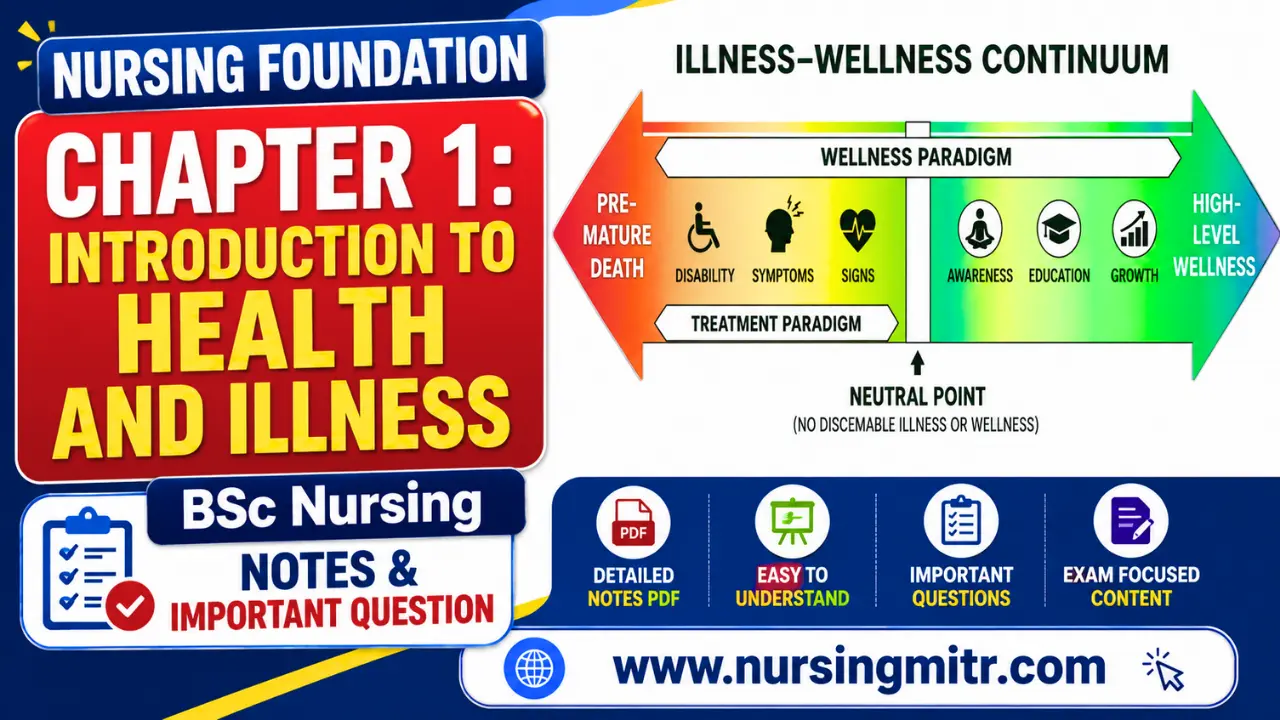
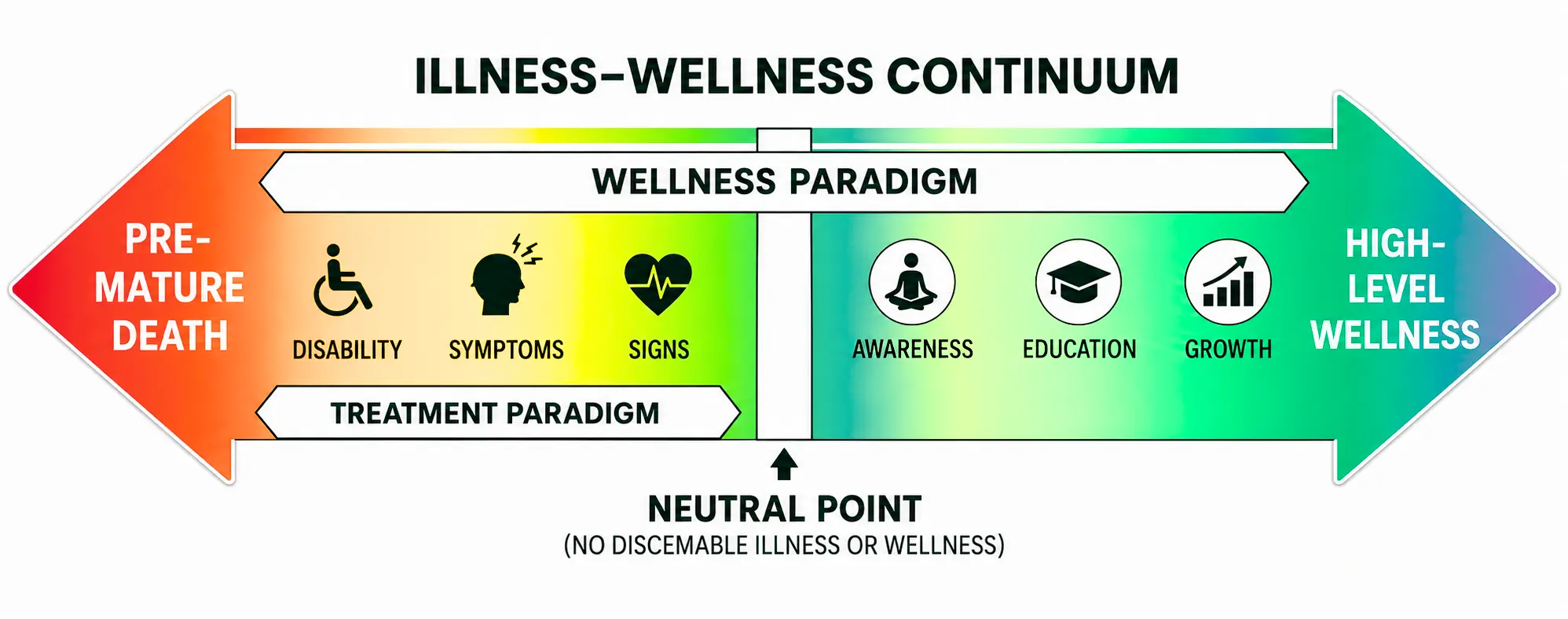
HEALTH-ILLNESS CONTINUUM
- A model that views health as a constantly changing state, ranging from high-level wellness to premature death.
- It features two arrows pointing in opposite directions from a neutral point.
- Movement to the Right (Towards High-Level Wellness): Achieved in 3 steps:
- Awareness: Recognizing health status and not ignoring warning signs (e.g., noticing obesity and starting to work out).
- Education: Learning about general day-to-day health issues.
- Growth: Overall intellectual, mental, physical, and spiritual growth.
- Movement to the Left (Towards Premature Death): Achieved in 3 steps:
- Signs: Objective indicators of illness that can be observed/measured by a healthcare worker.
- Symptoms: Subjective feelings noticed only by the patient (e.g., back pain, fatigue).
- Disability: Impairment of the body or mind that limits normal activities.
FACTORS INFLUENCING HEALTH
- Income & Social Status: Higher income links to better health. The wider the rich-poor gap, the bigger the health difference.
- Education: Lower education levels link to poor health, higher stress, and lower self-confidence.
- Physical Environment: Safe water, clean air, healthy workplaces, and safe housing/roads contribute to good health.
- Social Support Networks: Greater support from family, friends, and communities improves health.
- Culture: Customs, traditions, and beliefs affect health choices.
- Genetics: Inheritance determines lifespan and the likelihood of developing certain diseases.
- Health Services: Access to preventative and curative services influences individual health.
- Gender: Men and women suffer from different diseases at different stages of life.
ILLNESS
Definition: An illness is a person’s response to a disease; it is a process where a person’s level of functioning changes compared to their previous level. (Illness ≠ Disease).
Types of Illness:
- Acute Illness: Rapid onset of symptoms, lasts a short time (e.g., common cold, diarrhea). Usually not life-threatening.
- Chronic Illness: Persists for longer than 6 months. Encompasses physical/mental alterations in health.
Causes & Risk Factors: (Situations/habits that increase the probability of disease)
- Age: Different age groups have different risks (e.g., school children are at higher risk for communicable diseases).
- Lifestyle: Habits can positively or negatively impact health.
- Environment: Where a person lives or works can increase illness risk.
- Genetic/Physiological Factors: Inheritance plays a role in disease development.
Epidemiological Triad (Causes of Disease):
- Agent: The infectious microorganism/pathogen (virus, bacteria, parasite).
- Host: The human who gets the disease (influenced by their own risk factors).
- Environment: External factors affecting the agent/host (climate, insects, socioeconomic factors like crowding and sanitation).
ILLNESS BEHAVIOR (4 Stages)
- Experiencing Symptoms: Recognizing symptoms that do not fit one’s personal definition of health.
- Assuming the Sick Role: Self-defining as sick, seeking validation from others, giving up normal activities.
- Assuming the Dependent Role: Accepting the medical diagnosis and following the prescribed treatment plan.
- Achieving Recovery & Rehabilitation: Recovery begins in the hospital/center and concludes at home.
IMPACT OF ILLNESS ON PATIENT AND FAMILY
- Impact on Behavior: Individuals react differently based on the nature and duration of the illness. Even short-term illness causes behavioral changes.
- Impact on Body Image: Illness may result in the loss of a body part or a change in physical appearance. Responses vary by individual.
- Impact on Family Roles: Normal roles and responsibilities shift and change when a family member becomes ill.
IMMUNITY
Definition: The resistance exhibited by the host towards injury caused by microorganisms and their products. It prevents pathogen development or counteracts their effects.
A. Innate (Native) Immunity
Present at birth, genetic in origin.
- Types:
- Species Immunity: Total resistance to a pathogen shared by a whole species (e.g., humans are immune to plant pathogens).
- Racial Immunity: Different races show different susceptibilities (e.g., Algerian sheep are highly resistant to anthrax).
- Individual Immunity: Differences in immunity between individuals of the same race (e.g., identical twins sharing similar susceptibility to TB).
- Mechanisms:
- Epithelial surfaces (skin/mucous membranes acting as barriers).
- Antibacterial substances in blood/tissues (complement system).
- Microbial antagonisms (normal bacterial flora preventing pathogen colonization).
- Cellular factors (phagocytic cells ingesting/destroying invaders).
- Inflammation (non-specific defense against tissue injury/irritants).
- Fever (rising temperature accelerates physiological processes and destroys pathogens).
- Factors Affecting Innate Immunity: Age, Hygiene, Circadian rhythm (sleep-wake cycles), Nutrition (Vitamins C, A, B, E, Iron, Zinc), Psychological factors (stress lowers immunity), Genetic makeup.
B. Acquired Immunity
Resistance acquired during a person’s life.
- Active Acquired Immunity: The immune system is stimulated by an antigen (Adaptive Immunity).
- Natural Active: Immunity developed after a natural clinical or sub-clinical infection.
- Artificial Active: Immunity induced by vaccines (injected modified/killed pathogens to prevent future infection).
- Passive Acquired Immunity: Readymade antibodies are given; the person’s own immune system does not do the work.
- Natural Passive: Antibodies passed from mother to baby in the womb.
- Artificial Passive: Antibodies administered artificially in emergencies (e.g., traveling to a disease-prone area).
IMMUNIZATION
Definition: A protective process where the body produces antibodies against vaccine-preventable diseases through the administration of a specific vaccine.
Importance:
- Protects children from specific diseases (polio, diphtheria, measles, hepatitis B, tetanus, etc.).
- Stimulates the host body to produce specific immunity.
Immunological Preparations:
- Immunoglobulins: 5 major classes (IgM, IgA, IgG, IgE, IgD). Used for passive immunization (Normal or Specific/Hyper-immune).
- Antisera: Prepared in animals (e.g., horses) or non-human sources.
- Vaccines: Immuno-biological substances that are “antigenic” but not “pathogenic.”
Types of Vaccines:
- Live/Attenuated Vaccines: Made from live infectious agents without modification (e.g., OPV, BCG).
- Inactivated (Killed) Vaccines: Organisms killed by heat/chemicals. Safe, but less effective than live vaccines.
- Toxoids: Detoxified bacterial exotoxins. Adjuvants (like alum) are added to increase potency (e.g., Diphtheria, Tetanus).
- Polysaccharide & Polypeptide Vaccines: Prepared from cellular fractions of organisms (e.g., Meningococcal, Hepatitis B).
- Combination Vaccines: Multiple vaccines in one (e.g., DPT, DT).
Introduction to Health and Illness Questions & Answers
Q1. Who defined health as “State of complete physical, mental, and social well-being, not merely the absence of disease or infirmity”?
(a) Dorothea Orem
(b) Virginia Henderson
(c) World Health Organization, 1947
(d) Hildegard Peplau
उत्तर / Answer: (ग) विश्व स्वास्थ्य संगठन, 1947 (WHO, 1947)
Q2. The “germ theory of disease” is the basis of which concept of health?
(a) Ecological Concept
(b) Biomedical Concept
(c) Psychosocial Concept
(d) Holistic Concept
उत्तर / Answer: (ख) जैव चिकित्सा संकल्पना (Biomedical Concept)
Q3. What is at the highest level (top level) in Maslow’s Hierarchy of Needs?
(a) Self-esteem
(b) Love and Belongingness
(c) Self-actualization
(d) Physiological Needs
उत्तर / Answer: (ग) आत्म-पूर्ति / आत्म-साक्षात्कार (Self-actualization)
Q4. In the health-illness continuum, what is the correct sequence for movement towards the left arrow (towards premature death)?
(a) Awareness -> Education -> Growth
(b) Symptoms -> Signs -> Disability
(c) Disability -> Signs -> Symptoms
(d) Education -> Awareness -> Disability
उत्तर / Answer: (ख) लक्षण -> चिह्न -> विकलांगता (Symptoms -> Signs -> Disability) (नोट: पाठ्यक्रम के अनुसार चिह्न सबसे पहले आते हैं, लेकिन विकल्पों में यही सही क्रम दिया गया है)
Q5. Which of the following factors influences health where higher income and social status are linked to better health?
(a) Education
(b) Income and social status
(c) Gender (d) Genetics
उत्तर / Answer: (ख) आय और सामाजिक दर्जा (Income and social status)
Q6. What is the characteristic of an acute illness?
(a) It persists for more than 6 months
(b) It usually has a rapid onset of symptoms and lasts a relatively short time
(c) It is a broad term encompassing only mental alterations
(d) It always requires medical treatment
उत्तर / Answer: (ख) इसके लक्षणों का शीघ्र आरंभ होता है और यह अपेक्षिक रूप से कम समय तक रहती है
(b) It usually has a rapid onset of symptoms and lasts a relatively short time
Q7. In the Epidemiological Triad, what does ‘Host’ refer to?
(a) External physical factors such as climate
(b) Pathogenic microorganism
(c) The human who can get the disease
(d) Vaccine
उत्तर / Answer: (ग) वह इंसान जो बीमारी का शिकार हो सकता है
(c) The human who can get the disease
Q8. What does an individual do in the second stage of illness behavior?
(a) Experiences symptoms of illness
(b) Accepts the diagnosis and follows the prescribed treatment plan
(c) Self-defines as being sick, gives up normal activities, and assumes a “sick role”
(d) Achieves recovery and rehabilitation
उत्तर / Answer: (ग) स्वयं को बीमार मानता है, सामान्य गतिविधियों को छोड़ देता है और ‘बीमार की भूमिका’ ग्रहण करता है (c) Self-defines as being sick, gives up normal activities, and assumes a “sick role”
Q9. Illness may result in the loss of a body part or change in physical appearance. This is defined as impact on:
(a) Impact on behavior
(b) Impact on family roles
(c) Impact on body image
(d) Impact on self-esteem
उत्तर / Answer: (ग) शरीर छवि पर प्रभाव (Impact on body image)
Q10. Innate immunity depends upon what?
(a) Antigenic stimulus acquired during life
(b) Constitutional/Genetic makeup of an individual
(c) Vaccination
(d) Antibodies received from mother
उत्तर / Answer: (ख) व्यक्ति की संवैधानिक (Genetic) बनावट पर
(b) Constitutional/Genetic makeup of an individual
Q11. High resistance of Algerian sheep to anthrax disease demonstrates which type of immunity?
(a) Species Immunity
(b) Racial Immunity
(c) Individual Immunity
(d) Acquired Immunity
उत्तर / Answer: (ख) नस्लीय प्रतिरक्षा (Racial Immunity)
Q12. A baby receives ready-made immunity naturally from the mother during the prenatal period. This is called:
(a) Natural active acquired immunity
(b) Artificial passive acquired immunity
(c) Natural passive acquired immunity
(d) Artificial active acquired immunity
उत्तर / Answer: (ग) प्राकृतिक निष्क्रिय अर्जित प्रतिरक्षा (Natural passive acquired immunity)
Q13. OPV (Oral Polio Vaccine) and BCG are examples of which type of vaccines?
(a) Inactivated/Killed vaccines
(b) Toxoids
(c) Live/Attenuated vaccines
(d) Polysaccharide vaccines
उत्तर / Answer: (ख) जीवित/क्षीणित (Live/Attenuated) टीके
Q14. Under which category do the vaccines for Diphtheria and Tetanus fall?
(a) Live/Attenuated vaccines
(b) Toxoids
(c) Combination vaccines
(DPT) (d) Polypeptide vaccines
उत्तर / Answer: (ख) टॉक्सॉइड्स (Toxoids) (नोट: DPT संयोजक टीका है, लेकिन डिफ्थीरिया और टेटनस के एकल टीके टॉक्सॉइड होते हैं)
FAQs
What is Introduction to Health and Illness in Nursing?
Introduction to Health and Illness is the first unit of Nursing Foundation that explains the concepts of health, illness, wellness, disease, determinants of health, and the WHO definition of health.
Where can I download Introduction to Health and Illness PDF?
You can download Introduction to Health and Illness PDF from NursingMitr, which provides notes, important questions, MCQs, and assignments for BSc Nursing students.
Is Introduction to Health and Illness important for BSc Nursing exams?
Yes. It is one of the most important chapters in Nursing Foundation and is frequently asked in university examinations and viva.
Which semester includes Health and Illness in BSc Nursing?
Health and Illness is taught in the 1st Semester under the Nursing Foundation subject in BSc Nursing.
What topics are covered in Nursing Foundation Unit 1?
Unit 1 covers health, illness, wellness, disease, health continuum, determinants of health, dimensions of health, and WHO definition of health.